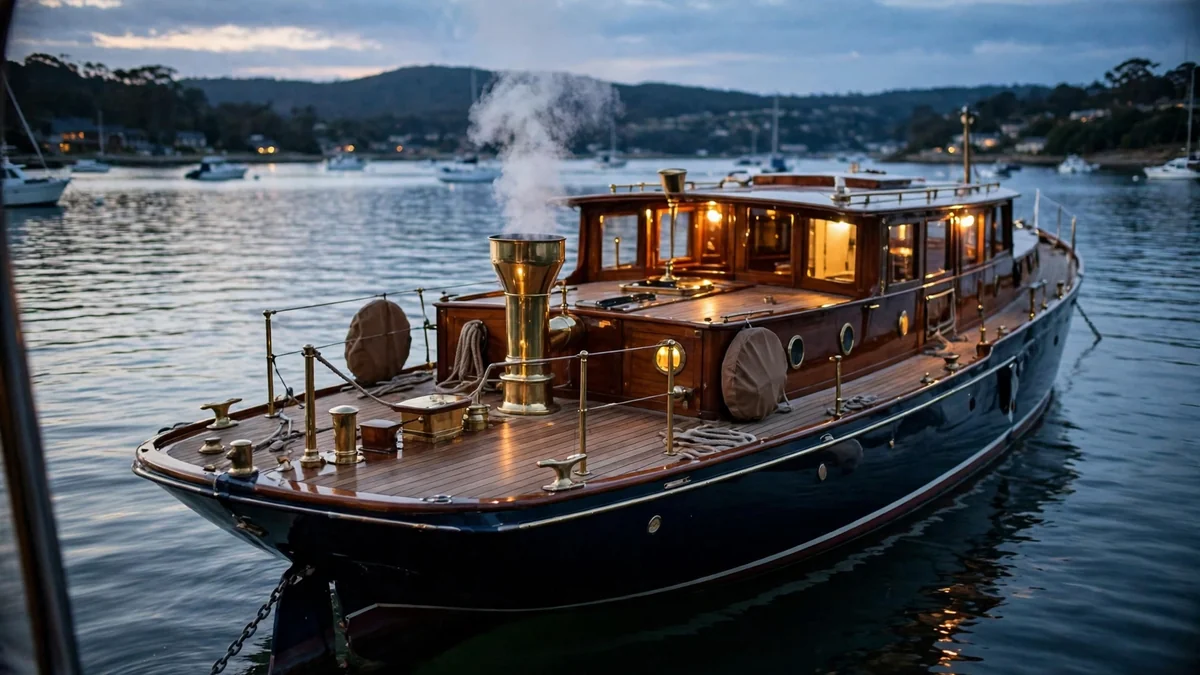
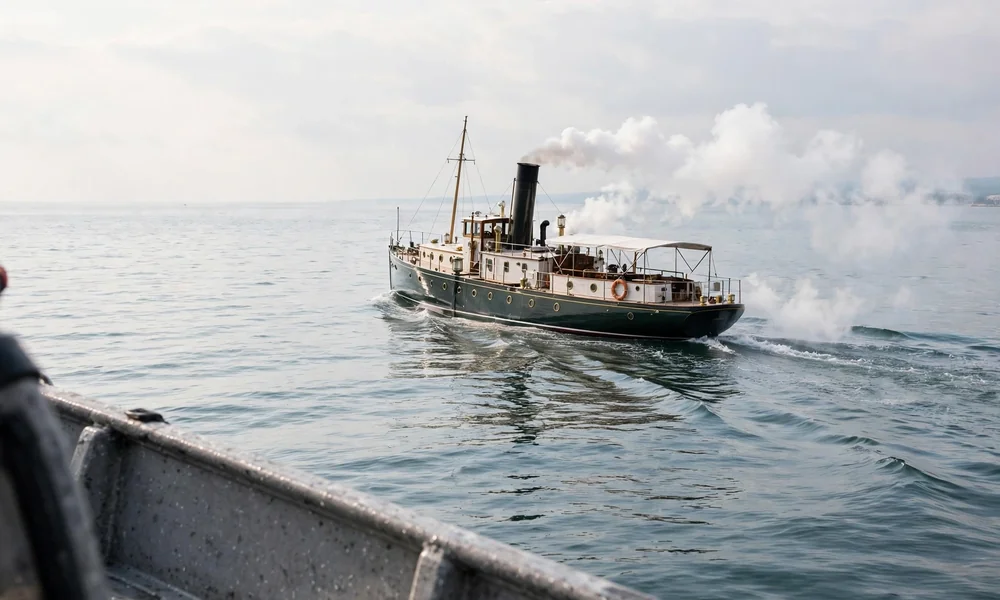
There is a particular sound that gives a steam yacht away long before you see her. It is not the throb of a diesel or the whine of a turbine, but a soft, rhythmic chuffing, a puff of white steam from a polished brass funnel, and the slow turn of a paddle or propeller that seems unhurried by anything at all. She moves the way the nineteenth century moved: deliberately, gracefully, and with a great deal of ceremony.
A luxury steam yacht is a vessel powered by steam, built or restored to the standards of a modern superyacht. The boiler and engine are old technology, but everything around them is new: the cabins are quiet and warm, the decks are teak, the navigation is electronic, and the galley would embarrass a good restaurant. Reading her specification sheet is a strange pleasure, because it mixes figures from two centuries, and every number tells a story about how steam actually works at sea.
The spec sheet at a glance
| Specification | Typical luxury figure |
|---|---|
| Length overall | 25 to 45 metres |
| Beam | 5 to 8 metres |
| Displacement | 150 to 600 tonnes |
| Boiler type | Oil-fired Scotch or water-tube boiler |
| Boiler pressure | 12 to 20 bar |
| Engine type | Triple-expansion steam engine |
| Power output | 600 to 2,000 horsepower |
| Top speed | 10 to 14 knots |
| Cruising range | 1,500 to 3,500 nautical miles |
| Fuel | Marine diesel oil or heavy fuel oil |
| Passengers | 8 to 12, plus crew of 8 to 14 |
| Hull material | Riveted steel or steel with teak decks |
Those figures cover a wide band because steam yachts are almost never built to a standard design. Some are faithful restorations of Victorian and Edwardian originals, rebuilt plank by plank and rivet by rivet. Others are new hulls fitted with a modern boiler and a rebuilt or replica engine.
Length, displacement and the hull
Length and displacement decide how a steam yacht feels under way. A yacht of around thirty-five metres and three hundred tonnes is heavy enough to ride calmly through a chop, and that weight is part of the luxury: the motion is slow and easy, the cabins stay level, and the dining table does not need a gimbal. The hull is usually riveted steel, built the old way, because a steam yacht owner wants the structure to match the machinery. If you want to understand the world these yachts come from, the story of how a luxury paddle steamer is made shows the same craft at work on a riverboat hull.
Beam matters more than it does on a modern motor yacht, because the boiler and engine sit low and amidships, and they need width. A beam of six or seven metres gives the engine room space for the boiler, the engine, the coal or oil bunkers on older boats, and the crew to work around them. It also gives the cabins above a generous layout, with a full-width saloon and staterooms that feel like rooms in a house rather than cabins in a boat.
The boiler and the engine
The boiler is the heart of the yacht, and its pressure is the most important number on the sheet. A boiler pressure of 12 to 20 bar means the steam is hot and energetic enough to drive the engine hard, but low enough that the boiler can be built and maintained to modern safety standards. Modern luxury steam yachts burn oil rather than coal, so the boiler is cleaner and easier to manage, but the principle is unchanged: heat water, make steam, and let the steam push pistons.
The engine itself is usually a triple-expansion steam engine, in which the steam passes through three cylinders of increasing size, giving up its energy in stages. It is an efficient design for its era, and it has a quality no diesel can match: it is almost silent at low speed, turning slowly with a steady rhythm, and it can run astern simply by reversing the valve gear.

Speed, range and fuel
Top speed is the number most likely to surprise a first-time reader. A luxury steam yacht tops out at 10 to 14 knots, roughly 18 to 26 kilometres per hour, which is slower than a modern motor yacht of the same size by a wide margin. The reason is simple: the engine is heavy, the hull is heavy, and the boiler can only make so much steam. In practice, owners cruise at 9 or 10 knots, where the engine is at its most efficient and the ride is at its smoothest.
Range is more generous than the speed suggests. A cruising range of 1,500 to 3,500 nautical miles comes from large fuel bunkers and an engine that sips fuel at low speed, and it is enough for a season of coastal cruising or a crossing of a smaller ocean with a fuel stop. The trade-off is time: a steam yacht needs an hour or more to raise steam from cold, so a departure is planned, not spontaneous, and the crew starts the boiler long before the guests come aboard.
What the numbers mean in practice
Comfort is where the specification sheet earns its luxury label. A steam yacht carries a large crew for her size, because the boiler and engine need constant attention, and that crew is part of the service the guests enjoy. The cabins are quiet because the engine turns slowly, the decks are warm because the boiler throws off heat, and the whole vessel smells faintly of oil, brass polish, and teak. The vintage yacht tradition explains much of this, since many steam yachts are restorations of exactly that kind of vessel, rebuilt for modern guests.
Maintenance is the hidden number behind every figure on the sheet. A boiler must be inspected and certified every year, the engine needs regular attention from engineers who understand steam, and the riveted hull must be surveyed for corrosion. Owners budget generously for this, and the expedition yacht specs explained for long-range cruising make a useful comparison, showing how much simpler a modern diesel yacht is to keep running.
Price
A restored luxury steam yacht typically costs between an estimated $3 million and $15 million, depending on size, age, and the quality of the restoration, with the finest Edwardian originals reaching higher. A new-build steam yacht is rarer still and can cost an estimated $10 million to $30 million, because the boiler, the engine, and the hull must all be built by specialists. That estimate covers the yacht herself, not the crew, the fuel, or the annual boiler survey, all of which run well above ordinary yacht costs.
A rare fact
One of the strangest details of a steam yacht is that her engine can run in reverse as easily as forwards, simply by shifting the valve gear, with no gearbox at all. In a crowded harbour, an engineer can stop the propeller and spin it backwards in seconds, giving the captain a level of control that feels almost modern, from machinery designed more than a century ago.
A luxury steam yacht is best judged the way her specification sheet asks to be judged: boiler first, then engine, then comfort, and only then speed. The yacht that gets those numbers right will take her guests back a century without asking them to give up a single modern comfort, and she will do it to the soft, unhurried rhythm of steam.