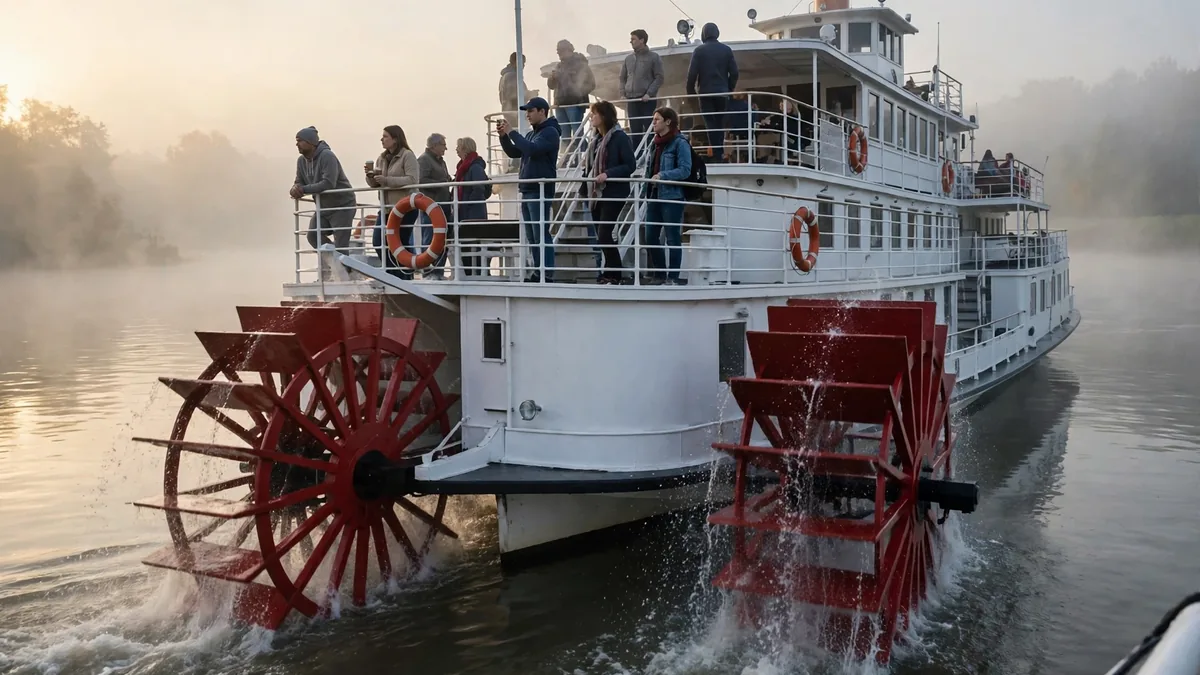
On a slow bend of the river, just after sunrise, the paddle steamer comes around the corner the way she has for more than a century: white paint, brass trim, and two great wheels turning lazily at her sides, throwing up a fine curtain of spray. Passengers lean on the rail with coffee in hand, watching the banks slide past at the pace of a bicycle. Nothing about her looks hurried, and that is the point. A luxury paddle steamer is a machine built for slowness, and every part of her, from the steel hull below the waterline to the polished wood of the saloon, exists to make that slowness feel generous rather than old-fashioned.
Building one today is a strange and wonderful job. The shape is Victorian, but the engineering underneath is entirely modern. A shipyard cannot simply copy a nineteenth-century drawing and hope for the best, because modern safety rules, modern engines, and modern passengers all demand something better. This is how that balance is achieved, from the first steel plate to the first river cruise.
How a Luxury Paddle Steamer Is Made
Step 1: The hull takes shape
Everything starts with the hull, and a paddle steamer hull is a different animal from the hull of an ordinary ship. It is long, shallow, and flat-bottomed, because it must work in rivers where the water is sometimes barely deeper than a tall man. Steel plates are cut by computer-controlled machines, bent into gentle curves, and welded together on a slipway, with the bottom kept almost flat so the vessel can float in shallow water and sit upright if she touches a sandbank. A shallow draught is the whole reason the design exists, and the shipyard measures it constantly, because every tonne added above the waterline makes the hull sit a little deeper.
Step 2: The paddle wheels are built
The paddle wheels are the steamer’s signature, and they are also its most demanding piece of engineering. Each wheel is a circle of steel arms, called floats or paddles, mounted on a hub and driven by a shaft that runs across the ship. On a modern luxury steamer the wheels are usually driven by a diesel engine or an electric motor through a gearbox, rather than by a steam engine, which gives the captain precise control over speed and lets the two wheels turn at different rates to help the ship steer. The floats are shaped to enter the water cleanly and leave it without throwing spray onto the decks, and they are balanced so carefully that the wheel turns without shaking the ship.
Step 3: Engines and steering go in
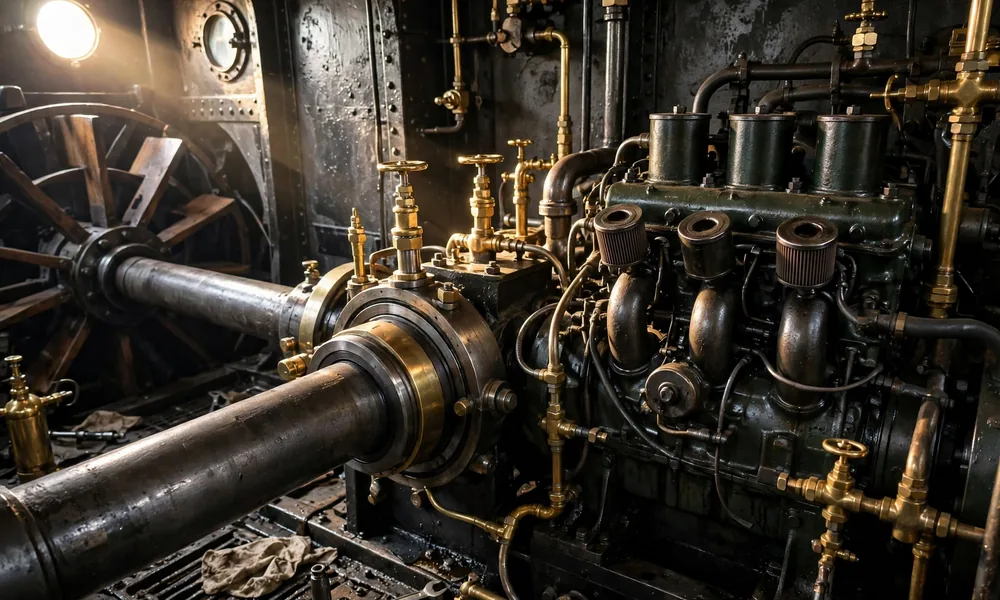
With the hull and wheels in place, the engine room is fitted out. Most new luxury paddle steamers use a modern diesel engine, sometimes paired with an electric drive, and the exhaust is routed carefully so that no smoke or smell reaches the passenger decks. The steering gear is fitted at the stern, where a large rudder sits between the paddle wheels, and on some vessels a small bow thruster is added to help the captain manoeuvre in tight river bends and crowded landing stages. The cruise ship bridge on a large ocean liner is a room full of screens, and a paddle steamer’s wheelhouse is its smaller cousin, with radar, river charts, and engine controls arranged within easy reach of one person.
Step 4: Decks, cabins, and the saloon
Once the machinery is working, the ship becomes a hotel. The passenger decks are built up in timber and steel, with large windows, open promenades, and staircases wide enough for two people to pass comfortably. Cabins are fitted with real beds, private bathrooms, and sound insulation thick enough that the thump of the paddle wheels becomes a gentle background rhythm rather than a disturbance. The cruise ship suites on an ocean liner show how much passengers value space and light, and a paddle steamer borrows the same lesson at river scale, trading size for intimacy and a view that changes every few minutes.
Step 5: Safety systems and finishing
Before any passenger steps aboard, the steamer must pass the safety checks that govern every modern passenger vessel. Life jackets, lifeboats or rescue boats, fire detection and sprinkler systems, emergency lighting, and clear escape routes are fitted and tested, and the crew rehearses evacuation drills until they can be done quickly and calmly. The hull is painted below the waterline with coatings that resist river weed and corrosion, and above the waterline the traditional white paint and varnish are applied by hand, layer after layer, until the wood and steel gleam. The steel ship hulls of ocean-going vessels face the same battle against rust and fouling, but a river steamer’s hull lives a gentler life in fresh water, and a good coating can last for years between dockings.
Step 6: Trials on the river
The final step is a series of trials on the river itself. The steamer is loaded to her full passenger weight, and the captain tests her at every speed, through bends and narrow channels, stopping and turning to check that she answers the helm and the paddle wheels as she should. Engineers measure vibration, fuel consumption, and the depth of water beneath the keel, and they listen for any rattle or hum that suggests something is not quite right.
Specifications
| Feature | Typical luxury paddle steamer |
|---|---|
| Length | 60 to 90 metres |
| Beam | 12 to 17 metres, including paddle boxes |
| Draught | 1.2 to 2 metres |
| Passengers | 100 to 250, plus crew of 25 to 40 |
| Propulsion | Diesel or diesel-electric driving two side paddle wheels |
| Service speed | 10 to 14 knots on open river reaches |
| Hull | Steel, flat-bottomed, with watertight compartments |

What It Costs
A new luxury paddle steamer is a bespoke vessel, so there is no fixed showroom price. A small river steamer with around 100 passenger berths is estimated to cost roughly $15 million to $25 million to build, while a larger vessel with 200 or more berths, grand public rooms, and premium cabins is estimated to cost roughly $40 million to $70 million. Those are estimates, and the final figure depends on the size of the ship, the standard of the interior, and the propulsion system chosen. Running costs are estimated at roughly $3 million to $6 million a year, covering crew, fuel, maintenance, insurance, and docking. A week-long river cruise aboard such a vessel is estimated to cost roughly $4,000 to $10,000 per passenger, depending on the cabin and the season.
A Rare Fact
Here is a detail few passengers ever notice: on many paddle steamers, the paddle wheels can be used as brakes. By stopping one wheel and reversing the other, the captain can turn the ship almost within her own length, spinning her around in a river bend too narrow for a normal turn. It is a manoeuvre no propeller-driven ship can copy, and it is one reason paddle steamers survived on winding rivers long after they vanished from the open sea. Passengers often gather at the stern just to watch the wheels turn, and on a still morning the spray they throw catches the sunlight in a way no photograph quite captures. It is the sound, as much as the sight, that stays with people.