The harbour is still half asleep when the boat leaves the berth, the water flat and grey, the engine note low and unhurried. Then the throttle opens, the bow rises, and the whole boat seems to stand up on the water and run. In a few seconds the world narrows to spray, wind and the horizon coming fast. A luxury speedboat is not really a boat that goes fast; it is a boat that makes speed feel effortless, quiet and controlled, and the spec sheet is where that feeling is engineered.
Most buyers fix on the top speed, and top speed is the least useful number on the page. What matters is how the boat gets there, how it behaves in a chop, how far it can go on a tank, and how comfortable the people on board are while it does all of that. This guide reads the spec sheet the way an owner does, starting with the hull and the engines and ending with the numbers that decide whether a day on the water ends in a smile or a sore back.

The spec sheet at a glance
| Specification | Typical luxury figure |
|---|---|
| Length overall | 7 to 12 metres |
| Beam | 2.5 to 3.5 metres |
| Hull | Deep-V fibreglass or carbon composite |
| Deadrise | 20 to 24 degrees at the transom |
| Engines | One to three outboards, or twin inboards |
| Power | 400 to 1,200 horsepower total |
| Top speed | 45 to 70 knots |
| Cruising speed | 25 to 35 knots |
| Fuel tank | 300 to 900 litres |
| Range | 150 to 300 nautical miles at cruise |
| Passengers | 8 to 12 |
| Dry weight | 3,000 to 8,000 kilograms |
| Draft | 0.6 to 1.0 metres |
| Seating | Helm seats, sun pad, cockpit lounge |
| Electronics | Chartplotter, radar, sonar, joystick docking |
The hull: deadrise decides the ride
The hull is the most important part of a speedboat, and its key number is deadrise: the angle of the V at the back of the boat. A deep V of 20 to 24 degrees slices through waves instead of slamming into them, so the ride stays soft even when the water turns choppy. A flatter hull is faster on calm water and more stable at rest, but it pounds in a chop, and every passenger feels it in their spine.
Most luxury speedboats use a deep-V hull in fibreglass, with carbon composite on the lightest and fastest models. Carbon saves weight, and weight is everything on a boat: a lighter hull needs less power to go fast, uses less fuel, and accelerates harder. Stepped hulls add another trick, trapping air under the hull to reduce drag, but they demand a careful hand at the helm. The mechanics of how a fast boat moves through water are covered in how a luxury speedboat works, from the propeller to the trim tabs that level the ride.
Engines and speed: why three outboards beat one big one
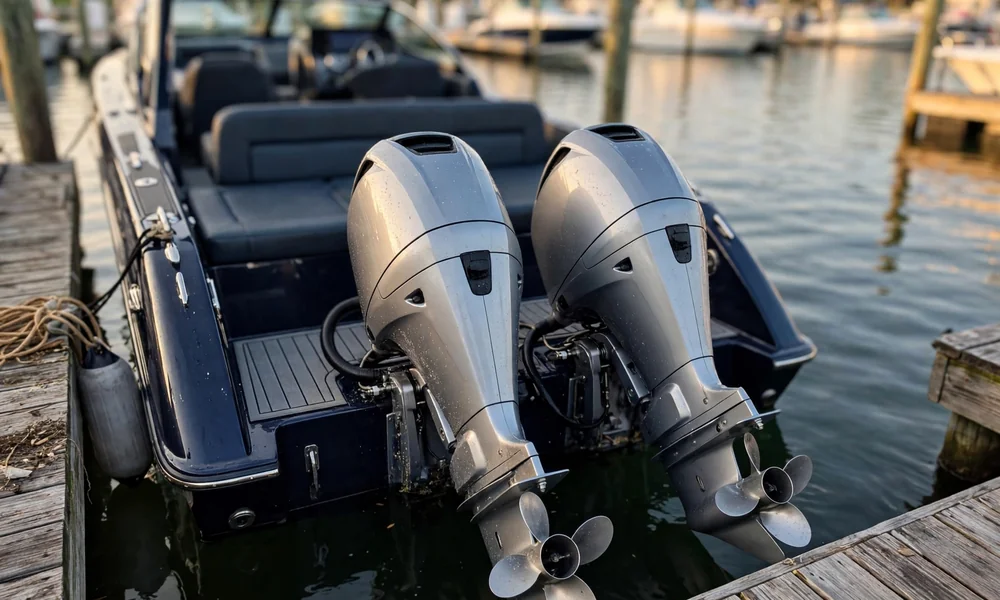
Total horsepower of 400 to 1,200 sounds enormous, and it is, but the number hides the layout. Many luxury speedboats use two or three outboard engines instead of one huge inboard, and the reasons are practical: outboards are easier to service, they lift clear of the water when the boat is moored, and if one fails the others can still bring the boat home. Twin or triple engines also give better balance and a smaller turning circle at low speed.
Top speed of 45 to 70 knots is thrilling, but cruising speed is the number that shapes a day on the water. A boat that cruises happily at 25 to 35 knots covers a long coastline before lunch, while a boat that only feels settled at full throttle is tiring to drive and thirsty to run. Fuel burn rises steeply with speed, roughly doubling when the speed rises by a third, so the most experienced owners cruise at the speed where the boat sits cleanly on the plane and the engines hum rather than roar.
Range and fuel: how far a day really goes
A fuel tank of 300 to 900 litres looks generous until the burn rate is counted. At cruising speed a powerful speedboat can use 80 to 150 litres an hour, so a full tank gives roughly two to three hours of fast running before the reserve matters. Range of 150 to 300 nautical miles at cruise is the realistic figure, and it shrinks quickly in rough water, where the engines work harder, or when the boat carries a full load of passengers and gear.
Smart owners plan around the tank, not the speedometer. They fill up before a long crossing, keep a third of the tank in reserve, and know where the fuel pontoons are along the coast. The tank itself sits low in the hull, which helps stability, and the fuel system includes filters and water separators, because a single bad batch of fuel can stop a boat far from help. A smaller, slower boat is a useful contrast: how a luxury fishing boat works shows how a displacement hull trades speed for range and a steady platform at rest.
The cockpit: seating, shade and the helm
A luxury speedboat carries 8 to 12 people, and the cockpit layout decides whether they enjoy it. Helm seats with bolsters let the driver and co-pilot stand or sit through rough water, a sun pad at the stern turns the boat into a floating terrace at anchor, and a cockpit lounge with a table and a cooler keeps everyone together. Shade matters more than buyers expect: a bimini top or a hard top keeps the sun off at midday and makes a long day bearable.
At the helm, the electronics are the real luxury. A large chartplotter shows position, depth and hazards, radar watches for other boats in poor visibility, sonar reads the seabed, and a joystick docking system lets the driver slide a big boat sideways into a tight berth with one hand. These systems cost a large share of the boat’s price, and they are the difference between a fast boat and a fast boat that is easy to own. The wider family of performance hulls is covered in luxury sailboat specs explained, where the numbers describe a very different kind of speed.

Draft, weight and trailering
Price: what the money buys
A luxury speedboat typically costs an estimated 250,000 to 900,000 dollars, with the largest triple-engine models going higher still. The hull and engines are the biggest costs, followed by the electronics, the upholstery and the finishing. Hand-laid fibreglass or carbon, teak decks, custom paint and a bespoke interior are all priced by the hour, and a boat built in small numbers cannot spread those hours across thousands of units the way a car factory can.
A rare fact worth knowing
Some luxury speedboats hide a small detail that owners come to love: a freshwater shower at the transom and a freshwater wash-down for the deck. After a swim, a quick rinse with fresh water stops salt drying on skin and gear, and hosing the deck takes minutes instead of a long scrub at the marina. It is a tiny item on the spec sheet, listed as a tank capacity and a pump, but on a hot afternoon with children jumping in and out of the sea it is the feature that gets used more than almost anything else on board.


