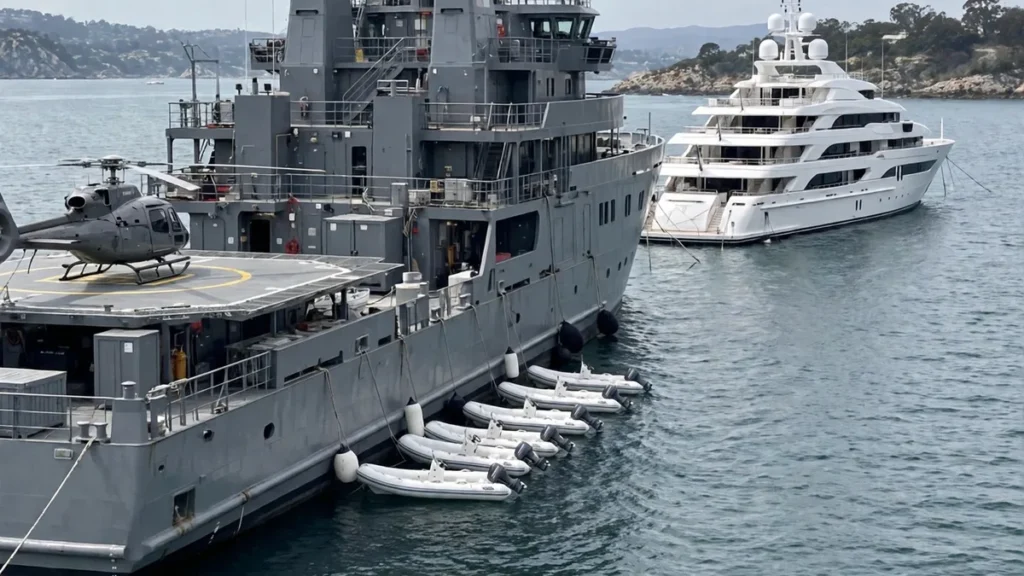
The ship held its position in a swell that would have sent a ferry rolling, and on deck a crane lowered a steel frame over the side on a wire as thin as a finger. Below, three kilometres down, the frame would land softly on the seabed and scoop up mud that no human had ever seen. In the laboratory, a scientist watched the wire tension on a screen and waited, while the cook made lunch two decks below in a galley that would not look out of place in a good hotel.
That is a luxury research vessel: part floating laboratory, part expedition yacht, built to do serious science in the middle of nowhere and to keep its crew comfortable while doing it. It carries winches and cranes and sonar arrays, but it also carries quiet cabins, a proper galley and a lounge with a view. The science and the comfort are not an odd pairing. A crew that sleeps well and eats well works better, and a ship that can stay at sea for weeks gathers more data than one that must keep coming home.
The spec sheet for such a ship is long and technical, and it mixes the language of shipbuilding with the language of laboratories. Length sits next to laboratory space, engine power next to sonar range, and a figure that matters enormously to a scientist means almost nothing to a sailor. This guide explains the numbers one by one, so you can tell a genuine research vessel from a yacht with a few instruments bolted on.

The spec sheet at a glance
| Figure | Typical luxury research vessel | What it tells you |
|---|---|---|
| Length | 55 to 85 metres | How much ship there is to work with |
| Gross tonnage | 1,500 to 3,500 GT | The ship’s overall size and volume |
| Top speed | 14 to 17 knots | How fast it can reach a study site |
| Range | 8,000 to 12,000 nautical miles | How far it can go without refuelling |
| Endurance | 40 to 60 days at sea | How long a voyage can last |
| Berths | 24 to 40 people | Scientists and crew it can carry |
| Laboratory space | 150 to 300 square metres | Room for real science on board |
| Winch wire depth | 6,000 to 10,000 metres | How deep its instruments can reach |
| Dynamic positioning | DP2 class | Holding still without an anchor |
| Underwater noise | Silent-class notation | How quietly it moves past sea life |
Length, tonnage and the shape of the ship
Length is the first number on any spec sheet, and on a luxury research vessel it usually runs from 55 to 85 metres. That size is a deliberate compromise. A longer ship is steadier in a swell and has more room for laboratories, but it costs more to run, needs a bigger crew and cannot get into small harbours. The plain working version is decoded in the guide to research vessel specs explained.
Speed, range and endurance
A research vessel is not built for speed. Its top speed is usually 14 to 17 knots, which is slow next to a ferry, because the hull is shaped for steadiness and fuel economy rather than for going fast. What matters instead is range: 8,000 to 12,000 nautical miles on one load of fuel, enough to cross an ocean and work for weeks before refuelling. That range is what lets a ship reach the middle of the Pacific or the edge of the Antarctic and still have fuel to get home. How such a ship is put together is set out in the guide to how a research vessel is made.
Dynamic positioning and the quiet ship
Dynamic positioning is the system that lets a research vessel hold its place over a point on the seabed without dropping an anchor, and it is one of the most important numbers on the spec sheet. Sensors measure the wind, the current and the ship’s movement, and a computer drives the thrusters and propellers to cancel them out, holding the ship within a metre or two. Most luxury research vessels are rated DP2, which means the system keeps working even if one part of it fails. That matters when a remotely operated vehicle is working on the seabed below, because a ship that drifts can drag its tether across the very thing it came to study.

Laboratories, winches and the working deck
Laboratory space is what turns a ship into a research vessel, and a luxury one usually carries 150 to 300 square metres of it, split between wet labs for handling samples and dry labs for computers and instruments. The wet lab needs seawater on tap, drains in the floor and benches that can be hosed down, while the dry lab needs steady power, clean air and somewhere to store delicate instruments. Some ships also carry a moon pool, a hole through the hull that lets instruments be lowered into the water in shelter, away from the waves.
The winches are the ship’s arms. A deep-water winch carries kilometres of wire, and the best ships can lower instruments 6,000 to 10,000 metres down, which is deep enough to reach the floor of most oceans. The wire must be strong, the winch must be precise, and the whole system must be able to hold a heavy frame still in a current. The working deck itself is the open space at the stern where cranes, frames and small boats are handled, and on a good ship it is wide, clear and fitted with rails, sockets and tie-down points everywhere. The closest luxury cousin is the superyacht, and its numbers are decoded in the guide to luxury yacht specs explained, where the same hull serves a very different purpose.
What a luxury research vessel costs
A luxury research vessel typically costs an estimated $80 million to $250 million to build, depending on its size, its laboratories and its ice strengthening, and running it costs an estimated $30,000 to $60,000 a day at sea. Those are estimates, and they vary a great deal by yard, outfit and mission. The money buys the hull, the quiet engines, the positioning system, the laboratories and the cabins, but it also buys time: weeks at sea, far from land, doing science that cannot be done any other way. Few machines in the world are asked to do so many different jobs at once, and fewer still are asked to do them in comfort.
A rare fact
Some research vessels carry a bubble system under the hull that releases a curtain of tiny air bubbles around the ship, and the bubbles scatter sound so well that they can shield sensitive sea life from the noise of the ship’s own sonar. It is a gentle piece of engineering, almost invisible, and it shows how much thought goes into a ship whose job is to study the ocean without disturbing it.

A luxury research vessel spec sheet is not a list of boasts. It is a promise about what the ship can do far from land: hold still in a swell, reach the deep ocean floor, keep its laboratories running and bring its crew home safely. Learn to read the range, the positioning class and the laboratory space, and the numbers stop being a puzzle and start being the reason the ship exists at all.