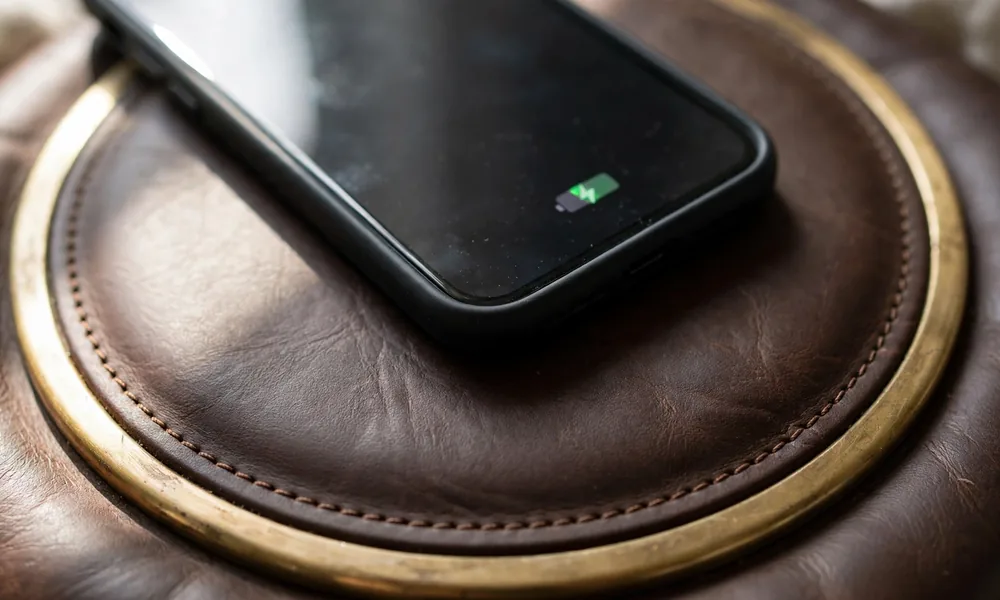
The charger on the bedside table looked like a small piece of sculpture. It was a smooth disc of leather and brass, it weighed as much as a paperback book, and it held the phone at a gentle angle, like a tiny easel. A guest picked it up, turned it over, and asked the obvious question: it only charges a phone, so why does it cost as much as the phone’s monthly contract? The owner smiled and said the phone was the cheap part of the arrangement.
That is the puzzle of a luxury wireless charger. It does a job that a ten-dollar cable can do, yet the best ones sell for hundreds of dollars, and they sell to people who could buy the cheap version a hundred times over. The price is not about the electricity. It is about the materials, the engineering, the safety, and the small number of hands that ever touch one. This guide explains why.

The materials: leather, brass, and stone
A cheap wireless charger is a plastic disc with a coil inside, and a luxury one is often a small piece of furniture. The top surface might be full-grain leather, stitched by hand, or a slab of polished marble, or a plate of brushed brass that will age and darken over the years. The base is usually a block of machined aluminium, heavy enough that the charger never slides across the table when the phone is lifted off it. Every material is chosen to feel expensive and to last, and the leather alone can cost more than a whole budget charger.
The coil: the part that actually charges
Inside every wireless charger is a coil of copper wire, and when electricity flows through it, the coil creates a magnetic field that the phone turns back into electricity. A luxury charger usually uses a larger coil made from thicker copper wire, sometimes wound with a special litz wire made of many fine strands, which wastes less energy as heat. A bigger coil also means the phone does not have to sit in exactly the right spot, so it charges even when it is placed down carelessly in the dark.
Heat: the enemy of a fast charge
The heat problem gets worse with faster charging. A luxury charger that delivers 15 watts wirelessly has to manage far more heat than a 5-watt charger, and the engineering to do it quietly, without a noisy fan, is expensive. The guide to how a luxury wireless charger is made explains how the coil, the case, and the cooling are fitted together by hand.
Safety: a charger that watches itself
A luxury charger is full of sensors that a cheap charger does not have. It checks for foreign objects, so a coin or a key left on the pad will not heat up, and it watches the temperature of the coil, the phone, and the case, cutting the power if anything gets too warm. It also talks to the phone, agreeing on the fastest safe speed before the charging starts, and it keeps checking that agreement as the phone fills up. A cheap charger can overheat a phone battery over months of nightly use, and the damage only shows up when the battery starts to die early.
Design and the designer’s name
Many luxury chargers are designed by a named studio or a famous designer, and the name on the box is part of what the buyer pays for. The design process can take a year or more, with dozens of prototypes tested for how they feel in the hand, how they look on a table, and how the phone sits on them at night. The charger is meant to be a permanent object in a home, like a lamp or a clock, and it is designed to be looked at every day for years without tiring the eye.
Small numbers, made by hand
A budget charger is made by the million on an automated line, and a luxury charger is often made in the thousands, with much of the work done by hand. The leather is cut and stitched by a worker, the metal is polished by a worker, and the finished charger is tested by a worker who places a phone on it and watches it charge before it is boxed. Hand work is slow and expensive, and it means the maker cannot spread the cost of the design and the tooling across millions of units.
Small numbers also mean small suppliers. A luxury maker cannot order coils and circuits by the container-load, so it pays more for every part, and it has to keep spare parts for years because its customers expect a repair, not a replacement. The guide to how a luxury smartphone works shows how the phone on top of the charger is itself a small-volume luxury product, and the charger is built to match it. The guide to how a luxury smart ring works shows the same craft applied to a device small enough to wear on a finger.
The numbers at a glance
| Specification | Budget charger | Luxury charger |
|---|---|---|
| Charging power | 5 W | 15 W |
| Devices at once | 1 | 3 |
| Coil | Single copper | Multi-coil litz |
| Case material | Plastic | Leather, brass, stone |
| Weight | 80 g | 450 g |
| Foreign object detection | Basic | Full sensor array |
| Cooling | None | Aluminium heatsink |
| Production volume | Millions | Thousands |
| Typical price | 10 dollars | 300 dollars |
What the price buys
A luxury wireless charger costs an estimated 250 to 500 dollars, and the most exclusive designs cost an estimated 1,000 dollars or more. The materials are the largest single cost, followed by the multi-coil electronics, the safety certification, and the hand assembly, and the small production numbers mean none of those costs can be spread thin. The charger will not charge a phone faster than a good mid-range pad by a large margin, but it will do it cooler, quieter, safer, and on a table where it looks like it belongs.
A rare fact
The first wireless chargers were built for electric toothbrushes in the 1990s, because a toothbrush cannot have a hole in it for a cable without letting water in. The technology sat in bathrooms for years before anyone thought to put it under a phone, and the earliest phone chargers were so slow that they took all night to fill a battery. The strangest detail is that a modern luxury charger still uses the same basic idea as that toothbrush stand, a coil in a sealed case, only now the coil is tuned, cooled, and watched by sensors the toothbrush never had.

The next time a wireless charger costs more than the phone accessory shelf seems to allow, look at what it is made of, how many devices it charges, and how cool it keeps the phone while it works. A cheap charger moves electricity, and a luxury charger moves electricity while also being a piece of furniture, a safety system, and a small piece of hand work. That is a lot to ask of a disc on a bedside table, and it is why the price is what it is.


