It was two in the morning and the office was empty except for one desk lamp and the sound of typing. Not the clatter of a cheap keyboard, but a low, even thock with every keystroke, like small wooden hammers falling in rhythm. The writer at that desk had been typing for six hours and his hands did not ache. He had paid more for his keyboard than for his monitor, and everyone who borrowed it for five minutes understood why.
A luxury keyboard is a strange object to love. It does one job, and it does it with a precision that most people never notice until they try a good one. The spec sheet is full of unfamiliar words: switch types, actuation forces, polling rates, keycap profiles. Each one describes a tiny part of the feeling under your fingers, and together they decide whether typing feels like work or like music.
How to Read a Luxury Keyboard Spec Sheet
Step 1: The switch is the heart of the keyboard
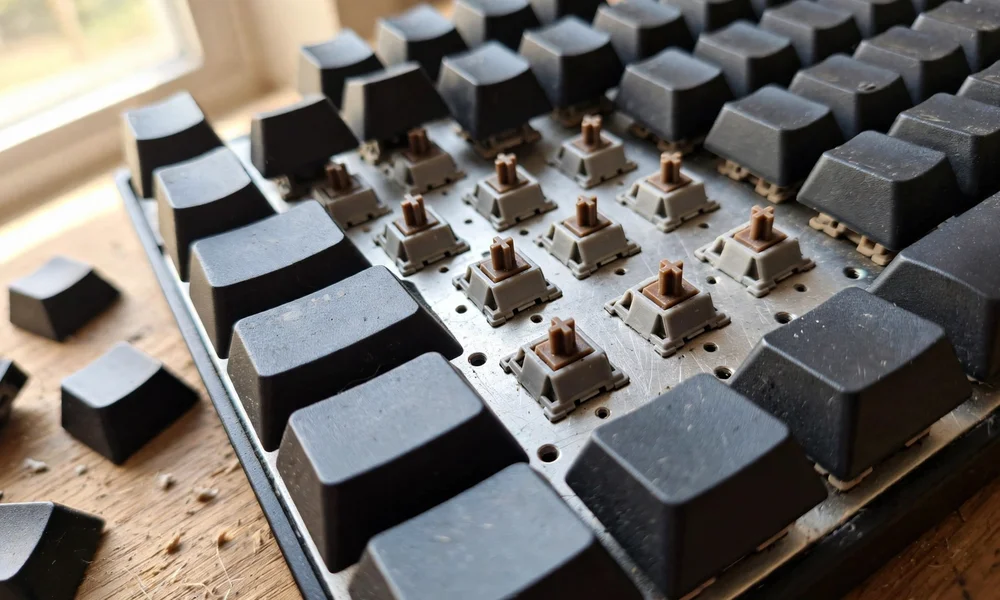
Every key on a mechanical keyboard sits on its own switch, a small mechanism that registers the press, and the switch type is the most important spec of all. Linear switches travel smoothly from top to bottom with no bump, which suits fast typing and gaming. Tactile switches add a small bump halfway down so your finger knows the key has registered without bottoming out. Clicky switches add an audible click on top of that bump, which some typists adore and their neighbours do not. The right choice is personal, but the spec to compare is actuation force, the weight needed to register a keypress, because it decides how tired your fingers feel after a long day.
Step 2: Actuation point and travel distance shape the feel
Two millimetres. That is roughly how far a key travels before it registers, the actuation point, and it is one of the most quoted numbers on a keyboard spec sheet. Total travel is usually around 4 millimetres, so the key keeps moving a little after it has already fired. Shorter actuation means faster response, which is why gaming keyboards advertise actuation points as low as 1 millimetre. The trade is accuracy: a very short actuation point makes accidental presses more likely, so writers often prefer a deeper, more deliberate 2 millimetres.
Step 3: Polling rate and latency decide responsiveness
Polling rate measures how often the keyboard reports its state to the computer, and on a luxury board it is usually 1,000 times per second, or 1,000 hertz. Some flagship models now reach 8,000 hertz, reporting eight times as often. In practice, the jump from 125 hertz on a cheap office keyboard to 1,000 hertz is the one you can feel, a small but real sharpening of response. Latency, the total delay between pressing a key and the computer acting on it, is the number that wraps polling, switch and processing delays together, and the best boards keep it under a millisecond. For most typists the lesson is simple: a 1,000 hertz board is fast enough for anything. The same pursuit of instant response drives the audio world, as our guide to wireless earbuds driver specs shows in a very different kind of device.
Step 4: Keycaps are where your fingers actually live
Keycaps, the plastic tops you touch, are often the most expensive part of a luxury keyboard. The material matters: ABS plastic is smooth and common, but it shines and wears smooth with use, while PBT plastic stays textured and resists shine for years. The legends, the letters printed on the caps, are made by double-shot moulding on the best boards, where two layers of plastic are fused so the letter can never wear off, or by dye sublimation, where the ink is baked into the plastic itself. Profile, the shape and height of the caps, changes the feel as much as the switch does: tall sculpted profiles cradle the fingers, while low flat profiles feel fast and modern.
Step 5: The case, plate and stabilisers set the sound
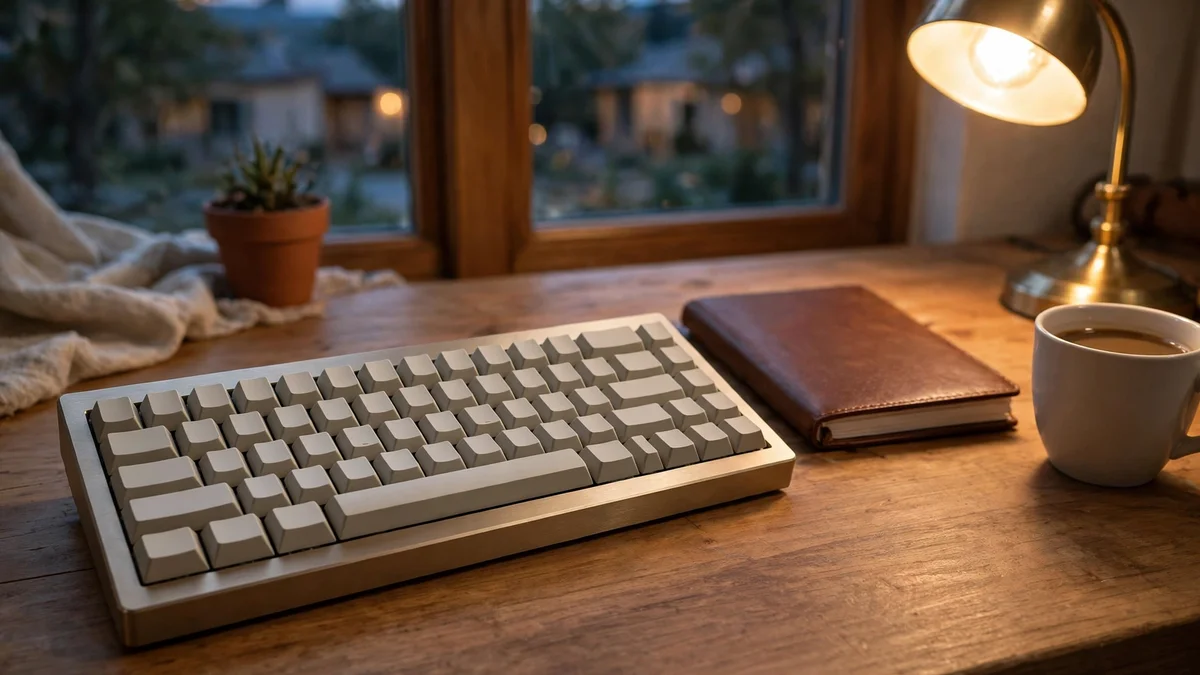
The sound of a luxury keyboard, that deep thock from the opening scene, is engineered, not accidental. The case, usually machined from a solid block of aluminium, gives the board its weight and rigidity, and a heavier case absorbs vibration that would otherwise make the board sound hollow. Inside, the plate that holds the switches can be aluminium for a firm, crisp feel or softer materials like brass or polycarbonate for a deeper, more muted sound. Gasket mounting, where the plate floats on small rubber gaskets instead of being screwed down tight, is the current luxury standard because it softens each keystroke and evens out the sound across the board. A close relative in the world of precision sound is the turntable, whose engineering is explained in our guide to luxury turntable specs.
Step 6: Layout, connection and build quality
Layout is the last big decision. A full-size board has a number pad, a tenkeyless board drops it, and a 65 or 75 percent board keeps the arrows and trims everything else, saving desk space and bringing the mouse closer to your body. Connection matters too: wired USB is the most reliable, while Bluetooth and 2.4 gigahertz wireless on a luxury board now rival wired speeds, with batteries lasting weeks. The definitive comparison is the mechanical keyboard itself, covered in depth in our guide to luxury mechanical keyboard specs.
Luxury Keyboard Specs at a Glance
| Specification | Typical range |
|---|---|
| Switch type | Linear, tactile or clicky mechanical switches |
| Actuation force | About 45 to 65 grams |
| Actuation point | About 1 to 2 mm; total travel about 4 mm |
| Polling rate | 1,000 Hz standard, up to 8,000 Hz flagship |
| Keycap material | PBT preferred; double-shot or dye-sublimated legends |
| Case material | CNC-machined aluminium, gasket mounted |
| Weight | About 1.5 to 2.5 kg |
| Connection | Wired USB, Bluetooth and 2.4 GHz wireless |
What Does a Luxury Keyboard Cost?
A luxury keyboard is estimated to cost roughly $300 to $700 for a complete board from a respected maker, with fully custom builds estimated at $1,000 to $2,500 or more once artisan keycaps and a machined case are added. Individual switch sets are estimated at $50 to $150, and a premium keycap set at $100 to $400. Prices are estimates only and vary by maker, materials and availability. The cost is easier to understand when you count the hours: a keyboard is the tool a writer or programmer touches for thousands of hours a year, and a small improvement in feel, repeated that many times, is worth more than it first appears.
A Rare Fact
The most expensive keyboards in the world are not electronic at all in the usual sense. A small number of boards are milled from a single block of brass or titanium and assembled by hand in runs of fewer than a hundred, and collectors trade them like watches. One famous limited board, made in a run of just a few dozen, now changes hands for many times its original price, not because it types faster than a modern board, but because it will never be made again.

A keyboard spec sheet looks like a wall of jargon until you connect each number to a sensation: force to finger fatigue, travel to speed, case weight to sound. Once you know that, you can choose a board the way a musician chooses an instrument, by feel first and figures second. Try the switches before you buy, listen to the sound with your eyes closed, and remember that the best keyboard is the one your hands forget they are using.