The evening ferry left the harbour at half past six, on time to the minute, and nobody on the pier was surprised. Commuters found their usual seats, a family with two tired children settled by the window, and a couple ordered coffee from the small bar as the lights of the town slid past. It did not feel like a bus on water. It felt like a hotel that happened to move, and that feeling is the whole point of a luxury passenger ferry.
A luxury ferry is not simply a bigger boat with nicer chairs. It is a floating building that must carry hundreds of people, in all weathers, to a timetable, while keeping them warm, fed, entertained and safe. Every number on its spec sheet answers a different part of that job: how many people it holds, how fast it goes, how much power it needs, and how it stays steady when the sea does not cooperate.

How to Read a Luxury Passenger Ferry Spec Sheet
Step 1: Passenger capacity is about comfort, not just headcount
The first number most buyers look at is passenger capacity, and on a luxury ferry it usually sits between 300 and 1,200 people. That number alone tells you very little. What matters is how much space each passenger gets, because a luxury ferry trades some seats for wider aisles, a proper lounge, a restaurant, a quiet room and open deck space. A 600-passenger luxury ferry can feel roomier than a 1,000-passenger commuter boat, and that is deliberate. Operators also plan for peaks: a summer Saturday needs every seat, while a wet Tuesday in February needs the heating, the coffee and the view to do the work instead.
Step 2: Speed and range set the timetable
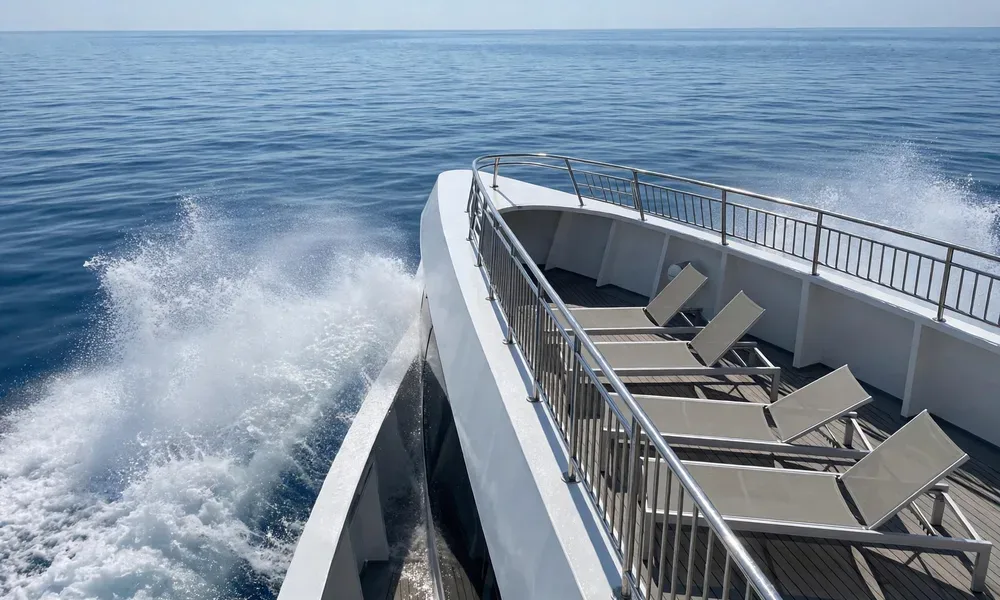
Most luxury passenger ferries cruise at 20 to 30 knots, fast enough to keep a coastal timetable honest without burning fuel at racing-boat rates. Speed is a compromise. Go faster and the fuel bill climbs sharply, the wake grows, and the ride gets harder in rough water. Go slower and the timetable slips, passengers miss connections, and the ferry stops being useful. Range matters too, because many luxury routes run all day with short turnarounds in port, so the ferry needs fuel or battery capacity for a full working day, plus a reserve for bad weather and diversions.
Step 3: The hull decides how the ride feels
The hull is the shape under the water, and it decides whether passengers feel like they are gliding or being shaken. Monohulls are the classic single-hull shape, steady and simple to build. Catamarans, with two hulls, are wider, more stable and often faster, which is why they are popular on luxury routes. The hull material matters as well: steel is strong and long-lived, aluminium is lighter and faster but needs more care, and modern composites can save weight in smaller craft. A good hull, paired with stabilisers, is what lets a passenger read a book in a swell that would have a smaller boat pitching like a fairground ride.
Step 4: Propulsion is where the money goes
Propulsion is the engine room, and it is the most expensive part of the ferry to buy and to run. Many luxury ferries still use diesel engines driving propellers, or waterjets for speed and shallow water. The newer generation adds hybrid and fully electric systems, with batteries charged in port, which cut noise, vibration and exhaust, and make the lounge noticeably quieter. The same shift towards electric power is reshaping smaller vessels too, as our guide to how a luxury electric ferry is made shows in detail. Whatever the fuel, the spec to compare is power output, usually measured in kilowatts, because it decides acceleration, top speed and how the ferry handles a headwind and a full load.
Step 5: Comfort systems are the luxury part
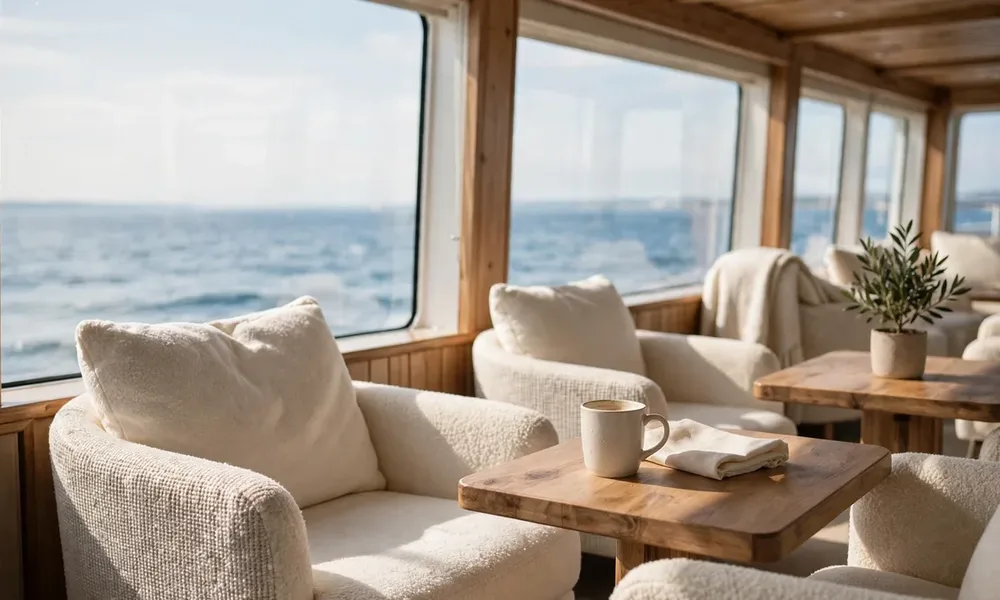
Once the ferry is moving, the luxury lives in the systems passengers never see. Heating and air conditioning must cope with a steel box full of people, in sun and in snow. Stabilisers, fins under the hull that counteract rolling, keep coffee in cups and stomachs settled. Sound insulation matters more than most people expect: a quiet ferry feels expensive, a rattling one feels cheap, whatever the seats cost. Then there are the visible comforts, the lounge, the restaurant, the Wi-Fi, the charging points and the accessible cabins, which are what passengers actually remember and photograph.
Step 6: Safety equipment is sized for everyone on board
Safety is the least glamorous spec and the most important. A luxury ferry carries lifejackets for every passenger plus spares, life rafts sized for the full complement, evacuation slides or chutes, and a bridge full of radar, navigation and communication equipment. Crew numbers are set by regulation, not by generosity, and the crew train for evacuation, fire and medical emergencies on a regular cycle. The basic ferry underneath all of this is explained in our guide to ferry specs, which covers the standard numbers before the luxury layer is added. When you read a spec sheet, check the safety figures as carefully as the speed: they are the numbers that decide whether the ferry is allowed to sail at all.
Luxury Passenger Ferry Specs at a Glance
| Specification | Typical range |
|---|---|
| Passenger capacity | About 300 to 1,200 passengers |
| Cruising speed | About 20 to 30 knots |
| Hull type | Monohull or catamaran; steel or aluminium |
| Propulsion | Diesel, hybrid or electric; propeller or waterjet |
| Power output | About 2,000 to 10,000 kW |
| Length | About 40 to 100 metres |
| Stabilisation | Fin stabilisers and active ride control |
| Onboard facilities | Lounge, restaurant, bar, Wi-Fi, open deck |
What Does a Luxury Passenger Ferry Cost?
A new luxury passenger ferry is estimated to cost roughly $20 million to $80 million, depending on size, speed and the standard of the interior, with large high-speed catamarans estimated at $100 million or more. Electric and hybrid versions are estimated to add $5 million to $15 million for batteries and charging systems. A ticket, by comparison, is estimated at $20 to $120 for a typical luxury coastal crossing. Prices are estimates only and vary by builder, route and season. The comparison that matters for operators is the cost per passenger over a twenty-year life, which is why comfort that keeps people coming back is treated as an investment, not a decoration. The market for these vessels is covered in our ranking of the best electric ferries, where the newest models are compared side by side.
A Rare Fact
Some luxury ferries are so quiet in electric mode that passengers notice sounds they never heard at sea before: the water against the hull, gulls overhead, and conversations three tables away. Engineers have had to add gentle background sound in the lounge, not to hide the engines, but because total silence in a crowded room feels stranger than a low hum. The quietest ferry afloat is, in that sense, a little too quiet for its own good.
A luxury ferry spec sheet is really a promise in numbers: so many people, at this speed, in this comfort, in all weathers, on time. Read capacity for space, speed for the timetable, hull for the ride, and propulsion for the running cost, and the rest of the sheet starts to make sense. The best test is still the simplest one. Take the crossing, sit by the window, and see whether you notice the ferry at all, or only the sea.