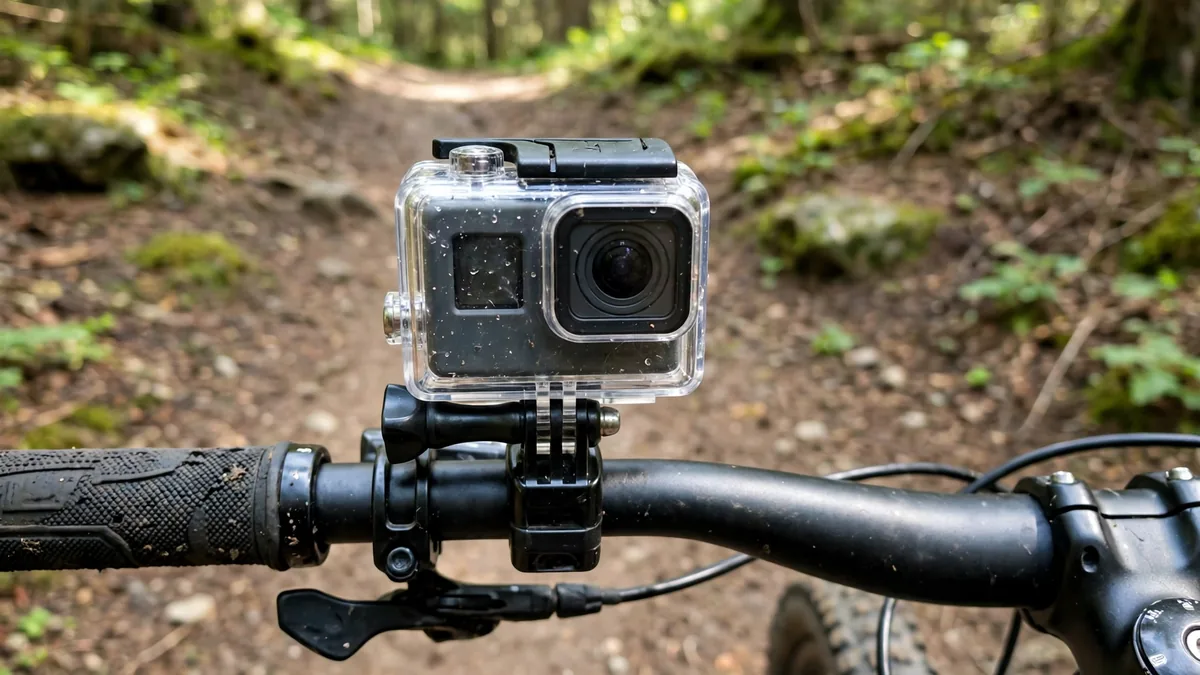
It was the third river crossing of the day, and the camera was already soaked. The rider hit the water at speed, the front wheel threw up a brown curtain, and the little black box on the handlebars disappeared inside it for a full second. When the spray cleared, the red light was still blinking, the lens was clear, and the footage was still rolling. The camera itself is a marvel, but it was not the camera that survived that river. It was the housing — a shell of plastic, rubber, and glass barely thicker than a coin, doing a job that would defeat most electronics in seconds.
An action camera housing is the difference between a camera and an adventure camera. Without it, a single drop of water or one hard knock on a rock would end the shoot. With it, the same camera films at forty metres underwater and keeps recording through dust storms that strip paint. The housing is not glamorous, and it never appears in the adverts, but it is the reason the footage exists at all.
This guide explains the numbers behind the action camera housing in plain English: what each one means, and how to judge whether a housing is genuinely tough or merely tough-looking.
How It Works
Step 1: The seal that keeps water out
Everything depends on the seal. A waterproof housing closes around the camera with an O-ring — a loop of rubber that squeezes between the two halves of the case and blocks water under pressure. The ring must be perfect: a single hair, grain of sand, or nick in the rubber is enough to let water in, and at depth the pressure forces it through eagerly. Before every dive, careful owners check the ring with a fingertip, clean the groove, and close the latch firmly. The full story of the case in action is told in how an action camera housing works.
Step 2: The lens port
The front of the housing is a flat or curved piece of optical glass or hard-coated plastic, and it is the only thing between the camera lens and the world. A flat port keeps the image true to life, while a domed port restores the wide field of view that water steals — underwater, a flat port narrows what the camera sees by about a third, and a dome brings it back. The port must be scratch-proof and perfectly clear, because every mark on it appears in every frame.
Step 3: Buttons that work through the wall
A sealed box is useless if you cannot press the buttons. Housings solve this with mechanical plungers — small waterproof rods that pass through the case and press the camera’s own buttons — or with a touchscreen membrane that lets a finger work the screen through a flexible window. Both must be precise: a plunger that sticks will hold the record button down, and a membrane that is too stiff makes the screen unusable with gloves.
Step 4: Shock absorption
Waterproof is not the same as drop-proof, and housings handle impacts in two ways. The outer shell is made from tough polycarbonate that flexes rather than shattering, spreading the force of a knock across the whole case. Inside, the camera sits in a cradle of foam or rubber that absorbs the shock before it reaches the lens or the sensor. Some housings add a rubber bumper around the edges — the first thing to hit the ground in a fall. The same thinking about small parts absorbing big forces keeps footage steady elsewhere too, as in a drone gimbal, where tiny motors cancel out shake the pilot never even feels.
Step 5: Heat and fog control
A sealed housing traps heat, and a camera working hard inside one gets hot — hot enough, in bright sun, to shut itself down. Good housings use the metal of the mount or the case itself as a heat path, drawing warmth away from the camera and into the air or water outside. They also fight fog: warm, damp air inside a cold housing condenses on the lens port, so anti-fog inserts — small absorbent pads tucked inside the case — soak up the moisture before it can condense.
Step 6: Mounting and staying put
Finally, the housing must hold on. Standardised mounting fingers on the bottom of the case clip into mounts on helmets, handlebars, surfboards, and chest straps, with a thumbscrew that locks the angle. The mount is a weak point by design — better the mount snaps in a crash than the housing tears open — but it must never slip during a run. Keeping the shot level is a job shared with the camera’s own stabilisation, and the motors that do that work have their own story, as the camera autofocus motor shows.

Action Camera Housing Specs
| Specification | Typical range |
|---|---|
| Waterproof depth (with housing) | About 40 to 60 metres for standard housings; 10 metres for a bare camera |
| Waterproof rating | IP68 for most housings; IPX8 for the camera alone |
| Drop resistance | Survives drops of about 2 metres onto hard ground (manufacturer figures) |
| Operating temperature | About -10 to 40 degrees Celsius for most housings |
| Shell material | Polycarbonate body with stainless steel hardware and a glass or coated plastic lens port |
| Weight (with camera) | About 150 to 250 grams total, depending on camera and housing |
| Lens port | Flat port standard; dome port available for underwater wide-angle work |
| Mount type | Standard two-finger folding mount with thumbscrew, shared across most brands |
| Anti-fog | Reusable desiccant inserts; typically 3 to 5 dives per set |
What Does an Action Camera Housing Cost?
A housing is a fraction of the price of the camera it protects, but the range is wide. A first-party waterproof housing for a current action camera is estimated at roughly $40 to $80, while a third-party case with similar depth ratings is estimated at roughly $20 to $40. A specialist aluminium dive housing, built for deep or technical diving, is estimated at roughly $200 to $500. Spare lens ports are estimated at roughly $10 to $25, and a pack of anti-fog inserts at roughly $5 to $10. All prices are estimates only and vary by brand, model, and retailer.
A Rare Fact
The first action cameras had no waterproof housings at all. Early surf photographers in the 1960s strapped cameras into homemade boxes sealed with silicone and rubber bands, and the boxes leaked so often that photographers carried spare cameras in their wetsuits. The first proper commercial housings appeared decades later: heavy aluminium boxes built like miniature submarines. The modern polycarbonate housing, light enough to forget on a helmet, is the product of fifty years of learning that the best protection is the kind you never notice.

A little armoured box that turns a camera into an explorer — that is the action camera housing, the cheapest insurance in adventure filming. Learn to read the specifications — depth rating, drop resistance, and port type — and the spec sheet stops being a list of big numbers and starts being a promise you can trust at forty metres down.


