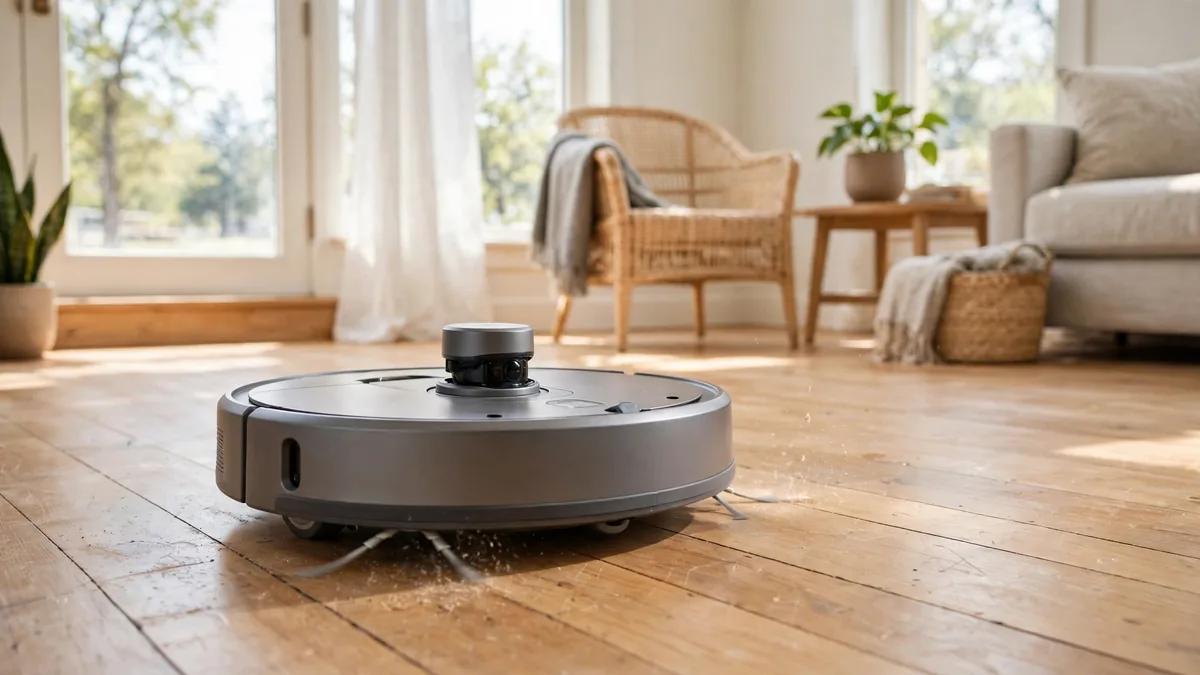
It was three in the morning, and the house was dark and silent, when the little round robot woke up. Nobody had told it to clean. Nobody was watching. It rolled out of its dock, spun a tiny turret on its head, and fired invisible pulses of light at the walls, the sofa legs, the doorway. In a fraction of a second it knew the shape of the room — where the furniture was, where the stairs began, where the cat was sleeping. Then it set off in neat, straight lines, covering the floor like a lawnmower, while its owner slept upstairs.
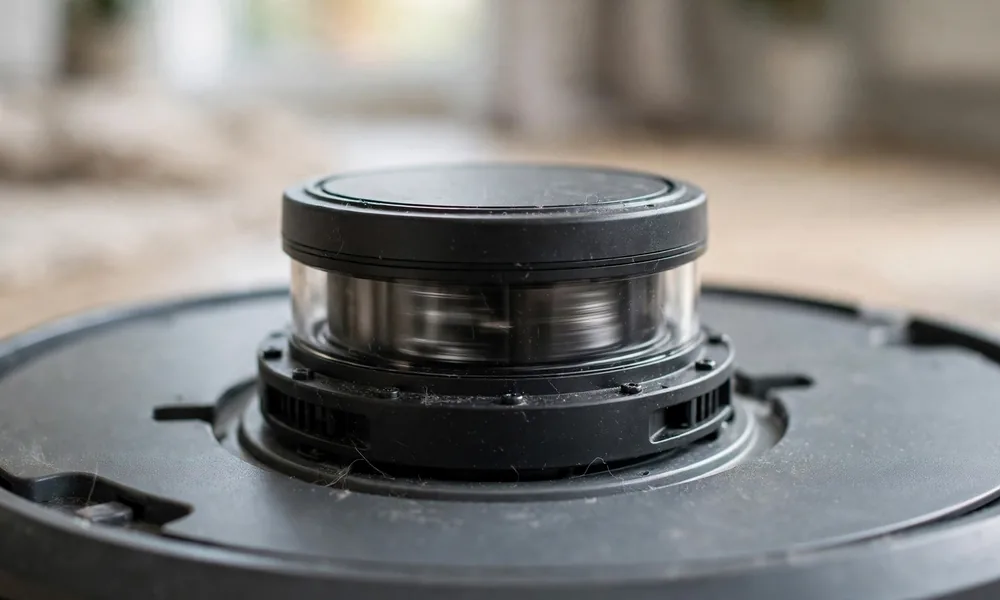
That turret is a LiDAR sensor, and it is the reason modern robot vacuums clean in orderly rows instead of bumping around at random like the first ones did. LiDAR — light detection and ranging — measures distance by timing how long a pulse of laser light takes to bounce back. The robot fires thousands of pulses a second, builds a map of the home, and then navigates by it, remembering where it has been and where it still needs to go.
This guide explains the numbers behind robot vacuum LiDAR in plain English: what each one means, and how to tell a genuinely clever navigator from a merely expensive one.
How It Works
Step 1: Firing the laser
At the heart of the turret is a tiny laser that fires short pulses of infrared light, invisible to human eyes. Each pulse travels out, hits a wall or a chair leg, and bounces back to a sensor. The system times the round trip — light moves at about 300,000 kilometres a second, so a wall three metres away returns its pulse in about twenty billionths of a second — and turns that time into a distance.
Step 2: Spinning the turret
One pulse measures one direction, so the turret spins. A small motor turns the laser and its sensor through a full circle several times a second, sweeping the room like a lighthouse beam. Each sweep produces hundreds of distance readings, one for each angle, and together they form a slice of the world at the height of the turret — a ring of distances that shows exactly where the walls and furniture are. Precision spinning in a small package is a skill shared with other gadgets, as the drone motor shows, where tiny motors must spin fast and true for hours at a time, and the build of such a motor is laid out in how a drone motor works.
Step 3: Building the map
As the robot moves, it stitches the sweeps together into a map. This is the hard part: the robot must know where it is inside the map it is drawing, a problem engineers call simultaneous localisation and mapping. It uses the LiDAR readings, its wheel rotations, and sometimes a gyroscope to track its position, correcting small errors every sweep. The result is a floor plan accurate to a few centimetres, stored in the robot’s memory.
Step 4: Planning the route
With a map in hand, the robot plans its cleaning like a person mowing a lawn: straight, overlapping lines that cover the whole floor without wasting effort. It splits the home into rooms, cleans one at a time, and goes around obstacles instead of pushing through them. The map also lets it remember no-go zones and virtual walls, so it stays out of the dog’s water bowl and the children’s Lego.
Step 5: Seeing low obstacles
LiDAR sits on top of the robot, so it cannot see things below its beam — a sock on the floor, a charging cable, a pet accident. Modern vacuums add extra sensors for that: a front bumper, a cliff sensor that watches for stairs, and sometimes a small camera or a second laser pointing forward and down. The LiDAR still does the mapping, but these helpers stop the robot from eating a cable or tumbling downstairs. The cliff sensor watches the floor constantly, even in the dark, where LiDAR works just as well as in daylight.
Step 6: Returning home and updating the map
When the battery runs low, or the job is done, the robot navigates back to its dock using the map it built, aligning itself with the charging contacts and settling in to recharge. On the next run, it compares what it sees with the map it remembers — a moved sofa, a new bookshelf — and updates the plan. That steady self-improvement is a quiet kind of engineering, the same care with small sensors that goes into a fingerprint sensor, where a tiny component must read the world accurately thousands of times a day.
Robot Vacuum LiDAR Specs
| Specification | Typical range |
|---|---|
| Scan rate | About 5 to 10 revolutions per second (1,800 to 3,600 degrees per second) |
| Measurement range | About 6 to 12 metres, depending on the model |
| Mapping accuracy | About 2 to 5 centimetres in a typical home |
| Sampling rate | About 2,000 to 4,000 distance points per second |
| Laser type | Infrared laser, Class 1 eye-safe, typically 905 nanometres |
| Turret height | About 15 to 25 millimetres above the robot’s body |
| Works in the dark | Yes — LiDAR needs no ambient light at all |
| Map storage | Typically 2 to 5 saved floor maps, depending on the model |
| Navigation type | LiDAR SLAM (simultaneous localisation and mapping) |
What Does a Robot Vacuum with LiDAR Cost?
LiDAR used to be a premium feature, and the price still shows it. A robot vacuum with LiDAR navigation is estimated at roughly $250 to $600 for a mid-range model, while a flagship with LiDAR plus obstacle cameras and a self-emptying dock is estimated at roughly $700 to $1,200. A basic random-navigation vacuum without LiDAR is estimated at roughly $100 to $200 — cheaper, but it cleans by bumping around and takes far longer to cover a room. The LiDAR premium buys time: a mapped clean of a typical home takes an estimated 30 to 50 percent less time than a random one, and the robot rarely misses a patch. All prices are estimates only and vary by brand, model, and retailer.
A Rare Fact
LiDAR in a robot vacuum is a hand-me-down from space. The same principle — timing laser pulses to measure distance — guided the Apollo missions, mapped the Moon, and now steers self-driving cars. The first robot vacuums with LiDAR appeared in the early 2010s, when the sensor cost more than the rest of the vacuum put together. Within a decade, the turret had shrunk to the size of a coin and the price had fallen by more than ninety percent, which is why a technology that once mapped planets now maps living rooms at three in the morning.

A lighthouse on wheels that maps your home in the dark — that is robot vacuum LiDAR, the quiet navigator that turned a bumping toy into a household tool. Learn to read the specifications — scan rate, range, and mapping accuracy — and the spec sheet stops being a list of big numbers and starts being a promise about how thoroughly your floors will be cleaned.