The camera hits the rock at full speed, tumbles down the trail, and lands in a puddle. Its owner picks it up, wipes the lens on a sleeve, and presses record again. The footage is perfect. Nothing inside the camera was ever in danger, because the camera itself was never really exposed to the crash at all. It was riding inside a second skin: the action camera housing.
An action camera housing looks like a simple clear box, but it is a small fortress. It has to be watertight, shock-proof, and optically invisible, all at once, while letting its owner press buttons and swap batteries through its walls. Here is how it does all of that, step by step.

How an Action Camera Housing Works
Step 1: The shell takes the hit
The first job of the housing is to be the thing that gets hurt instead of the camera. Its shell is moulded from tough polycarbonate, a plastic that bends slightly instead of cracking, and it is thicker at the corners and edges where impacts land. When the camera hits a rock, the shell flexes, spreads the force across its whole shape, and springs back. The camera inside is held by soft ribs and pads that grip it without squeezing it, so the shock never reaches the lens or the sensor. The shell is sacrificial by design: it can be scratched and scuffed for years while the camera inside stays new.
Step 2: The O-ring seal keeps the water out
Waterproofing comes down to one humble part: a rubber O-ring. When the housing closes, its lid presses the O-ring into a groove around the rim, squashing it into a continuous seal. Water pressure from outside only pushes the seal tighter, which is why a good housing is rated to depths of 40 metres or more. The ring must be perfectly clean — a single grain of sand or a stray hair across it is enough to let water creep in. That is why experienced owners rinse the seal and check it by eye before every dive. The way the shell and seal are made is covered in how an action camera housing is made, from the moulding of the shell to the fitting of the ring.
Step 3: The lens port stays optically invisible
The front of the housing is a flat window of glass or optical plastic, and its job is to disappear. It must pass light to the camera’s lens without bending it, fogging it, or reflecting it. The port is coated to cut reflections, and its flat shape avoids the distortion a curved window would cause underwater. Underwater, the window also changes how the camera sees: water bends light differently from air, so the field of view narrows and everything looks closer. Good housings are designed with this in mind, and some add a dome port or a colour filter to restore the lost reds. A scratched port ruins footage long before the camera itself is in trouble.
Step 4: The latch locks it all down
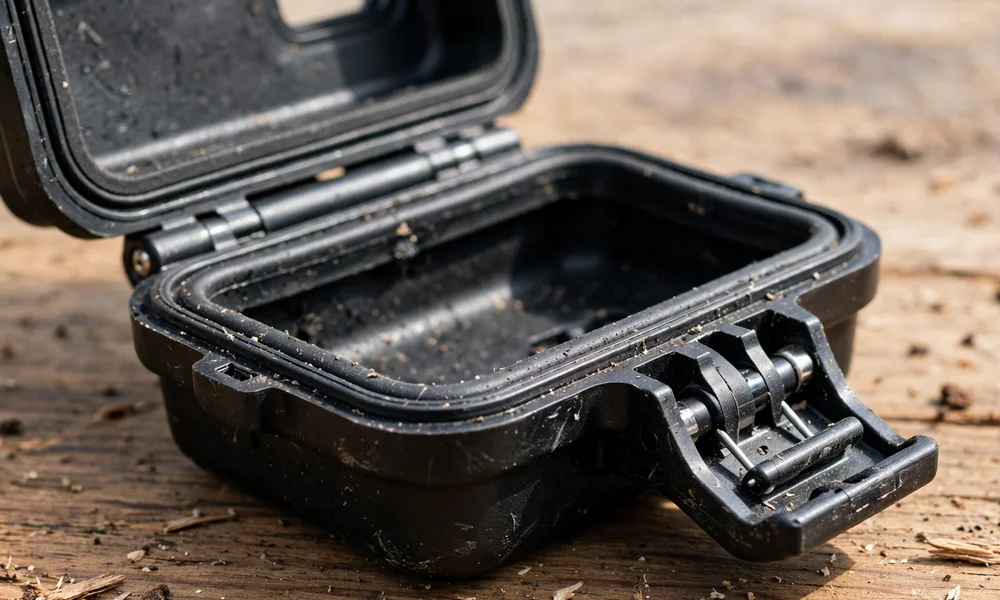
None of the sealing works without the latch. A good housing latch is a lever that pulls the lid down with a firm, even pressure, compressing the O-ring the same amount all the way around. It is designed to be opened with cold, wet, gloved hands, and to stay shut if the camera is dropped or knocked. Many housings add a second lock — a sliding catch or a twist — so a single accidental bump cannot spring the lid open underwater. The latch is also the most common point of failure, because its hinge and spring work hard on every single opening, and a tired latch is the first sign a housing needs replacing.
Step 5: Buttons work through the wall
The camera still needs to be operated while it is sealed inside, so the housing carries its buttons through its own walls. Each button is a plunger that passes through a small rubber gasket, pressing the camera’s own button on the other side. The gasket seals around the moving shaft, keeping water out while letting the press through. The shutter, the power button and the mode button each get their own plunger, lined up precisely with the camera inside. It is a neat trick: the housing is watertight, yet you can still start and stop recording without ever opening it. The materials that make these moving seals possible are explained in the materials engineering of the action camera housing, from the polycarbonate shell to the rubber that never quite wears out.
Step 6: Mounts and heat finish the job
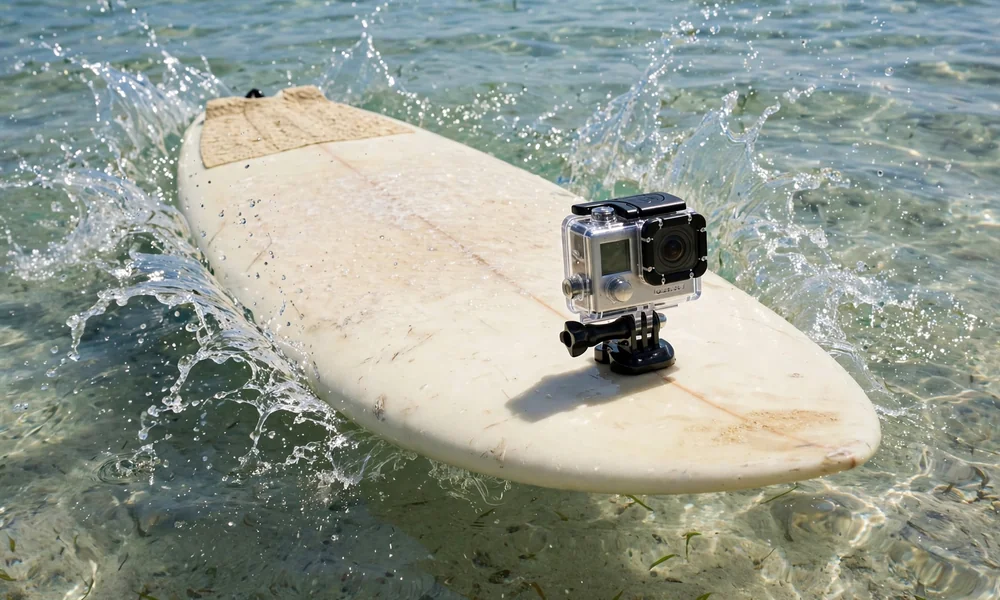
Finally the housing has to attach to the world. Its base carries the standard two-prong mount that clips into bike, helmet, chest and surfboard mounts, and the prongs are reinforced because they take every jolt the camera does. The housing also has to manage heat: a camera recording 4K video gets hot, and a sealed box traps that heat. Vents are impossible, so the shell is designed to conduct heat away from the camera and into the air or water outside. In cold water the housing can even fog up inside as warm, damp air meets a cold window — which is why many owners slip a small anti-fog insert inside before closing the lid. The same stabilisation thinking appears in how a drone gimbal works, where a camera must stay steady while the world around it moves.
Action Camera Housing Specifications
| Specification | Typical figure |
|---|---|
| Shell material | Polycarbonate |
| Waterproof rating | 40 m (with O-ring seal) |
| Lens port | Flat optical glass or plastic |
| Seal type | Silicone O-ring, latch compressed |
| Mount | Two-prong quick-release |
| Weight | Around 100–150 g empty |
How Much Does an Action Camera Housing Cost?
A replacement housing for a popular action camera typically costs an estimated $40 to $80, with premium dive housings rated for deeper water running to an estimated $100 to $200 or more — these are estimates, not list prices. That is a small price for the part that stands between a camera worth several hundred dollars and a rock, a wave, or a 40-metre dive. Most owners treat the housing as a consumable: scratched, tired, or fog-prone, it gets replaced while the camera inside carries on.
A Rare Fact About the Action Camera Housing
Here is something few owners realise: the clear housing actually makes the camera see less underwater, not more. Water bends light far more than air does, so the flat window narrows the camera’s field of view by roughly a quarter and makes everything look closer than it is. Filmmakers call this the refraction effect, and it is why underwater footage from a housed camera looks tighter and more zoomed-in than the same shot on land. The housing protects the camera perfectly — and quietly changes what it sees at the same time.
So the next time a camera survives a crash that should have killed it, remember the quiet engineering inside the clear box: a shell that flexes, a ring that seals, a window that disappears, a latch that holds, buttons that reach through a wall, and a mount that takes the beating — all so the camera inside never has to.


