Stand on the flight deck of an aircraft carrier and you are standing on one of the most abused surfaces on Earth. In a single day it is hit by jets landing at 150 miles per hour, blasted by exhaust hotter than a furnace, soaked in seawater and jet fuel, and pounded by the weight of aircraft, tractors and cranes. It is a runway, a car park, a workshop and a battlefield, all floating on the sea.
The flight deck has to do two contradictory jobs. It must be hard enough to survive a jet’s tailhook slamming into it and soft enough not to shatter a landing aircraft’s tyres. It must grip in rain and be slick enough for aircraft to be moved around by hand. And it must do all of this while the ship rolls, pitches and steams through salt spray for months at a time.

The Materials Behind the Aircraft Carrier Flight Deck
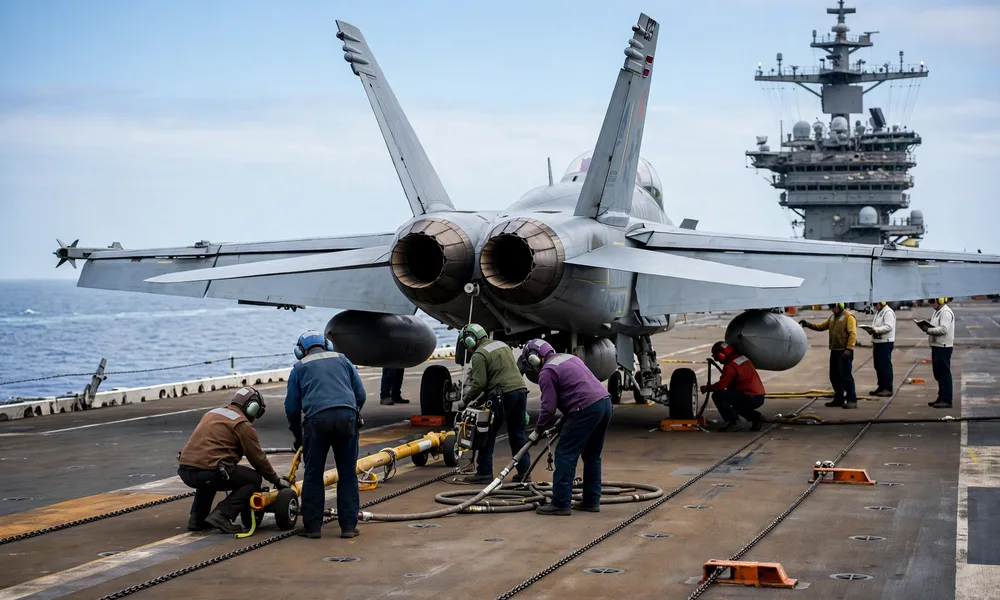
The deck is a sandwich of high-strength steel plate, a non-slip coating, and, in the landing area, a specialised surface that absorbs the impact of the tailhook. Beneath it run the catapults and arresting gear, the machinery that launches and stops the jets. Above it, the island, the lighting and the markings organise a space the size of several football fields into a working airfield. Every material is chosen for abuse, not comfort. The same grip problem, solved at a different scale, shapes the submarine pressure hull coatings, where the sea attacks from every side.
Step 1: The steel deck plate
The flight deck itself is made from high-strength steel plate, typically HY-80 or similar naval grades, welded into a single vast surface. This steel is far stronger than the mild steel of a merchant ship, because it must take the impact of landing aircraft and the heat of jet blast without warping. The plates are thick — several centimetres — and they are welded by specialists, because a bad weld in a flight deck is a crack waiting to happen.
Step 2: The non-slip coating
Bare steel is treacherously slippery when wet, so the flight deck is coated with a non-slip material: an epoxy or polyurethane coating loaded with aluminium oxide grit. The grit gives boots and tyres something to grip, even in rain, fuel and seawater. The coating is applied in sections and renewed constantly, because jet blast, tailhooks and tractor tyres wear it away. A carrier’s crew repaints and recoats the deck on a rolling schedule, a never-ending job that never makes the news.
Step 3: Arresting gear and the landing area
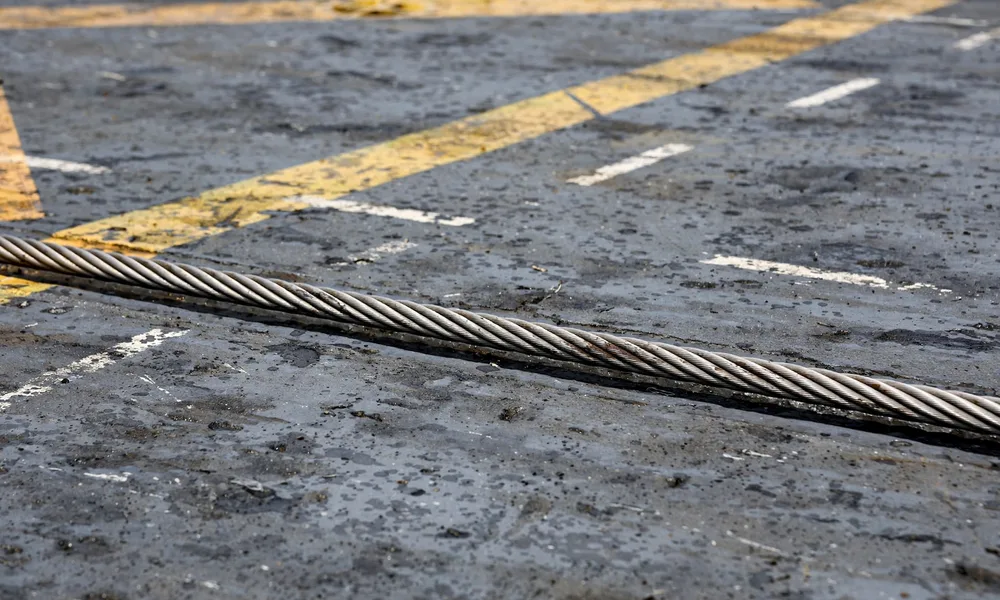
Stopping a jet on a short deck takes arresting wires: steel cables stretched across the landing area, held up slightly by supports so a jet’s tailhook can catch one. The wires are made from high-strength steel cable, replaced after a set number of landings because each catch stretches and fatigues them. Below the deck, hydraulic engines absorb the energy of a 25-tonne jet arriving at 150 miles per hour, turning speed into heat in a controlled way.
Step 4: Catapults and the launch area
Launching a jet needs a catapult: a steam or electromagnetic shuttle that runs in a slot down the deck, dragging the aircraft to flying speed in about 90 metres. The slot is lined with steel and sealed against seawater, and the shuttle itself is built from high-strength alloys that survive thousands of launches. The newest carriers use electromagnetic catapults, which replace steam with linear motors — a change that demands new materials in the deck, because the magnetic fields and the electrical systems must be shielded from the rest of the ship. The launch area is the hottest part of the deck, blasted by afterburners at every takeoff.
Step 5: Jet blast deflectors
Behind each catapult stands a jet blast deflector, a panel that rises from the deck to shield the aircraft behind from the exhaust of the one taking off. The deflector is made from steel panels with water cooling inside, because jet exhaust can reach over 1,000 degrees Celsius — hot enough to melt ordinary steel over time. Water is pumped through channels in the panels, carrying the heat away to the sea. When the deflector is lowered, it sits flush with the deck so aircraft can taxi over it. It is a piece of the deck that has to be both a wall and a floor.
Step 6: Lighting, markings and the island
The deck is painted with a language of lines, numbers and coloured shirts: landing stripes, parking spots, helicopter spots, and the lines that tell a pilot where to touch down. The paint is a specialist marine coating, resistant to fuel, heat and pressure washing. At night, the deck is lit by flush lights and by the island’s floodlights, and the landing aid — a series of lights that tells the pilot if they are high or low — guides jets in from kilometres away. The island itself is steel, crowded with radar and antennas, and it is the only thing that breaks the flat expanse of the deck.
Step 7: Maintenance, the never-ending job
A flight deck is never finished. Crews inspect it daily for cracks, worn coating and damaged wires, and repairs are made while the ship is at sea — welding, recoating and replacing wires between flight operations. The steel is checked with ultrasound for cracks that the eye cannot see, and the coating is renewed in patches, a few square metres at a time. A carrier that cannot maintain its deck cannot fly its aircraft. The organisation of this floating airfield owes as much to the cruise ship engine rooms below as to the pilots above: both are machines that never stop.
Aircraft Carrier Flight Deck at a Glance
| Specification | Detail |
|---|---|
| Deck plate | High-strength naval steel, several cm thick |
| Non-slip coating | Epoxy or polyurethane with aluminium oxide grit |
| Deck length | About 330 metres on a large carrier |
| Arresting wires | High-strength steel cable, replaced on schedule |
| Catapult | Steam or electromagnetic, about 90 m launch run |
| Blast deflectors | Water-cooled steel panels, over 1,000°C exhaust |
| Deck area | About 18,000 square metres (estimate) |
What Does It Cost?
A modern aircraft carrier costs roughly $13 billion (estimate) to build, and the flight deck and its systems — catapults, arresting gear, deflectors and coatings — account for a large share of that. The deck coating alone costs millions of dollars (estimate) to apply and must be renewed constantly. Running costs are higher still: every arrested landing wears the wires, every launch wears the catapult, and the crew that maintains the deck numbers in the hundreds. Compared with the aircraft carrier flight deck machinery below it, the visible deck is the cheapest part of the system — and the part that can never be allowed to fail.
A Rare Fact
The flight deck of a carrier is so hard on aircraft tyres that a jet’s tyres can be worn out in a handful of landings, and the rubber they shed becomes part of the deck itself. The black streaks on the landing area are not paint but rubber, baked into the coating by heat and pressure. Deck crews measure the rubber build-up, because too much of it makes the deck slippery, and too little means the coating is wearing through.


