Somewhere below a grey sea, a submarine hangs motionless at periscope depth, and the only part of it touching the world above is a tube no wider than a dinner plate. Through that tube, the captain sees the horizon, the sky, and any ship that might be watching. The periscope is the submarine’s eye — the one instrument that lets a vessel designed to be invisible take a look around — and it is one of the most precisely made objects in any navy.
A modern periscope is far more than a tube with mirrors. It is a sealed optical system that must stay perfectly dry inside while its top end is dunked in salt water, hold its alignment through depth charges and deep dives, and deliver a sharp image after years without maintenance. The glass, the metal, the seals and the electronics are all made to standards that few workshops on Earth can meet. That is why a single periscope can cost more than a house.

Why the Submarine Periscope Costs So Much
A periscope looks simple from the outside, but it is a precision instrument wrapped in a pressure vessel, made to survive conditions that would destroy ordinary optics. Here are the six reasons the price is so high.
Reason 1: The optics are flawless, and flawless is rare
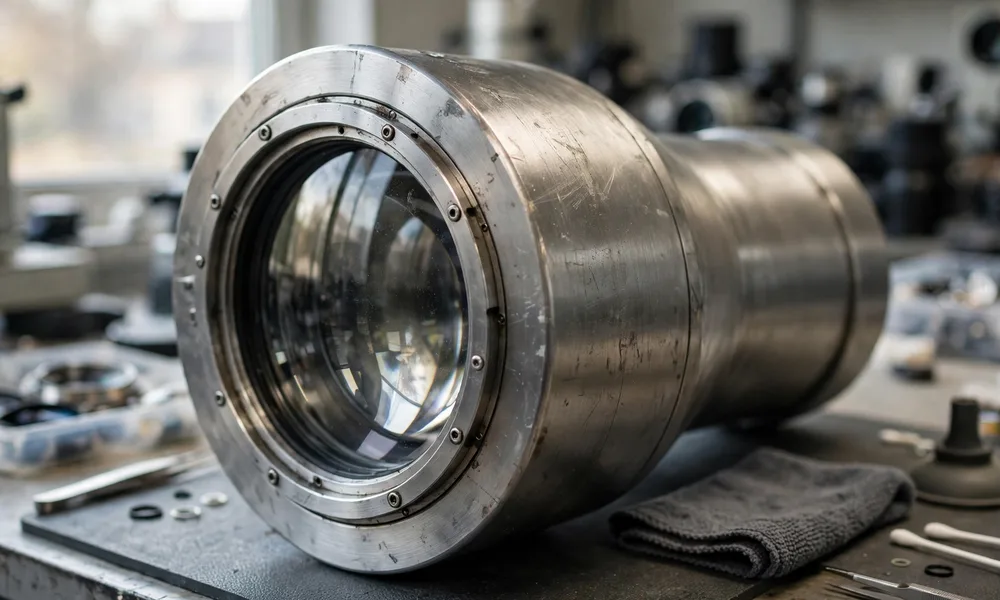
The lenses and prisms inside a periscope must be ground and polished to tolerances measured in fractions of the wavelength of light. A flaw invisible to the naked eye — a bubble, a scratch, a slight unevenness — blurs the image or throws a false reflection across the view. The glass itself is a special optical grade, made in small batches and tested piece by piece, and the prisms that bend the light down the tube must be aligned so precisely that the image stays sharp from the top of the mast to the eyepiece metres below. The people who grind this glass are among the rarest craftsmen in optics, and the rejection rate is high: many are made, few pass. The same obsession with precision governs the submarine periscope specifications, where every optical figure is stated to the finest detail.
Reason 2: The tube must survive the deep
The periscope mast is a long steel tube that passes through the submarine’s pressure hull — the strongest part of the boat — and it must be as strong as the hull around it. At depth, the water pressure tries to crush everything, and the mast must not bend, leak or distort — even a tiny bend throws the optics out of alignment. The tube is machined from high-strength steel, its walls carefully calculated, and it is fitted with seals that hold back the sea at hundreds of metres down. The hull it passes through is built to the same unforgiving standard, which is why the submarine pressure hull is one of the most expensive structures in naval engineering.
Reason 3: Seals that can never fail
A periscope has two enemies: water and time. The top of the mast is regularly dunked in salt water, and the seals that keep that water out of the optics must work perfectly for years, through thousands of dives, without a service call. A single drop of seawater inside the tube would fog the lenses and corrode the coatings, blinding the submarine at the worst possible moment. The seals are made from specialised materials, fitted by hand, and tested under pressure before the mast is ever installed. The assembly is tested again and again, because a seal failure at depth is not an inconvenience — it is a flood in the control room.

Reason 4: It must stay invisible
A periscope’s job is to see without being seen, and that is harder than it sounds. The mast above the water is small, but radar can spot it, and the wake it leaves can be seen from the air. Modern masts are shaped to cut radar reflection, coated to reduce their signature, and fitted with sensors that warn when the mast is exposed for too long. Some periscopes no longer use a direct optical path at all: a camera on the mast sends the picture down by cable, so the captain watches a screen and the mast can be thinner and harder to detect. That electronic path adds cameras, cables and displays — and each one adds cost.
Reason 5: Stabilisation in a moving sea
A submarine at periscope depth is not still: it rolls and pitches with the swell, and the periscope must hold its view steady while the boat moves beneath it. Gyroscopic stabilisation keeps the optics level, compensating for the motion many times a second, and the mechanism must do this silently — a noisy stabiliser would betray the boat to enemy sonar. The gyroscopes, motors and bearings are built to silent-running standards, balanced and isolated so they make almost no sound and no vibration. It is the same discipline that shapes every quiet system aboard, from the propulsion to the submarine sonar array that listens for other vessels.
Reason 6: Almost nobody builds them
The final reason is scarcity. The world has only a handful of companies that can make a military-grade periscope, and their customers are a few dozen navies ordering in tiny numbers — sometimes one or two masts a year. There is no production line, no economy of scale, and no civilian market to share the development cost. Each mast is essentially built to order, with its own drawings and test programme. The price reflects decades of accumulated knowledge held by a very small group of people, and navies pay it because there is no substitute for seeing above the water.
Submarine Periscope at a Glance
| Specification | Detail |
|---|---|
| Mast length | Typically 10–18 metres (estimate) |
| Mast diameter | About 150–250 mm at the head (estimate) |
| Optics | Precision ground lenses and prisms |
| Field of view | About 30–40 degrees, magnified (estimate) |
| Tube material | High-strength steel, corrosion resistant |
| Stabilisation | Gyroscopic, silent-running |
| Modern types | Optical periscope and optronic mast with camera |
| Operating depth | Periscope depth, about 15–20 metres (estimate) |
What Does It Cost?
A modern submarine periscope typically costs between $1 million and $3 million (estimate), with optronic masts — the camera-based replacements — costing more (estimate). The price covers the precision optics, the pressure-proof mast, the seals, the stabilisation and the testing, all built in tiny numbers by a handful of suppliers. A submarine may carry two masts, doubling the bill, and the training, spares and maintenance over the boat’s thirty-year life add far more (estimate). For a navy, though, the eye is worth it: a submarine that cannot see is a submarine that cannot fight.
A Rare Fact
Periscope depth is the most dangerous place a submarine can be. The boat is shallow enough for the mast to break the surface, but deep enough that it cannot see anything except through that one thin tube — and the mast itself, with its wake, is the easiest thing about the submarine to spot. Captains raise the periscope for seconds at a time, sweeping the horizon in a quick arc, then lower it before anyone can fix its position. The most expensive eye in the navy is used like a blink: a fast look, then darkness again.