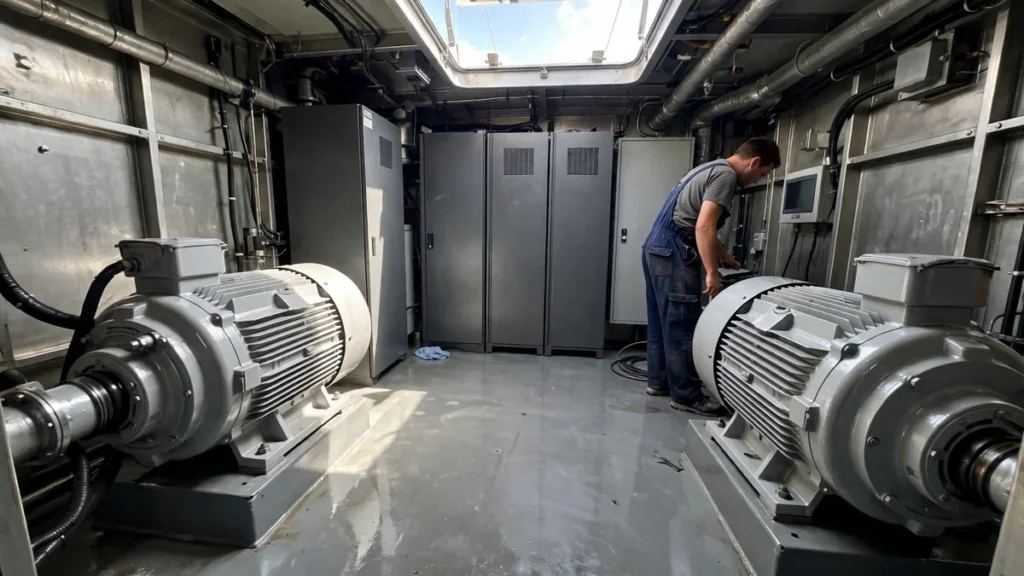
Step below deck on a superyacht and the world changes. Up top there is teak, linen and champagne; down here there is white paint, polished steel, and the deep, steady thrum of two enormous engines. The engine room is the heart of the yacht — it makes the power, the fresh water, the air conditioning and the electricity — and it is also one of the most expensive rooms afloat. Building it costs more than most houses — and the reason is not the size of the engines, but everything around them.
A superyacht engine room is not a garage with engines in it. It is a self-contained power station, built to run for weeks without stopping, in a space that cannot be made bigger, in conditions of heat, salt and constant motion. Every pipe, cable and pump has a backup, every surface is finished to a hospital standard, and every component must be removable through a hatch barely bigger than itself. The cost is the price of packing a power station into a box — and making it beautiful.
Why the Superyacht Engine Room Costs So Much
The engines themselves are only the beginning. The room around them — its systems, finishing and certification — is where the money goes. Here are the six reasons the bill is so large.
Reason 1: The engines are bespoke power plants
A superyacht’s main engines are not bought off the shelf. Each is a large marine diesel, often producing several thousand horsepower, specified for the yacht’s weight, speed and range, and built to run at high load for days on end. The engines are marinised — protected against salt air, fitted with special cooling and exhaust systems, and tuned for quiet running, because a superyacht that vibrates is a failed superyacht. Two main engines alone run into millions of dollars (estimate), before gearboxes, shafts and propellers. The engineering behind them is the same discipline that shapes a cruise ship engine, scaled down and made quieter.
Reason 2: Every system has a backup
A superyacht cannot call a tow truck. If the main generator fails a thousand miles from land, the yacht must keep going, so every critical system is duplicated: two main engines, multiple generators, twin fuel systems, backup pumps for cooling, firefighting and bilge. The duplication doubles the equipment, the pipework and the space needed — and space is the scarcest thing on the boat. Designing a room where everything has a twin, yet everything can still be reached, is a puzzle that takes naval architects months. The redundancy is invisible to the owner, until the day it saves the voyage.
Reason 3: Silence is engineered, not hoped for
Guests on a superyacht expect to hear the sea, not the engines. Achieving that means mounting every engine and generator on flexible mounts that absorb vibration, lining the room with acoustic insulation, and designing the exhausts to muffle the sound without choking the engines. The exhaust runs are long, the silencers large, and the whole installation is tested with sound meters in every cabin. A single rattling pipe can ruin the result, so specialists chase vibrations the way a piano tuner chases a wrong note. The quiet is one of the most expensive features on the yacht, and it is one the guests will never notice — which is the point.
Reason 4: The finishing is hospital-grade
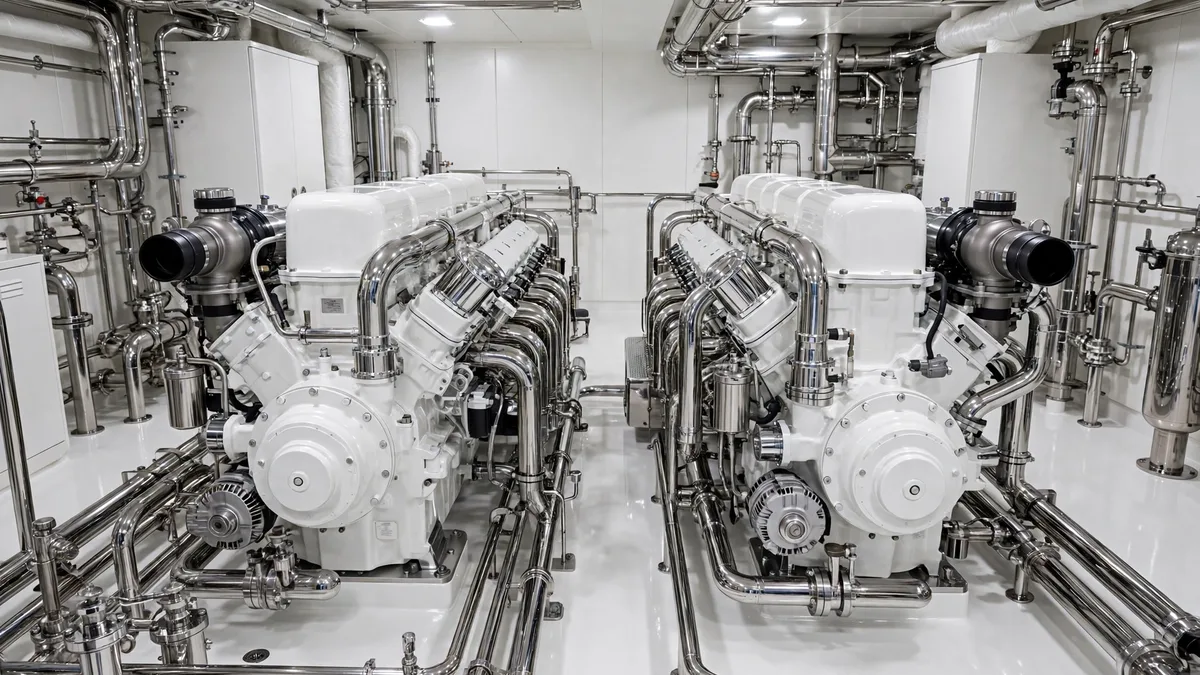
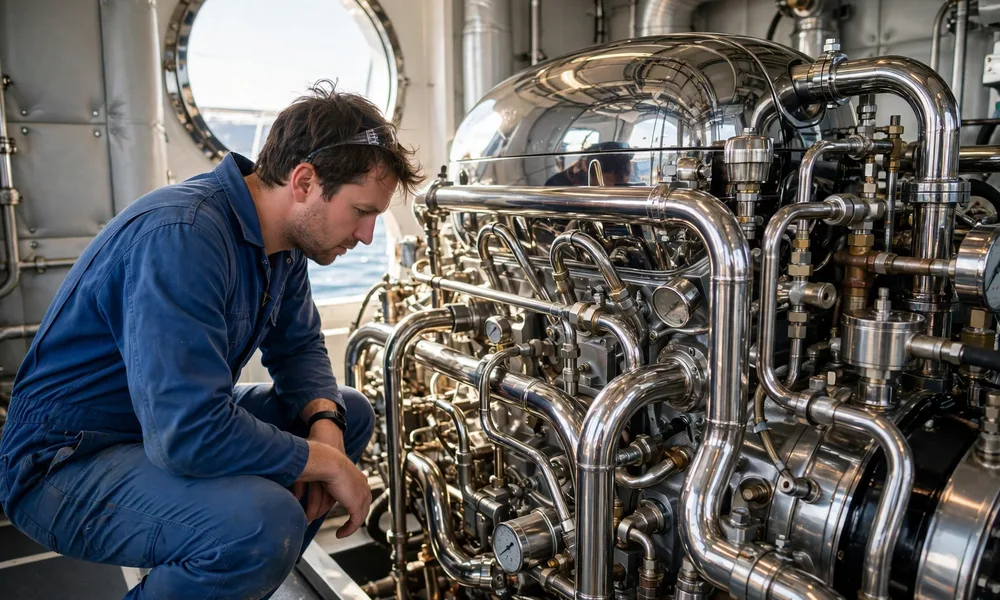
Open the door of a superyacht engine room and the first surprise is how clean it is. The floors are white and glossy, the pipework is polished stainless steel, the engines are painted in the yard’s colours, and every cable is labelled and routed in neat runs. This is not vanity: a clean room makes leaks visible instantly, and a leak found early is a small repair, not a fire. But the finish is also a matter of pride — owners judge a yard by its engine rooms — so the painting, polishing and labelling take weeks of skilled labour. The room must also resist fire, so the insulation, the paint and the cable coverings are all fire-rated and certified, which adds cost to every square metre.
Reason 5: Fuel, water and power — all made aboard
The engine room does more than drive the propellers. It houses the generators that make the yacht’s electricity, the watermakers that turn seawater into drinking water, the air conditioning plants, the sewage treatment system and the fuel purification system. Each is industrial equipment in its own right, and each must fit into a room already crowded with engines. The fuel system alone is a project: tanks, filters, separators and day tanks, all built to rules that prevent a single drop of diesel reaching the sea. Making all these systems work together, safely, in a small space is where the engineering hours pile up. The steel that holds it all together is built to the same standard as the superyacht steel hull, because the room is part of the structure, not just a compartment in it.
Reason 6: Certification and class rules
Nothing in a superyacht engine room is installed without approval. Classification societies — the independent bodies that certify ships — set rules for everything: the thickness of the fuel pipes, the fire resistance of the insulation, the number of bilge pumps, the escape routes from the room. Every component must be certified, every installation inspected, and every test documented. The paperwork alone takes months, with inspections at every stage of the build. The rules exist because a fire in an engine room at sea is one of the worst things that can happen to a ship. The material standards behind the room are the same ones that govern the superyacht engine room materials, chosen for fire resistance and survival, not for price.

Superyacht Engine Room at a Glance
| Specification | Detail |
|---|---|
| Main engines | Two marine diesels, several thousand hp each (estimate) |
| Generators | Two or three, plus emergency generator |
| Fuel capacity | Tens of thousands of litres (estimate) |
| Fresh water | Made aboard by reverse-osmosis watermakers |
| Noise in cabins | Below 50 decibels at cruising speed (estimate) |
| Fire protection | Fire-rated insulation, fixed extinguishing system |
| Certification | Classification society approved |
| Crew | Chief engineer plus engineers, on watch 24 hours |
What Does It Cost?
The engine room of a large superyacht typically costs between $5 million and $15 million (estimate), with the main engines accounting for the largest share. The rest goes to generators, watermakers, air conditioning, fuel systems, soundproofing, fire protection and the labour of fitting it all into a space that was never big enough. On the largest yachts the figure is higher still (estimate). It is a large share of the yacht’s total build cost, and the share the owner sees least — until something goes wrong.
A Rare Fact
A superyacht engine room is so clean that engineers work in it wearing white overalls — and the overalls stay white. The tradition comes from the days when a dirty engine room meant a badly run ship, and the standard has never slipped: a chief engineer can tell the health of the whole yacht by looking at the floor. A single dark drip under a pump is investigated like a symptom, because in an engine room, cleanliness is not housekeeping. It is an early warning system, and it has saved more yachts than any alarm.