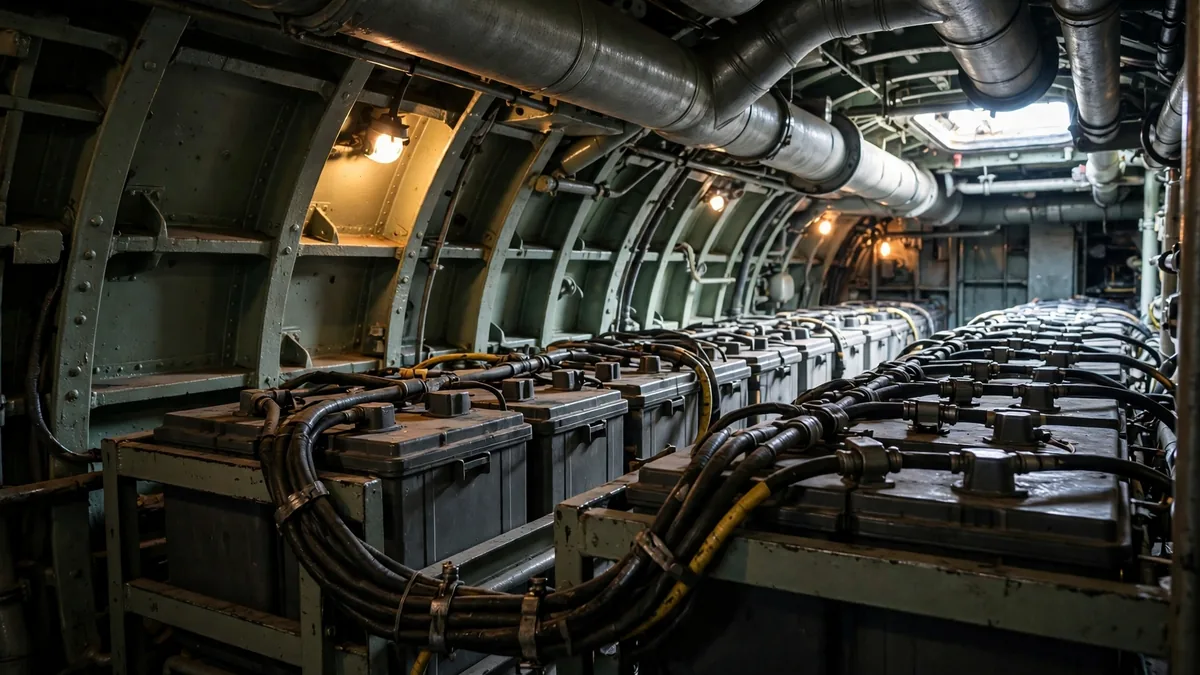
Deep under the sea, a submarine glides in silence. There is no engine noise, no exhaust, no wake on the surface. The only sound is the hum of the crew and the quiet turn of the propeller, and all of it is powered by a battery. Not a battery like the one in a car or a phone, but a battery the size of a small house, made of hundreds of cells, each one weighing as much as a grown man. It is the boat’s silent heart, and it is one of the most expensive batteries ever built.
A submarine battery has to do things no other battery is asked to do. It must store enough energy to drive a warship for hours without surfacing, survive being charged and discharged thousands of times, and keep working in a sealed steel tube where a leak of gas could be fatal. That combination is why it costs so much.
Why It Costs So Much
The price of a submarine battery is set by its contradictions. It must be huge and yet fit inside a hull that is already crowded. It must be powerful and yet safe in a space where the crew sleeps beside it. It must be built to last for years and yet be replaceable in a dry dock. Every one of those demands fights the others, and resolving them takes specialist materials, specialist labour, and testing that no ordinary battery ever faces.
The materials
Most submarine batteries are still built on lead-acid chemistry, refined to a level far beyond anything in a car. The plates inside each cell are thick, pure, and carefully formed, because a thin plate would wear out too fast and a dirty one would fail early. The acid is purified, the separators are made from specialist materials, and the cases are built from hard rubber or plastic that can survive decades of vibration and temperature swings without cracking.
Newer boats use lithium-ion cells, and the materials bill climbs again. Lithium cells need sophisticated management electronics, fire-resistant housings, and cooling systems that keep every cell at the same temperature. Whether lead or lithium, the materials are ordered in small quantities, built to a standard no commercial battery meets, and priced accordingly.
The labour
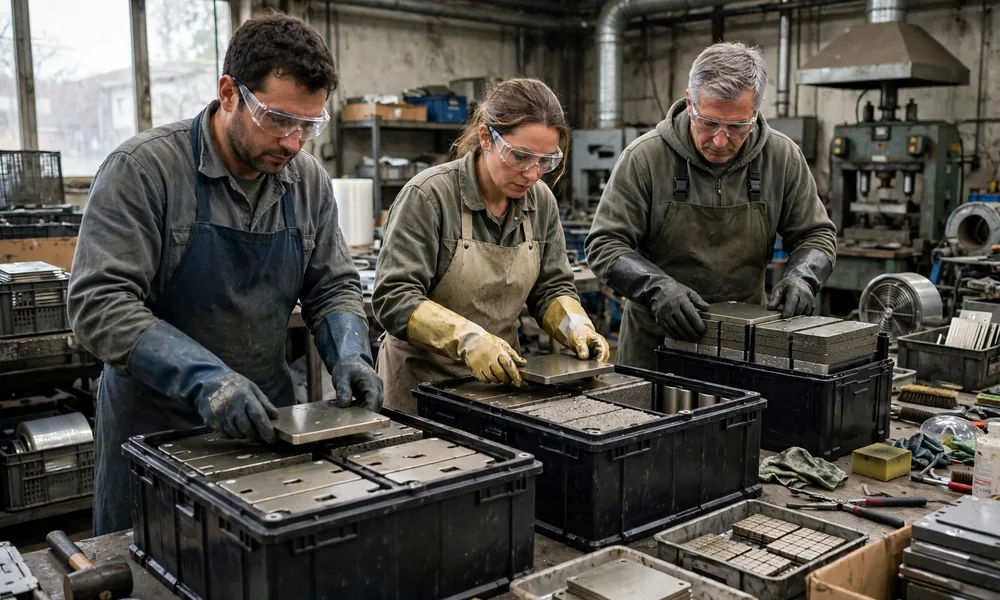
A submarine battery is assembled by hand, cell by cell. Workers fill each cell, connect it to its neighbours with heavy copper busbars, and test it individually before it joins the bank. The work is done in a battery shop, a dedicated space in the shipyard where the air is controlled and the floors are acid-proof.
The labour does not end at assembly. The battery is charged and discharged for weeks in the shop, a process called forming, which conditions the plates and proves that every cell holds its charge. Technicians monitor each cell through hundreds of cycles, logging voltages and temperatures, and any cell that falls behind is pulled out and replaced. By the time the battery goes into the boat, it has already lived a working life in the workshop, and every hour of that life was skilled, careful, and expensive.
The rarity
Submarine batteries are built in tiny numbers. A country may order only a few boats in a decade, and each boat needs one battery, replaced once or twice in its life. The whole world builds perhaps a few dozen submarine batteries a year, and they are made by a handful of specialist firms. There is no mass market to spread the cost of the factories, the test rigs, or the design work.
That rarity extends to the people. A battery that must work silently, safely, and for years inside a submarine is not something a general battery factory can turn its hand to. The firms that can do it charge for the privilege, and navies pay, because there is no cheaper way to buy silence.
The testing
Testing a submarine battery takes months. Each cell is cycled, measured, and inspected before it is accepted. The whole bank is then tested as a unit, charged and discharged under loads that mimic a patrol: slow cruising, sudden sprints, and long silent waits.
Safety testing is the most demanding of all. A battery in a sealed hull must not produce dangerous gas, must not overheat, and must survive a short circuit without fire. Test rigs deliberately abuse cells to prove that a fault stays contained, and the results are reviewed by the navy and the classification society before the battery is approved. It is slow, costly work, but it is the reason submarine batteries have an extraordinary safety record.
The low volumes
Low volumes make everything about a submarine battery dearer. The plates are cast in small runs. The cases are moulded to order. The test equipment is used a few times a year. The factory cannot spread its costs across a million car batteries, because it builds dozens of submarine batteries, and each one carries its full share of the overhead.
Replacement is just as costly. When a battery reaches the end of its life, the boat goes into dry dock, the old cells are lifted out one by one through a hatch, and a new battery is built into the hull. A submarine battery is expensive to buy, and expensive to replace, because it was never designed to be cheap. It was designed to be silent, safe, and certain.
Cost Breakdown
Exact prices are rarely published, so these figures are estimates showing where the money goes.
| Cost area | Estimated share | Estimated cost |
|---|---|---|
| Cells, plates, and chemistry | 30% | $3,000,000 – $9,000,000 (estimate) |
| Management, cooling, and safety systems | 20% | $2,000,000 – $6,000,000 (estimate) |
| Skilled labour and assembly | 20% | $2,000,000 – $6,000,000 (estimate) |
| Design and engineering | 15% | $1,500,000 – $4,500,000 (estimate) |
| Forming, testing, and approval | 10% | $1,000,000 – $3,000,000 (estimate) |
| Cases, busbars, and fittings | 5% | $500,000 – $1,500,000 (estimate) |
| Total | 100% | $10,000,000 – $30,000,000 (estimate) |
Specifications
| Feature | Typical detail |
|---|---|
| Chemistry | Lead-acid, with lithium-ion on newer boats |
| Cells per battery | Several hundred large cells |
| Cell weight | Up to 500 kg per cell |
| Energy stored | Several megawatt-hours |
| Endurance submerged | Hours to days, depending on speed |
| Service life | About 5 to 10 years per battery |
| Cooling | Air and water cooling, with gas monitoring |

A Rare Fact
A submarine battery is so large that the crew lives with it, not beside it. On many boats the battery compartment sits under the crew’s living quarters, and the sailors sleep, eat, and work directly above hundreds of tonnes of cells. The battery is the boat’s floor, its ballast, and its engine all at once, and when the boat dives, the battery is what keeps it moving in silence. It is a power station you can sleep on, built by hand and tested for months, and it is the quietest way ever found to move a warship. To learn more, read the submarine battery specs, what really goes into an EV battery pack, and how solid-state batteries are made.