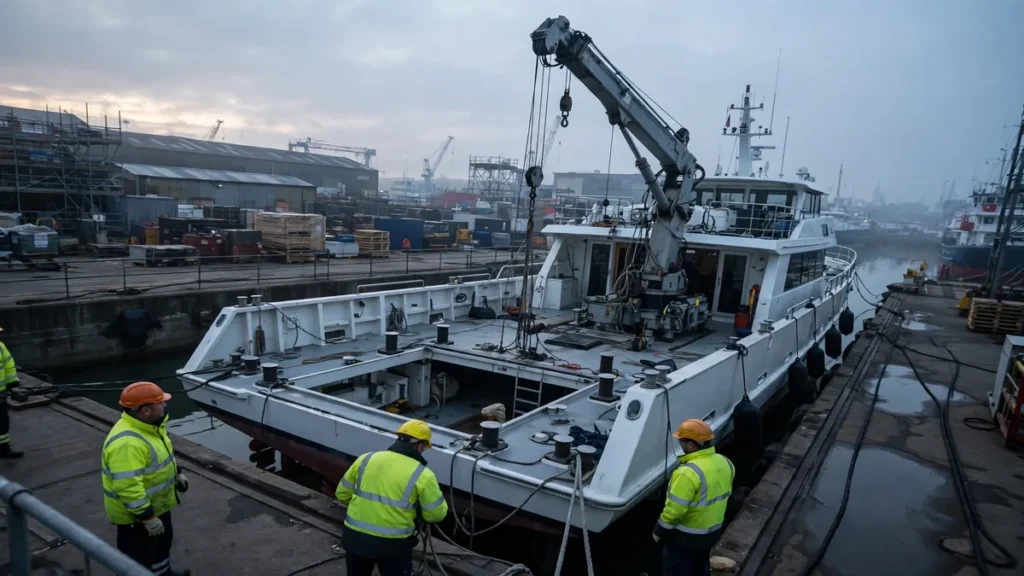
Shipping carries about 90 percent of world trade and produces about 3 percent of global greenhouse gas emissions, and the industry has promised to reach net zero around 2050. The engine that built that trade is the marine diesel, a machine so reliable and so cheap to run that it has dominated for a century. The challenger is hydrogen, burned in an engine or fed to a fuel cell, which produces no carbon dioxide at the funnel at all.
This comparison puts the two systems head to head across the seven things that actually decide what powers a ship: efficiency, emissions, fuel storage and range, cost, bunkering, maturity and safety, and regulation.
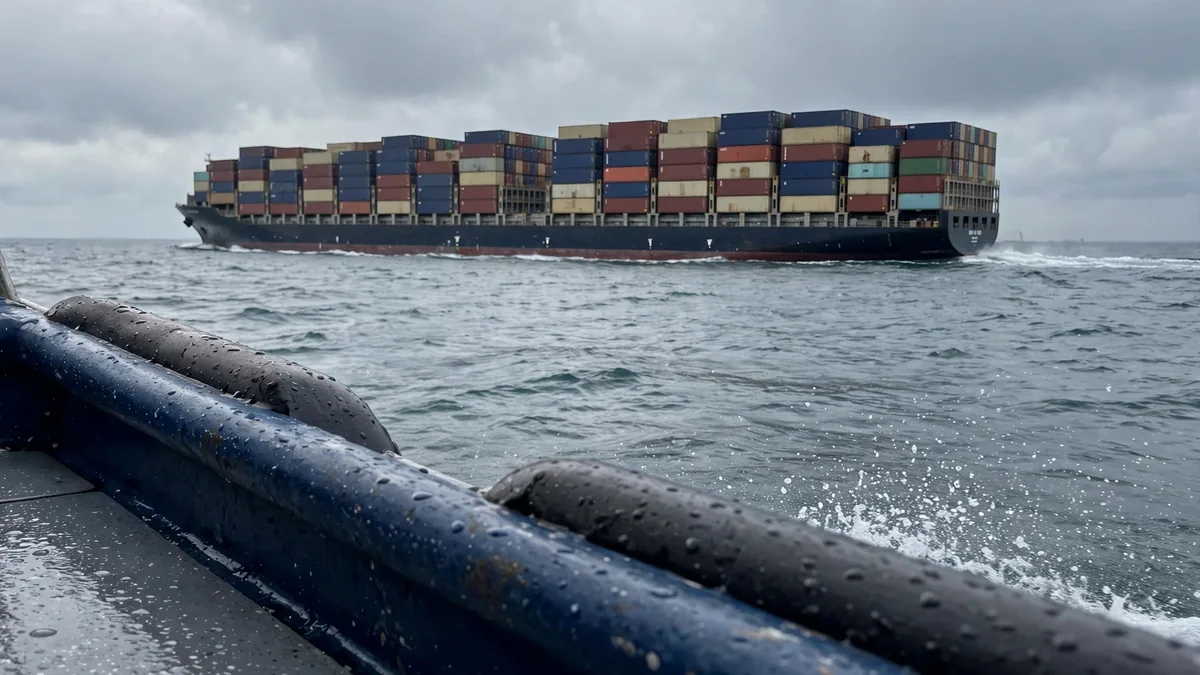
The Two Systems in Brief
Diesel: the incumbent
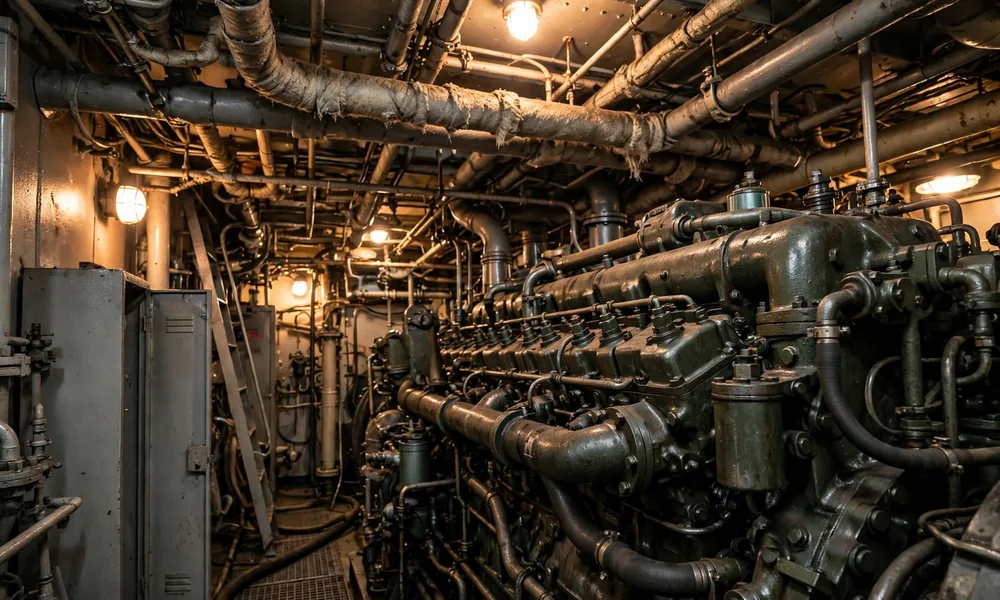
A marine diesel burns heavy fuel oil or marine diesel oil, and the best slow-speed two-stroke diesels are among the most efficient combustion engines ever built, converting roughly 50 to 55 percent of the fuel’s energy into propulsion. The fuel is energy-dense, stable at room temperature, and available in every port on Earth. The way a ship’s propulsion is put together is explained in our guide to how cruise ship propulsion works.
Hydrogen: the challenger
A hydrogen ship carries hydrogen as a compressed gas or as a liquid cooled to minus 253 degrees Celsius, then either burns it in a modified engine or feeds it to a fuel cell that makes electricity directly. A proton exchange membrane fuel cell converts hydrogen to electricity at up to about 75 percent efficiency, with water as the only exhaust.
Round 1: Efficiency — Hydrogen Wins
Hydrogen wins this round, and it is not close. A 2026 multi-criteria study of container-ship retrofits found a hydrogen fuel-cell system used 16.3 percent less energy than the diesel baseline, the lowest of any alternative fuel system tested. The fuel cell’s 75 percent conversion efficiency beats the best marine diesel’s 50 to 55 percent.
Round 2: Emissions — Hydrogen Wins
Hydrogen wins again, by a distance. The same 2026 study found green hydrogen fuel cells cut lifecycle greenhouse gas emissions by 88.4 percent against diesel, with a fuel greenhouse-gas intensity of just 9.99 grams of CO2 equivalent per megajoule, the lowest of any system tested. A separate analysis found green hydrogen and green ammonia pathways cut total emissions by 87 to 91 percent.

Round 3: Storage and Range — Diesel Wins
Diesel wins this round decisively. A litre of diesel holds about 36 megajoules of energy; a litre of liquid hydrogen holds about 8.5, so a hydrogen ship needs roughly four times the tank volume for the same energy, before counting the heavy insulation and cryogenic equipment. One study found that matching a diesel tank’s energy meant losing 20.3 percent of cargo space, or accepting a much shorter range.
Round 4: Cost — Diesel Wins
Diesel wins on cost today, and the gap is large. A 2026 techno-economic analysis put the lifecycle cost of a hydrogen solid-oxide fuel-cell system at $1,098 million, the highest of any propulsion option studied, driven mainly by hydrogen at $4.32 per kilogram. The same study found the cost could fall by two-thirds if hydrogen reached $1 per kilogram, which shows how sensitive the maths is to fuel price. Diesel is cheap, its engines are cheap, and its maintenance is understood by every engineer at sea.
Round 5: Bunkering — Diesel Wins
Diesel wins by a rout. Diesel bunkering exists in every commercial port in the world, with standardised fuel, standardised procedures and a global supply chain refined over a century. Hydrogen bunkering exists in a handful of ports, mostly in northern Europe and Japan, and each one is effectively a pilot project. A diesel ship can refuel anywhere on its route. A hydrogen ship must plan its route around the few ports that can supply it, which for most of world shipping means it cannot operate at all.
Round 6: Maturity and Safety — Diesel Wins
Diesel wins on maturity and draws on safety. Marine diesels have a century of operating history, a global parts network and a workforce that understands them. Hydrogen fuel cells at sea are new: the first liquid-hydrogen ferry entered service in Norway only recently, and most hydrogen ships are demonstrators. On safety, the picture is mixed. Diesel is flammable but familiar. Hydrogen is odourless, burns with an invisible flame and ignites across a very wide range of mixtures, demanding new training, new sensors and new procedures.
Round 7: Regulation — Hydrogen Wins
Hydrogen wins the future, and regulation is why. The International Maritime Organization has set greenhouse-gas intensity targets through 2040 and a net-zero goal around 2050, and the 2026 container-ship study found that all alternative-fuel retrofits comply with the 2040 targets, while only hydrogen-based systems approach the projected 2050 net-zero trajectory. Diesel cannot meet 2050 without carbon capture or offsetting
Diesel vs Hydrogen Compared
| Factor | Diesel | Hydrogen | Winner |
|---|---|---|---|
| Energy efficiency | 50 to 55 percent | Up to about 75 percent | Hydrogen |
| Lifecycle emissions | Baseline | Up to 88 percent lower, green only | Hydrogen |
| Fuel energy density | About 36 MJ per litre | About 8.5 MJ per litre, liquid | Diesel |
| Fuel cost | Cheap and stable | About $4.32 per kg today | Diesel |
| Bunkering | Every port in the world | A handful of pilot ports | Diesel |
| Maturity | A century of service | Demonstrators and first ferries | Diesel |
| Regulation to 2050 | Cannot reach net zero alone | Only pathway near the target | Hydrogen |
What Does Each System Cost?
A conventional diesel propulsion system for a large container ship costs tens of millions of dollars installed, with fuel as the dominant lifetime expense. A hydrogen fuel-cell system costs substantially more to build — the 2026 analysis put its lifecycle cost at $1,098 million against a diesel baseline, mostly because of fuel — and the gap only closes if green hydrogen falls towards $1 per kilogram. The middle path is worth noting too, as our comparison of diesel versus hybrid ship propulsion shows, and the alternative fuels around hydrogen are covered in our guide to what a methanol-fuelled ship is.
A Rare Fact
Hydrogen is the lightest element in the universe, and a hydrogen leak behaves nothing like a diesel spill. Hydrogen rises at about 20 metres per second — roughly 45 mph straight up — so a leak outdoors disperses in seconds rather than pooling like diesel or petrol. That is why hydrogen is in some ways safer than conventional fuel in open air, and in other ways more dangerous: the same lightness that clears a leak quickly also lets it collect under a deckhead indoors, where a single spark can ignite it.
The Verdict
Diesel wins four rounds, hydrogen wins three, and the score flatters diesel. Every round hydrogen loses is a problem of infrastructure, cost and maturity — problems that money and time can solve. Every round diesel loses is a problem of physics and chemistry, which money and time cannot solve. For a ferry on a short fixed route in northern Europe, hydrogen already wins. For a container ship crossing oceans, diesel wins for at least another decade. But the direction is clear: the ship that will still be legal and insurable in 2050 is the hydrogen one.