A drone hangs in the air above a field, perfectly still, while the wind pushes at it from the side. Nothing about the scene looks like hard work. Yet inside each of its four small motors, copper coils are switching on and off hundreds of times a second, magnets are pulling a spinning bell around a fixed core, and a shaft no thicker than a pencil is turning fast enough to blur. The whole aircraft weighs less than a bag of sugar, and the motors do all of it.
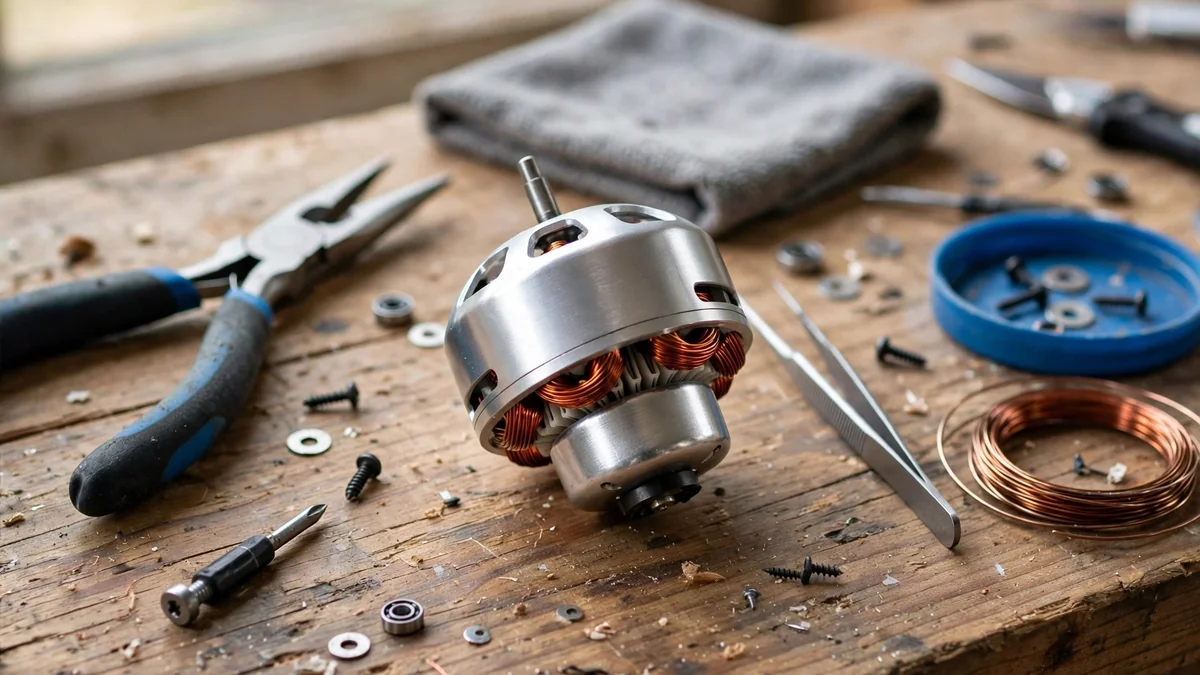
A drone motor is a study in doing more with less. It has no brushes to wear out, no gearbox, and almost no parts that touch each other while it spins. What it does have is a small set of materials, each chosen for a single job: copper to carry current, steel to guide magnetism, magnets to provide the pull, and aluminium to keep the whole thing light enough to fly.
Here is what those materials are, and why each one earned its place.
The Materials Behind the Drone Motor
1. Copper windings, where electricity becomes turning force
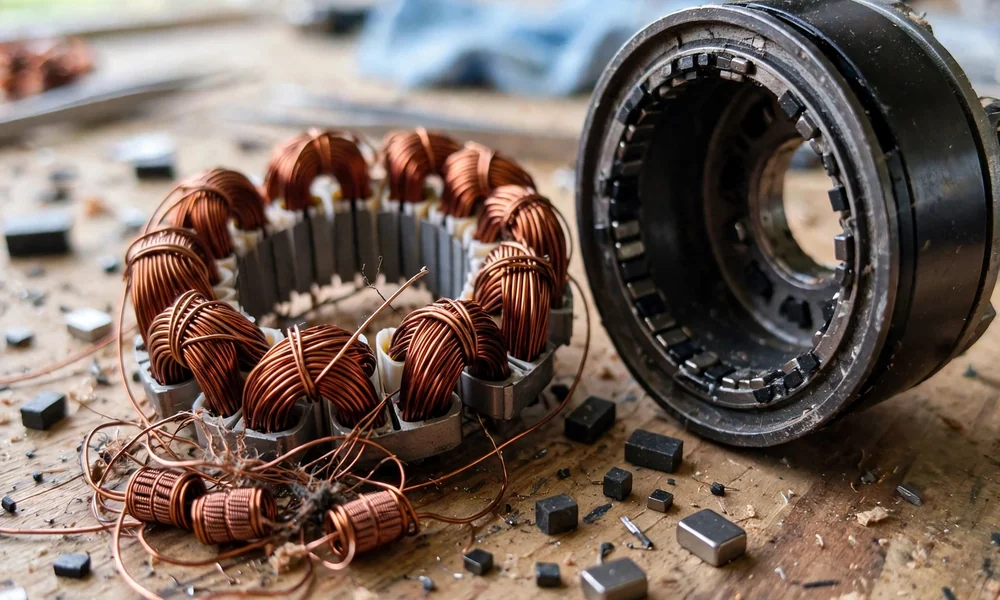
The stator, the part of the motor that stays still, is wrapped in coils of enamelled copper wire. Copper is used because no common metal carries current with less resistance, and less resistance means less of the battery’s energy wasted as heat. The wire is coated in a thin enamel insulation so that hundreds of turns can be packed side by side without shorting, and the coils are wound in a pattern that creates a rotating magnetic field as the current switches between them. The winding process is shown step by step in how a drone motor is made.
2. Neodymium magnets, the strongest pull in the smallest package
Inside the spinning bell sit the magnets, and they are the reason a motor the size of a bottle cap can lift a camera into the sky. Drone motors use neodymium magnets, an alloy of neodymium, iron and boron, the strongest permanent magnets available. A set of them, each smaller than a fingernail, provides the field that the copper coils push against. The magnets are usually coated in nickel or epoxy to protect them from corrosion, because bare neodymium rusts quickly. They have one weakness: heat. Above roughly 80 degrees Celsius, the cheaper grades start to lose strength permanently.
3. Silicon steel laminations, guiding magnetism without waste
The copper coils are wound around a core made from thin sheets of silicon steel, stacked like the pages of a book. The silicon is added to the steel to raise its electrical resistance, which cuts down the eddy currents, wasteful loops of current that would otherwise heat the core as the magnetic field flips back and forth. The sheets are stamped from coils of steel, coated to insulate them from each other, and pressed together into the stator. The numbers in the drone motor specs explained show how much efficiency comes down to this core: a badly made stator can waste a fifth of the battery’s energy as heat.
4. Aluminium bell housing, strong, light and cool
The spinning outer part of the motor, the bell, is usually machined from aluminium alloy. Aluminium is roughly a third the weight of steel, which matters when the motor has to lift itself into the air, and it is easy to machine to the tight tolerances a spinning part needs. The bell also acts as a heat sink, pulling warmth away from the magnets and bearings, and its shape is often cut with slots or fins to let cooling air through. In some racing motors the magnets are glued into pockets around the inside, held by high-temperature epoxy. The bell is balanced after machining, because even a slight imbalance makes the whole drone vibrate.
5. Steel shaft and bearings, the parts that must never wobble
Down the centre of the motor runs a hardened steel shaft, usually held by two small ball bearings. The shaft carries the propeller and takes every shock the drone meets, from hard landings to a propeller strike, so it is made from a tough alloy steel rather than the softer metals used elsewhere. The bearings are the only parts in the motor designed to touch while it spins, and they are packed with a light grease that stays put at high speed. When a drone starts to sound rough or a motor runs hot for no reason, a worn bearing is often the cause. The camera mount needs the same care, and the materials behind the drone gimbal show how it uses similar metals to stay smooth in the air.
6. Insulation, epoxy and coatings, the quiet protectors
The last materials are the ones you never see. Epoxy potting compound locks the windings in place so vibration cannot rub the enamel off the wire. A thin coating protects the stator from moisture, which matters for a machine that flies through rain and morning dew. The motor’s wires leave through a small exit sealed against dust, and the solder joints are covered so they cannot short against the carbon fibre frame. None of these materials makes the motor spin faster, but without them a motor that works perfectly on the bench can fail in a week of real flying.
Drone Motor Materials
| Material | Where it is used | Why it is chosen |
|---|---|---|
| Enamelled copper wire | Stator windings | Lowest resistance of any common metal, packs tightly |
| Neodymium-iron-boron magnets | Rotor bell | Strongest permanent magnets, tiny size, huge pull |
| Silicon steel laminations | Stator core | Guides magnetism, resists wasteful eddy currents |
| Aluminium alloy | Bell housing | Light, easy to machine, sheds heat |
| Hardened alloy steel | Shaft and bearings | Tough, resists bending, spins true at high speed |
| Epoxy and enamel coatings | Windings and joints | Locks parts in place, blocks moisture and vibration |
What Does a Drone Motor Cost?
A single drone motor is estimated at roughly $15 to $80 for a typical camera drone, depending on size and quality, while high-end racing motors can be estimated at $40 to $100 each. That is the price of the motor alone: the propellers, electronic speed controller and frame cost more again. The magnets are the most expensive raw material inside, and their price follows the rare-earth market, which is why motor prices have risen and fallen with it over the years. A cheap copy usually gives itself away with weaker magnets and looser bearings.
A Rare Fact
A racing drone motor can spin at more than 30,000 revolutions per minute, faster than a jet engine’s fan, while weighing less than a AA battery. At that speed the propeller tips move close to the speed of sound. The Kv rating printed on the motor is the clue: it tells you how many revolutions per minute the motor spins for each volt applied, with no propeller attached, and pilots use it to match motors to batteries and propellers.

A drone motor looks simple from the outside, a silver bell on a small base, but it is a balance of materials pulling in different directions. The copper wants to be thick, the magnets strong, the steel heavy, and the aluminium light. Get the balance right and the motor disappears into the flight, silent and invisible. Get it wrong and the drone tells you immediately, in heat, vibration, and short flights.