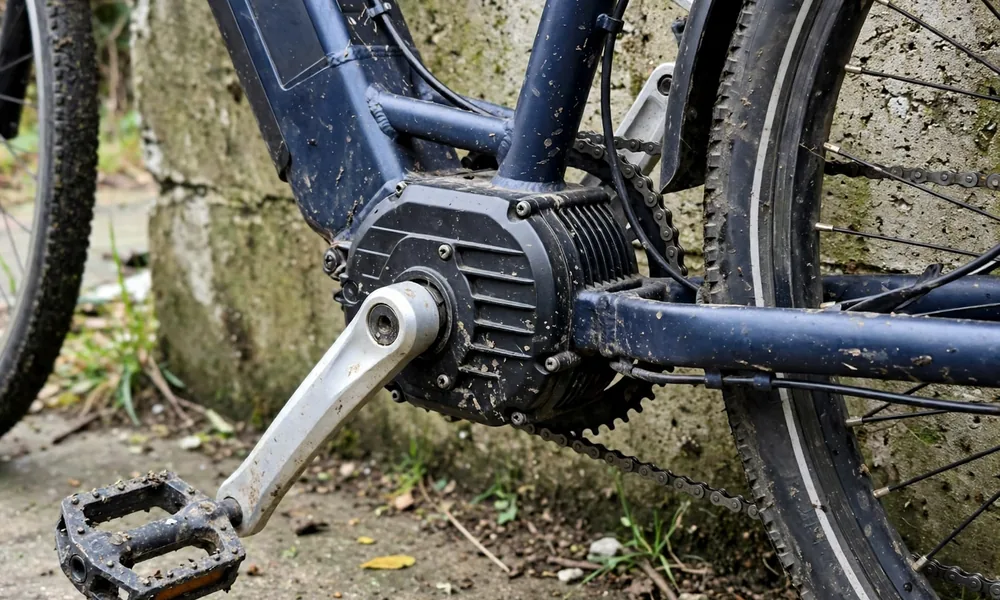
Ride an e-bike up a steep hill and you will feel the motor working, but you will not hear the part that does the hardest job. Inside the frame, between the cranks and the motor, sits a small gearbox, and it is the piece that turns a fast-spinning electric motor into slow, strong torque at the pedals.
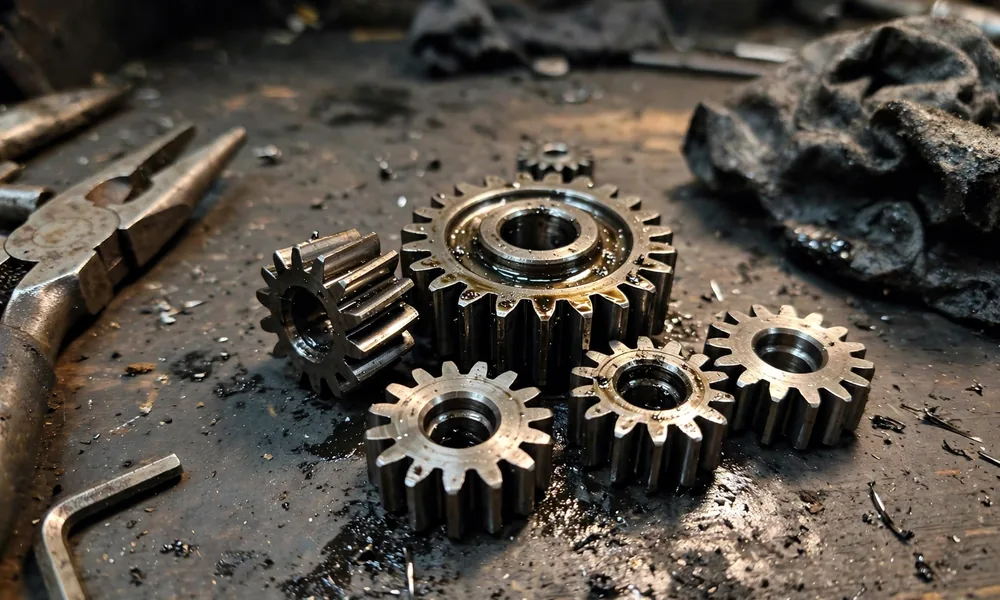
Open one up on a workbench and it looks like a watch that grew up. Tiny steel gears mesh in oil, shafts run in sealed bearings, and a cast casing holds everything in line. The materials are chosen for a brutal trade-off: the gearbox must be light enough to ride, strong enough to take a motor’s full torque, and sealed enough to keep the weather out.
Here is what those materials are, and why each one earned its place.

The Metals Inside an E-Bike Gearbox
1. Case-hardened steel gears, the teeth that take the load
The gears themselves are made from case-hardened alloy steel, usually a chromium-molybdenum grade. The teeth are hardened on the surface so they resist wear, while the core stays tough enough to absorb shock without cracking. Each gear is cut, heat-treated and then ground to a smooth finish, because a rough tooth is a noisy tooth and a noisy tooth wears fast. A motor can spin at several thousand revolutions per minute, and the gearbox has to reduce that to a pedalling speed of around ninety, so the small gears see far more revolutions than the large ones.
2. The aluminium casing, light and stiff
The casing that holds the gears is almost always cast aluminium alloy, often a silicon-rich grade that flows well into thin-walled moulds. Aluminium is chosen because it is light, it sheds heat from the motor and gears, and it can be cast into complex shapes with mounting points and cooling fins in one piece. Inside, the bearing seats are machined to exact sizes, because a bearing that sits even slightly off line will wear out in months. The casing is sealed with a gasket or a liquid sealant, and the lid is held on with stainless steel bolts.
3. Ball bearings and needle rollers, the parts that must not fail
Every shaft in the gearbox runs on bearings, and they are made from high-carbon chromium bearing steel, hardened and polished to a mirror finish. Ball bearings carry the shafts that spin fastest, while needle roller bearings are used where the space is tight and the loads are heavy. The bearings are sealed on both sides with rubber seals that keep the oil in and the mud out. A single bearing costs a few pounds, but if one seizes it can lock the whole gearbox, so manufacturers use far better bearings than the price of the part would suggest.
4. The shafts, ground steel under constant twist
The shafts that carry the gears are made from hardened alloy steel, ground to a precise diameter and often splined where the gears sit. They have to resist twisting under full motor torque, and they have to stay perfectly straight, because a bent shaft makes the gears mesh unevenly and wear on one side. Some shafts are hollow to save weight, and the best ones are polished after grinding so the seals can run on them without wearing a groove. Where a shaft passes through the casing, a rubber lip seal sits against it, and the seal only works if the shaft surface is smooth enough.
5. Grease and oil, the liquid material
The gearbox runs in a bath of synthetic grease or oil, and that lubricant is as much a material choice as any metal. It has to stay in place at high temperature, flow when cold, resist being washed out by water, and protect the gear teeth from the microscopic welding that happens when two steel surfaces rub under load. Modern e-bike gearboxes use a semi-fluid grease that clings to the teeth and seals the bearings at the same time. It is changed rarely, sometimes never, so it is made to last the life of the bike.
6. Nylon and composite gears, the quiet ones
Not every gear in the box is steel. The first reduction stage, where the motor spins fastest, often uses a gear made from glass-filled nylon or another engineering polymer. A polymer gear is far quieter than a steel one, it needs no lubrication of its own, and it acts as a fuse: if the motor jams, the nylon gear strips before the expensive steel gears or the motor itself is damaged. The trade-off is heat, because nylon softens as it warms, so the gear is sized generously and kept away from the hottest parts of the motor. It is a deliberate weak point, and replacing it is a cheap repair compared with a new motor. The metals inside an e-bike hub motor face the same trade-off between noise, weight and strength.
| Material | Where it is used | Why it was chosen |
|---|---|---|
| Case-hardened alloy steel | Gear teeth | Hard wearing surface, tough shock-absorbing core |
| Cast aluminium alloy | Gearbox casing | Light, sheds heat, casts into complex shapes |
| Bearing steel | Ball and needle bearings | Hard, polished, resists fatigue and cracking |
| Ground alloy steel | Shafts | Resists twisting, stays straight under load |
| Synthetic grease | Lubrication | Clings to teeth, resists heat and water |
| Glass-filled nylon | First-stage gear | Quiet, acts as a cheap sacrificial fuse |
What Does an E-Bike Gearbox Cost?
A gearbox is a small part of an e-bike’s price, but it is not a cheap part. A replacement gearbox unit for a mid-drive motor is estimated at roughly $200 to $600, depending on the brand and the model, and a full motor replacement can be estimated at roughly $600 to $1,200 because the gearbox is built into it. The gears themselves are the dearest pieces to make, because cutting and grinding a hardened steel gear takes time and expensive tooling. A single replacement nylon gear, by contrast, is estimated at roughly $20 to $50, which is why it is designed to fail first. Labour to open a gearbox and replace its parts is estimated at roughly $100 to $250.
A Rare Fact
The gearbox in an e-bike descends from a machine built for a very different job. The first compact reduction gearboxes of this kind were made for power tools and for the starter motors of cars, where a small electric motor also had to turn something heavy and slow. Early electric bikes in the 1990s often had no gearbox at all, and their motors were large, heavy and slow, bolted straight to the wheel. The modern mid-drive gearbox is what made the motor small enough to hide in the frame, and it is the reason an e-bike can climb a hill without looking like a motorbike.
An e-bike gearbox is a small box with a large responsibility, and its materials show it. Hardened steel takes the torque, aluminium keeps the weight down, bearing steel keeps the shafts spinning, grease keeps the teeth alive, and a humble nylon gear takes the blame when something goes wrong. The same balance of strength and lightness runs through the rest of the bike, from the gears and magnets of a mid-drive motor to the steel of e-bike disc brakes.