An electric bike can climb a steep hill without its rider breaking a sweat, yet cruise along a flat road at speed. The motor helps, but it is only half the story. The other half is a set of gears, and they decide how hard the rider’s legs work, how fast the wheels turn, and how much of the motor’s power reaches the road.
Electric bike gear systems are the mechanical parts that change the ratio between pedalling and the rear wheel. They are separate from the pedal-assist levels, which change how much help the motor gives, and from the gears inside a hub motor, which the rider never touches. The gears are what the rider shifts with a shifter on the handlebar.
Here is how e-bike gear systems work.

How Electric Bike Gear Systems Work
1. The derailleur
The derailleur is the gear system most riders know. A chain runs between a front chainring and a cassette of sprockets on the rear wheel, and the derailleur, a sprung arm with small guide wheels, pushes the chain sideways from one sprocket to another. A larger rear sprocket makes pedalling easier for climbs and starts, a smaller one lets the rider go faster. Derailleurs are light, efficient, and easy to service, with the widest range of ratios for the money. Their weakness is exposure: the chain, cassette and derailleur hang in the open, collecting mud and grit, and they need regular cleaning and adjustment. They also need the rider to be pedalling to shift. The sealed alternative is different, and the materials behind e-bike gearboxes show what that sealed alternative is made of.
2. The internal gear hub
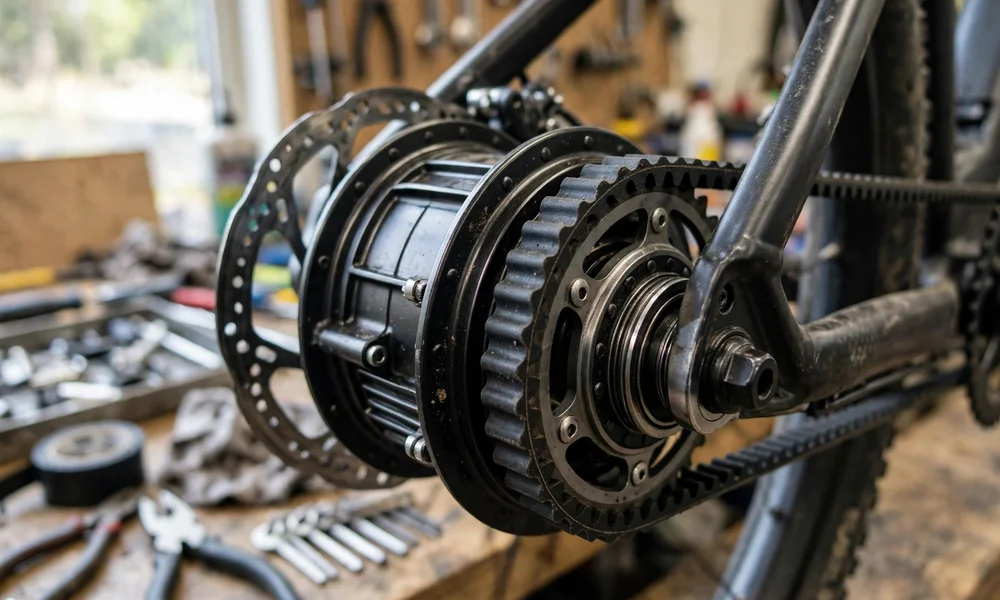
An internal gear hub hides the whole gear system inside the rear hub shell. Inside are small planetary gears that engage in different combinations to give the rider several ratios, often three, seven, eight or eleven speeds, all sealed away from rain and grit. The rider shifts with a twist grip or a trigger, and many hubs let the rider change gear while stopped. Because everything is enclosed, an internal hub needs little maintenance and pairs well with a belt drive. The trade-offs are weight and a narrower range of ratios than a derailleur, so very steep hills can be harder work.
3. The continuously variable hub
Some e-bikes have no fixed gears at all. A continuously variable hub, such as the Enviolo system, changes the gear ratio smoothly across a range instead of stepping between numbered gears. Inside the hub, steel balls tilt between two discs, and the angle decides the ratio. The rider twists a grip and the ratio slides up or down without any click or jump, and automatic versions hold a steady cadence by adjusting the ratio as speed changes. The range is narrower than a derailleur, roughly 380 percent from lowest to highest, and the system loses a little more energy to friction, but for commuting it is the simplest system to live with.
4. The gearbox
The newest gear systems move the gears out of the rear wheel and into the frame itself. A gearbox unit, such as the Pinion MGU, combines the electric motor and a twelve-speed gearbox in a single sealed unit at the bottom bracket, where the pedals are. The motor’s power and the rider’s pedalling both pass through the same hardened steel spur gears, giving a gear range of around 600 percent, wider than a derailleur, with the weight carried low and central in the frame. The rider shifts electronically, even under full motor torque and even at a standstill, and the whole unit is sealed against mud and water. The cost is a frame built specially around the unit. The motor matters just as much, and the materials behind e-bike hub motors show how the other common motor layout is built.
5. Mid-drive versus hub motor
Where the motor sits changes what the gears do, and the two layouts behave very differently. On a mid-drive e-bike, the motor drives the crank, so its power passes through the chain and the gears just like the rider’s legs do. Change gear and you change how the motor’s power reaches the wheel too, which is why mid-drive bikes climb so well. On a hub-motor e-bike, the motor drives the wheel directly, independent of the chain, so shifting changes only the rider’s pedalling effort. A hub-motor bike can therefore use simpler gears, or even a single speed, and still climb with motor power alone.
6. The belt drive
A belt is not a gear system, but it changes how gear systems behave. A carbon-reinforced rubber belt replaces the chain, running silently, without oil, and lasting far longer, often tens of thousands of kilometres. Belts cannot be shifted across sprockets like a chain, so they pair only with internal gear hubs, continuously variable hubs, gearboxes, or single-speed setups, never with a derailleur. For a commuter who wants a clean, low-maintenance bike, a belt with an internal hub is the most popular combination today. It costs more up front and needs a frame with a split in the rear triangle, but the rider never cleans a chain again. The power comes from the battery, and the materials behind e-bike batteries explain what stores that energy.
Electric Bike Gear Systems, at a Glance
| Gear system | How it works | Best for |
|---|---|---|
| Derailleur | Chain moves across cassette sprockets | Wide range, light, easy service |
| Internal gear hub | Planetary gears sealed in the rear hub | Low maintenance, shifts at a standstill |
| Continuously variable hub | Tilting balls change ratio smoothly | Commuting, no steps, auto cadence |
| Gearbox (Pinion MGU) | Motor and 12-speed gears in one unit | Widest range, sealed, shifts under load |
| Single-speed | One fixed ratio | Flat cities, simplest bike |
| Belt drive | Carbon belt replaces the chain | Clean, quiet, long life |
What Does an Electric Bike Gear System Cost?
Gear systems span a wide price range. A derailleur setup is the cheapest, with a complete drivetrain estimated at roughly $100 to $400, and replacement parts are inexpensive and available everywhere. An internal gear hub raises the cost to an estimated $300 to $1,000, while a continuously variable hub sits in a similar range. A gearbox unit such as the Pinion MGU is the most expensive option, adding an estimated $1,500 or more to the price of the bike, and it needs a dedicated frame. The running costs reverse the order: a derailleur needs chains and cassettes replaced regularly, while a sealed hub or gearbox with a belt can run for years with little more than an oil change.
A Rare Fact
The derailleur, the most common gear system on e-bikes, was once banned from professional racing. When it appeared in the early twentieth century, race organisers considered it cheating, and the Tour de France did not allow derailleurs until 1937. Riders had to stop, remove the rear wheel, and flip it around to use the second sprocket. The internal gear hub is even older, with the first three-speed hub patented in 1902. The e-bike gearbox, the newest system of all, is the oldest idea returning: putting the gears in a sealed box at the centre of the bike.

An e-bike’s gears do not make it go, the motor does that. What they do is decide how the rider’s legs and the motor’s power work together. A derailleur gives range and lightness for the price of maintenance. A hub gives simplicity for the price of weight. A gearbox gives everything at once for the price of a dedicated frame. There is no single best system, only the one that matches the motor, the terrain, and the rider’s patience for a chain.


