The ship is moving at four knots through ice a metre thick, and it is not slowing down. Ahead of the bow, the white sheet cracks with a sound like distant thunder, great slabs tilting up and sliding aside as the hull rides up onto the ice and crushes it with its own weight.
That margin is the hull, and an icebreaker hull is unlike any other ship hull on the water. It is not shaped to slip through the sea cleanly; it is shaped to climb onto ice and break it, to shrug off the crushing pressure of frozen seas, and to keep the propellers and rudder safe when the ice closes in behind.
The numbers behind that toughness are what this guide explains — steel thickness, ice class, hull shape, frame spacing and the power that drives the whole ship through the frozen sea.

How an Icebreaker Hull Works
Step 1: The spoon bow rides up onto the ice
An icebreaker bow is rounded and sloping, like a spoon, where a normal ship bow is sharp and upright. When the ship meets the ice, the sloping bow slides up onto the sheet instead of smashing into it edge-on, and the ship’s weight presses down until the ice bends and snaps. The stem angle — the angle of the bow against the water — is about 25 to 30 degrees on a modern icebreaker, compared with nearly vertical on a cargo ship. This spoon shape is the single most important feature of the whole ship, because it turns the icebreaker’s weight into the tool that breaks the ice.
Step 2: The ice belt takes the punishment
Around the waterline runs the ice belt, a band of extra-thick steel plating that wraps the hull where it meets the ice. On a polar icebreaker the ice belt plating is about 35 to 50 millimetres thick, roughly twice the thickness of the same area on a normal ship of the same size, and it extends from about a metre above the waterline to a couple of metres below it. Behind the plating, the frames are spaced much closer together than on a normal ship — about 400 to 600 millimetres apart — so an impact is shared across many frames instead of denting a single panel. The same obsession with hull strength drives the design of other heavy hulls, as described in our guide to container ship hull specs.
Step 3: Ice class sets the rules
Icebreakers are rated by ice class, a set of rules written by classification societies that says exactly how thick the steel must be and how strong the ship must be for a given ice thickness. The highest class, Polar Class 1, is for ships that can work year-round in the thickest Arctic ice, while Polar Class 7 covers summer operation in thin first-year ice. Each step up in class means thicker steel, stronger frames, more power and a heavier ship. The class also sets the design ice thickness the hull must survive — from about 0.7 metres for the lightest class to 3 metres and more for the heaviest.

Step 4: The hull shape fights ice pressure
Breaking ice from the front is only half the job. When the wind and currents push the ice together, it can squeeze a trapped ship with enormous pressure, and many early polar ships were crushed exactly this way. An icebreaker hull is therefore rounded in cross-section, with sloping sides, so that pressure from the sides pushes the ship up out of the ice instead of crushing it inwards. The ship literally pops up like a seed squeezed between two fingers. The materials that make this possible are covered in our guide to icebreaker hull materials engineering.
Step 5: Propellers and rudders hide from the ice
Propellers are the most vulnerable part of an icebreaker, because a spinning blade meeting a block of ice can shatter. Icebreakers protect them in three ways: the propellers sit in nozzles or tunnels, the rudder is mounted behind a reinforced skeg, and the propeller blades themselves are made from extra-thick stainless steel or nickel-aluminium bronze. Many modern icebreakers use azimuth thrusters — pods that can rotate 360 degrees — which can be turned to push ice away from the blades. A broken propeller in the Arctic can end an expedition, so the protection around it is designed as carefully as the bow. Steering loads on a big ship are a story of their own, as our guide to ship rudder specs explains.
Step 6: Power turns weight into icebreaking
All of this steel is useless without power. A large polar icebreaker needs about 30,000 to 60,000 kilowatts of propulsion power — roughly ten times the power of a cargo ship of the same size — delivered by diesel-electric or nuclear propulsion. Nuclear icebreakers, operated only by Russia, can run for years without refuelling and carry the most powerful icebreaking plants on Earth, with the largest rated at about 60,000 kilowatts.
Icebreaker Hull Specs
| Specification | Typical range |
|---|---|
| Ice belt plating | About 35 to 50 mm thick on a polar icebreaker |
| Stem angle | About 25 to 30 degrees from the waterline |
| Frame spacing | About 400 to 600 mm in the ice belt |
| Ice class | Polar Class 1 to 7, by design ice thickness |
| Design ice thickness | About 0.7 m light class, 3 m and more heavy class |
| Propulsion power | About 30,000 to 60,000 kW for a large polar ship |
| Icebreaking speed | About 3 to 4 knots through 2 m of ice |
| Hull steel | High-strength steel tough to minus 40 degrees Celsius |
What Does an Icebreaker Hull Cost?
A new polar icebreaker is estimated to cost roughly $500 million to $1.5 billion, with the hull steel and ice strengthening accounting for a large share of the price, while a medium icebreaker for seasonal work is estimated at $200 million to $500 million. Prices are estimates only and vary by size, ice class and propulsion type. Replacing a damaged section of ice belt plating in dry dock is estimated at $1 million to $5 million depending on the area, and a full hull recoating with ice-resistant paint is estimated at several million dollars.
A Rare Fact
The most powerful icebreaker ever built is the Russian nuclear icebreaker Arktika, launched in 2016, which can break ice more than 3 metres thick and carries two nuclear reactors producing about 60,000 kilowatts of propulsion power. But the strangest icebreaking fact belongs to the past: in 1899 the Russian icebreaker Yermak, the first true polar icebreaker, was designed by Admiral Stepan Makarov after he studied how the rounded hull of the Norwegian ship Fram survived being frozen into the Arctic ice for three years.
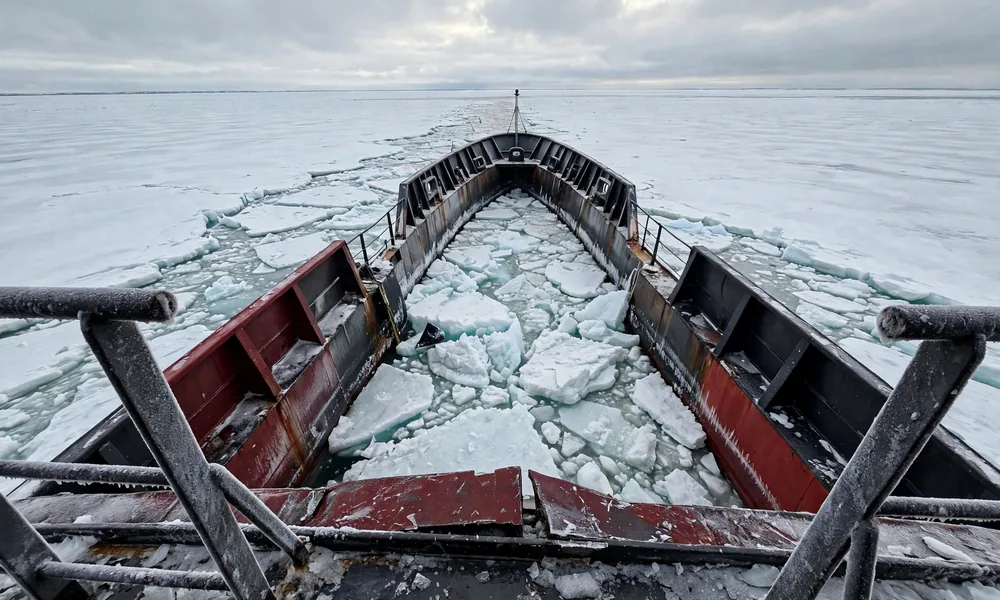
An icebreaker hull is a machine for turning a ship’s own weight into a hammer. Its spoon bow climbs the ice, its ice belt shrugs off the scraping, its rounded sides refuse to be crushed, and its power plant keeps the whole mass moving at a walking pace through a frozen sea. The numbers — steel thickness, ice class and power — are the difference between a ship that works all winter in the Arctic and one that waits in port for spring.


