The wind has picked up to twenty knots and the genoa is pulling like a truck. On the cockpit coaming, one crew member is leaning into a winch handle, turning it in short, steady cranks, while another tails the sheet — feeding the rope in as the drum takes it up. Each crank moves the sail only a few centimetres, but the load on the line is enormous, hundreds of kilos of wind pressure, and nobody on board is holding it with their bare hands. A small drum of polished metal is doing the work.
That drum is the winch, and it is the muscle of every sailing yacht. A winch turns a load no sailor could ever hold into something one person can manage with a handle and a bit of patience.
Winches look simple, but their numbers decide whether a yacht is easy to sail or a wrestling match. This guide explains them one by one — drum size, gear ratios, power ratios, load ratings and the difference between a winch that helps you and one that fights you.

How a Yacht Winch Works
Step 1: The drum grips the rope
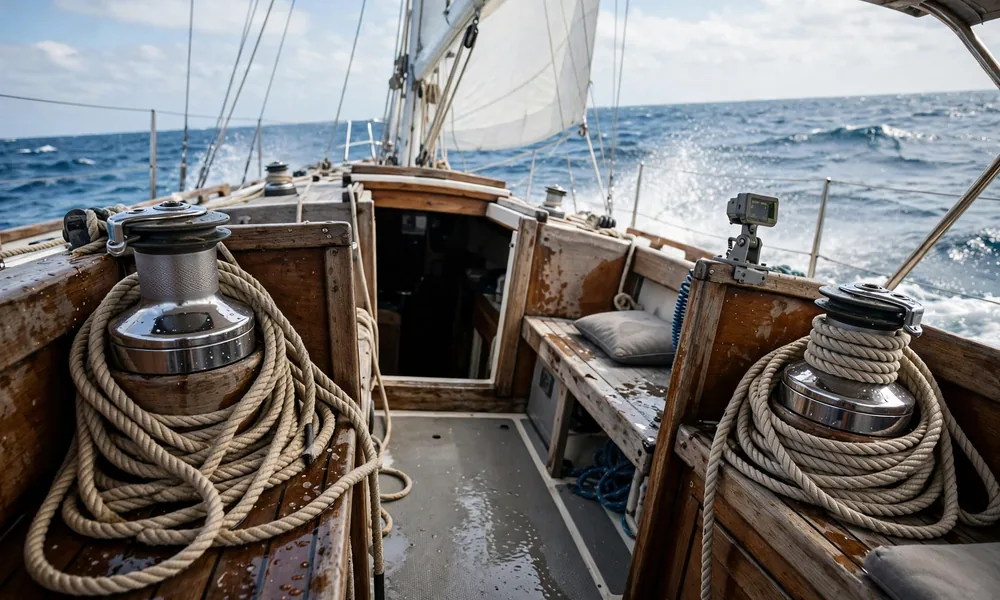
The heart of a winch is its drum, a polished cylinder that the rope wraps around three or four times. The wraps create friction, and that friction is what lets the drum hold the load: each wrap multiplies the grip, so a rope under hundreds of kilos of tension can be held by a tailing hand pulling with only a few kilos of force. Drums are usually made from hard-anodised aluminium or chrome-plated bronze, and their surfaces are ribbed or grooved so the rope bites without slipping. On a typical 12-metre cruising yacht the main sheet winches have drums about 90 to 110 millimetres across, while a large racing yacht can carry drums of 150 millimetres or more.
Step 2: Gears multiply your effort
Inside the drum sits a set of gears, and the gear ratio is the winch’s most quoted number. A two-speed winch has a low gear for fast winding when the load is light and a high gear for slow, powerful hauling when the sail is nearly in. Typical ratios run from about 1:1 in first gear to 1:15 or more in second gear, meaning fifteen turns of the handle produce one turn of the drum. Three-speed winches add a middle ratio for the awkward in-between loads. The trade is always speed for power: the higher the gear, the slower the rope comes in.
Step 3: The power ratio tells the truth
Gear ratio alone does not tell you how strong a winch feels, because the handle length and drum size matter too. The power ratio combines them all into one number: how many kilos of load one kilo of handle effort can hold. A typical cruising winch has a power ratio of about 25:1 to 45:1, while large racing winches reach 60:1 or more. That means a sailor pushing with 10 kilos of force on the handle can hold 450 kilos of sail load. Our guide to yacht sail rigging specs explains how those loads get from the sail to the winch in the first place.

Step 4: The self-tailer holds the line
Modern winches are almost all self-tailing, which means the winch itself grips the rope after it leaves the drum. A spring-loaded jaw at the top of the drum clamps the tail, so the crew member can crank with both hands and the rope stays put when they stop. Before self-tailers, a second person had to tail the line — pulling the slack in by hand while the first person cranked. The self-tailer turned winching from a two-person job into a one-person job, which is why short-handed sailing is practical today.
Step 5: Working load and breaking load
Every winch carries two load ratings, and confusing them is a common mistake. The working load limit is the maximum pull the winch is designed to handle in everyday use — about 1,000 to 2,000 kilos for a typical cruising yacht winch — while the breaking load is the force at which something fails, usually about twice the working load. Sails, sheets and fittings are all sized from the working load, with a safety factor built in. A genoa sheet on a 12-metre yacht in 25 knots of wind can easily load a winch to 800 kilos, which is why undersized winches are one of the most common complaints on older boats.
Step 6: Electric and hydraulic winches
On larger yachts the winch handle gives way to a button. Electric winches use a motor built into the drum base, and hydraulic winches run off the yacht’s central hydraulic system, and both let a single sailor trim sails that would otherwise need a whole crew. Electric winches typically draw 50 to 100 amps at 12 volts under full load, so they need heavy cabling and a healthy battery bank. They are slower than a strong crew member on the handle, but they never get tired. The same relentless loads that winches manage also act on the yacht’s ground tackle, as described in our guide to yacht anchor system specs, and on the bow thruster that pushes the boat sideways in a marina, as covered in our guide to yacht bow thruster specs.
Yacht Winch Specs
| Specification | Typical range |
|---|---|
| Drum diameter | About 90 to 110 mm on a 12-metre cruiser |
| Gear ratio, first gear | About 1:1 to 1:3 |
| Gear ratio, second gear | About 1:8 to 1:15 |
| Power ratio | About 25:1 to 45:1 cruising, 60:1 and above racing |
| Working load limit | About 1,000 to 2,000 kg on a cruising yacht |
| Drum material | Hard-anodised aluminium or chrome-plated bronze |
| Self-tailer rope range | About 8 to 14 mm diameter |
| Winch type | Manual two-speed, three-speed, electric, or hydraulic |
What Does a Yacht Winch Cost?
A manual two-speed winch for a 12-metre cruising yacht is estimated to cost roughly $800 to $2,500, while a large racing winch is estimated at $3,000 to $8,000 or more. An electric winch of the same size is estimated at $3,000 to $7,000 including the motor and controls, plus the cost of heavy cabling and installation. Prices are estimates only and vary by size, brand and materials.
A Rare Fact
The largest winches ever fitted to a sailing yacht are the coffee grinders of the America’s Cup, pedestal winches turned by two crew members cranking handles like an old-fashioned coffee mill. On the AC75 foiling yachts, the grinders generate hydraulic power rather than pulling ropes directly, and a crew of grinders can produce more than a kilowatt of power — about the same as a small household generator — for the length of a race.
The winch is the most used piece of machinery on a sailing yacht and the least thought about until it fails. It takes the impossible loads of a sail in a strong wind and turns them into a handle a single person can turn. Its numbers — drum size, gear ratio and power ratio — are the difference between a yacht that is a pleasure to sail and one that leaves the crew exhausted after every tack. Choose the winch by the loads, service it once a year, and it will quietly do the hardest job on the boat.


