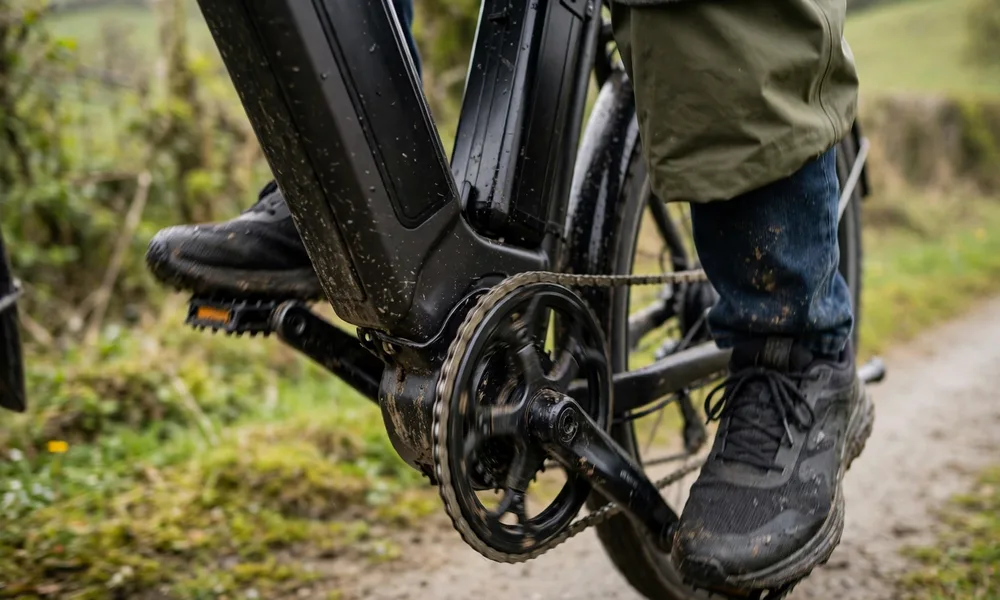
Push gently on the pedals of a good e-bike and the motor helps gently. Stand up and stamp on them to climb a hill, and the motor surges with you, matching your effort exactly, as if reading your mind. It cannot read your mind, but it can read your feet: a torque sensor in the bottom bracket measures how hard you are pedalling, hundreds of times a second, and tells the motor precisely how much help to give.
That little sensor is the difference between an e-bike that feels like a bicycle with a tailwind and one that feels like a moped with pedals attached for decoration. Get it right and the assistance is invisible, arriving the instant your muscles ask and fading the moment you ease off. Get it wrong and the motor surges, lags, or kicks in while you coast. The materials inside that sensor decide which bike you get.

The Materials Behind the Torque Sensor
At the heart of most torque sensors sits a strain gauge, a zigzag of copper-nickel foil bonded to a steel spindle or crank spider, so thin it stretches with the metal beneath. When you press the pedals, the spindle twists by a fraction of a degree, the foil stretches, and its electrical resistance changes by a tiny amount the bike’s controller can read. The foil is made from constantan, a copper-nickel alloy chosen because its resistance barely changes with temperature, so a hot climb and a freezing morning read alike.
The foil is bonded to the steel with an epoxy adhesive that must hold through millions of pedal strokes without creeping or cracking, and the gauge is sealed under a silicone coating that keeps out rain, mud and road salt. The signal travels through fine enamelled copper wires to a small circuit board, where it is amplified and sent to the motor controller, and the sensor housing is a machined aluminium or steel shell shielding the delicate gauge from knocks. Some designs skip the gauge and use a magnetic sensor instead, reading the twist of a magnetised steel shaft, but the materials logic is the same: measure a tiny mechanical change without ever touching the moving part. The same obsession with measuring force precisely shapes the rest of the bike, from the motor answering the sensor, as in an e-bike mid-drive motor, to the battery powering it, as in an e-bike battery.
How It Is Made
Building a torque sensor is instrument-making on a bicycle budget: foil thinner than paper, bonded to steel, sealed against the weather. The process runs roughly like this.
- Machine the spindle. A steel bottom-bracket spindle or crank spider is machined and ground, with a flat polished area for the gauge.
- Etch the gauge. Constantan foil is etched into a fine zigzag on a thin polyimide backing, forming the strain gauge, then trimmed to size.
- Bond the gauge. The gauge is glued to the steel with epoxy under pressure, then oven-cured so the bond survives millions of flexes.
- Wire the bridge. Fine copper wires are soldered to the gauge to form a Wheatstone bridge, the circuit turning a tiny resistance change into a readable voltage.
- Seal the assembly. Gauge and wires are coated in silicone and fitted into the machined housing, with a gasket keeping water and grit out.
- Calibrate under load. Each finished sensor is twisted with known torques on a test rig and its output recorded, and any sensor drifting or reading unevenly is rejected.

Why These Materials Win
Constantan wins because temperature stability is everything outdoors: an alloy whose resistance drifts with heat would make the motor surge on a summer climb and go quiet in the cold. Steel wins for the spindle because it twists predictably and returns to shape millions of times without fatiguing, and polyimide wins as the gauge backing because it is thin, tough and immune to curing-oven heat. Silicone wins for sealing because it stays flexible from freezing mornings to baking afternoons, and copper wins for wiring because the signals are so faint that any extra resistance would bury them in noise.
The failures are instructive, too. An epoxy bond that creeps makes the sensor read torque that is not there, so the motor helps while you coast. A cracked silicone seal lets road salt reach the gauge and corrode the foil, and a wire chafed by vibration breaks the bridge and silences the sensor. Engineers fight all three with better adhesives, seals and cable routing, and the result survives years of rain, mud and potholes. It is the same materials logic that shapes the rest of the drivetrain: the sensor must be tough yet sensitive, which is why a regenerative braking system relies on the same kind of precise force measurement, with every material chosen to keep a tiny signal clean in a dirty world.
Specifications
| Specification | Detail |
|---|---|
| Sensor type | Strain gauge or magnetic torque sensor |
| Gauge foil | Constantan copper-nickel alloy on polyimide |
| Spindle | Heat-treated steel, ground and polished |
| Adhesive | Epoxy, oven cured under pressure |
| Sealing | Silicone coating with gasketed housing |
| Housing | Machined aluminium or steel shell |
| Measurement range | 0 to 100 newton-metres |
| Sampling rate | 100 to 1,000 samples per second |
Price
An e-bike torque sensor is one of the cheapest parts in a mid-drive e-bike, yet priced like a precision instrument. Replacement bottom-bracket torque sensors for popular e-bikes typically sell as spare parts for around $40 to $120 (estimate), while the sensor inside a new bike is estimated to cost only a few tens of dollars at volume (estimate). The real expense is not the materials but the calibration: every sensor is twisted with known torques on a test rig before it leaves the factory, because one inaccurate sensor would make an expensive e-bike feel broken. That testing is why a good e-bike still reads your pedalling after years of daily rides.
Rare Fact
The strain gauge inside a torque sensor can detect the steel spindle twisting by less than a thousandth of a degree, a movement smaller than a bacterium, by measuring a change in electrical resistance of less than one part in a thousand. The same kind of gauge, invented in the 1930s, still weighs aircraft, tests bridges and measures rocket thrust, because no other sensor is as simple, cheap and reliable at turning a tiny stretch of metal into a number. On your e-bike, that number tells the motor exactly how hard you are working, a thousand times a second, without you ever knowing it is there.
That is the hidden craft of the e-bike torque sensor: a foil thinner than paper, glued to steel, reading twists too small to see, all sealed inside a shell that shrugs off rain and mud. You never see it, yet it is the part of your e-bike that makes the motor feel like an extension of your own legs.


