Stand on the foredeck of a ship as the anchor goes down and you will feel the whole vessel shudder. The chain runs out through the hawse pipe in a rush of black steel, link after link, until the anchor bites and the chain goes taut. At that moment the chain is holding thousands of tonnes of steel against wind and current, and it is doing it with nothing but its own weight and strength.
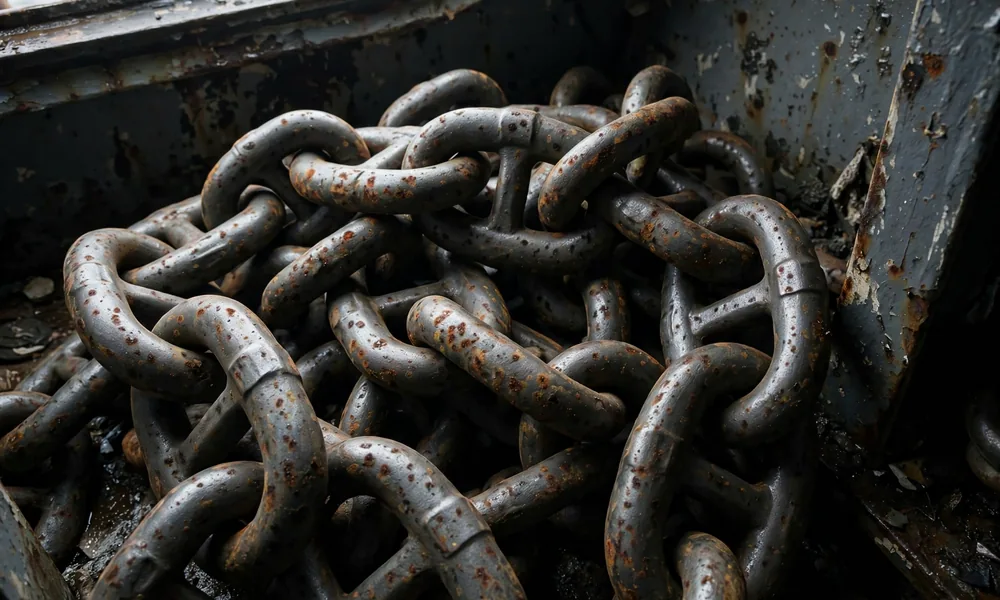
An anchor chain is not a rope that happens to be made of metal. It is a precision-made chain of forged steel links, each one tested, measured and marked, and it has to survive being dragged across rock, buried in mud, soaked in salt water and then hauled back up again, voyage after voyage.
Here is what those materials are, and why each one earned its place.

The Steel That Holds a Ship
1. High-tensile steel, the links themselves
Anchor chain links are made from high-tensile alloy steel, usually a manganese or chromium-molybdenum grade, chosen for strength and toughness rather than hardness. Each link is formed from a bar of steel, bent into an oval and flash-butt welded shut, then heat-treated to relieve the stress of welding. The steel has to be tough enough to bend slightly under a sudden load rather than snap, because a chain that is too hard shatters. The links are made in grades, and the higher the grade the stronger the chain for the same size: a Grade 3 chain, known as U3, is roughly twice as strong as a Grade 1 chain of the same diameter.
2. The stud, the bar that stops the links collapsing
Look closely at a ship’s anchor chain and you will see a bar across the middle of every link. That is the stud, and it is what makes it a stud-link chain. The stud is a piece of steel pressed into the link after forming, and it stops the link from collapsing sideways under load and keeps the chain from tangling in the locker. It also adds weight, and weight is useful: a heavy chain lies along the seabed and holds the anchor at a shallow angle, which is what makes the anchor dig in. The steel of a ferry hull faces the same sea, but it never has to hold the whole ship by itself.
3. Zinc and bitumen, the coatings that fight rust
Fresh from the forge, anchor chain is protected against rust, usually by hot-dip galvanising or by a coating of bitumen and paint. Galvanising dips the chain in molten zinc, which bonds to the steel and corrodes first, sacrificing itself to protect the links. Bitumen coatings are cheaper and common on large chains, painted on thick and renewed when the chain is surveyed. Neither coating lasts forever: the chain is dragged over the seabed every time it is used, and the coating is scraped off link by link.
4. The shackles and swivels, the joints in the chain
A chain is not one endless length. It is made in shots, usually 27.5 metres long, joined by detachable shackles called Kenter shackles, and the anchor itself is joined by a swivel that stops the chain twisting. The shackles are forged from the same high-tensile steel as the links, and the swivel is a heavy steel body with a tapered pin and a lead seal. These joints are the weakest points in the system, so they are inspected more often than the links and replaced sooner. Each shackle is stamped with its size and grade, and the stamps are how a surveyor knows the chain is what the papers say it is.
5. The windlass and the chain locker, the machinery around the chain
The chain is only half the system. The windlass that hauls it is built from cast steel and ductile iron, with a wildcat, a toothed wheel that grips the links and pulls them in. The wildcat has to match the chain exactly, link for link, or it will jam or jump, and a jumping chain can injure a crewman. Below deck, the chain locker is a steel compartment lined with cement or bitumen, where the chain piles up as it comes aboard. The locker is drained and ventilated, because a locker full of wet chain and mud is a perfect place for corrosion to start.
6. The anchor itself, cast steel and a sharp fluke
The chain ends at the anchor, and the anchor is usually cast steel, sometimes with a forged steel shank and a cast fluke. The fluke is the flat blade that digs into the seabed, and its edge has to be hard enough to bite into clay and sand but tough enough not to snap on rock. Modern anchors are designed by computer and tested in tanks, but the material is old-fashioned: heavy, tough steel, cast in one piece where possible, because a weld in an anchor is a place for a crack to start.
| Material | Where it is used | Why it was chosen |
|---|---|---|
| High-tensile alloy steel | Chain links | Strong and tough, bends rather than snaps |
| Stud steel | Crossbar in each link | Stops collapse and tangling, adds holding weight |
| Zinc and bitumen | Protective coatings | Zinc sacrifices itself, bitumen seals out water |
| Forged steel | Shackles and swivels | Strong joints that can be repaired on deck |
| Cast steel and ductile iron | Windlass and locker | Resists abrasion from the moving chain |
| Cast steel | The anchor | Heavy and tough, digs in without cracking |
What Does a Ship Anchor Chain Cost?
Anchor chain is sold by weight, and a large ship carries a great deal of it. A full outfit of chain for a medium cargo ship, around 300 metres of 76-millimetre chain, is estimated at roughly $100,000 to $250,000, depending on the grade and the price of steel. The chain itself is estimated at roughly $3 to $6 per kilogram, and a single shot of 27.5 metres can weigh several tonnes. A replacement anchor is estimated at roughly $10,000 to $50,000, and a new windlass can be estimated at roughly $50,000 to $200,000. Chains are surveyed every few years, and a chain is retired when its links have lost about 10 to 12 percent of their diameter to wear and corrosion.
A Rare Fact
The anchor chain has a language of its own. The shots of chain are joined by shackles, and the shackles are painted in different colours so the crew can tell how much chain is out without measuring it: the first shackle might be painted white, the second red, and so on. Old sailors also tied coloured rags to the links for the same reason. The chain is marked in shots because a ship’s anchor watch is judged by how much chain is paid out, and in a storm the difference between five shots and six can be the difference between holding and dragging.

An anchor chain is a simple thing made with great care, and its materials show it. High-tensile steel takes the load, the stud keeps the links true, zinc and bitumen hold the rust back, and the shackles and windlass make the whole system workable at sea. The same demand for steel that can be trusted runs through the rest of the ship, from the materials of a deep-sea submersible to the steel that lands jets on an aircraft carrier.


