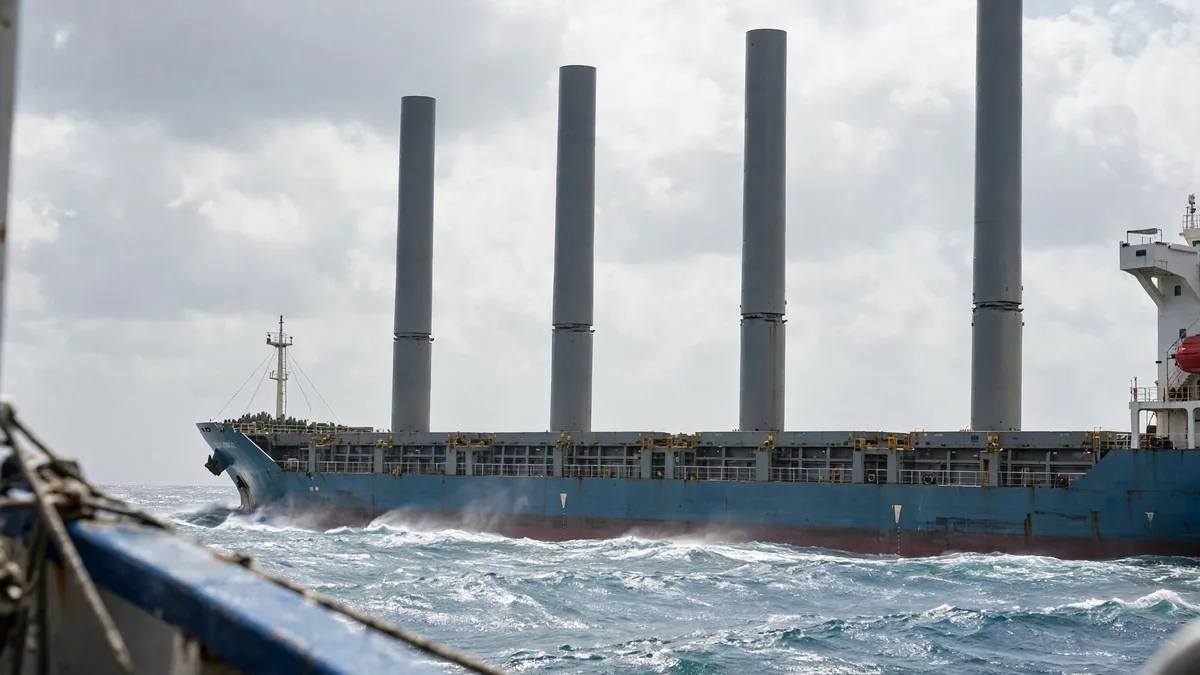
From the shore, the ship looks wrong. Where a mast and sail should be, there are four tall cylinders standing on the deck, spinning slowly like the drums of a washing machine stood on end. There is no canvas, no rigging, nothing that looks like it could catch the wind. Yet the ship is moving faster than its engines alone should allow, and the crew will tell you that those spinning tubes are doing real work — pushing the vessel forward, saving fuel, and cutting its emissions on every crossing.
Those cylinders are rotor sails, and they are one of the oldest new ideas in shipping. They use a quirk of physics discovered a century ago, were tried and largely forgotten, and have now come back because fuel is expensive and the rules on shipping emissions are tightening. A rotor sail does not look like a sail, and it does not work like one, but it does the same job: it turns wind into forward thrust, for free, using nothing but a spinning tube and the air moving past it.
The Spinning Tube That Pulls a Ship
The secret of the rotor sail is a phenomenon called the Magnus effect, named after the German physicist who described it in the 1850s. When a cylinder spins in a flow of air, it drags some of the air around with it. On one side of the cylinder, the spinning surface moves with the wind, and the air speeds up; on the other side, the surface moves against the wind, and the air slows down. Faster air means lower pressure, slower air means higher pressure, and the difference pushes the cylinder sideways — at right angles to the wind.
That sideways push is the whole trick. Mount the cylinder vertically on a ship, spin it the right way, and the push points forward, along the ship’s course, adding to the thrust of the propeller. Spin it the other way, and the push reverses. The crew, or more often an automated control system, adjusts the speed and direction of each rotor to match the wind, so the thrust is always helping rather than hindering. It is a sail in the sense that it harvests the wind, but the mechanism is entirely different from canvas: there is no cloth to tear, no boom to swing, and nothing to trim by hand.
How the System Works in Practice
A modern rotor sail is a tall steel or composite cylinder, typically twenty to thirty metres high and three to five metres across, mounted on a bearing that lets it spin freely. An electric motor inside drives the rotation, and the power it draws is small compared with the thrust it produces — a good rotor can return many times more propulsive energy than it consumes in spinning.
What They Save, and What They Cost
The fuel saving from rotor sails depends on the route, the ship, and the weather, which is why honest figures come as a range rather than a single number. On a windy ocean crossing, a well-fitted ship can save five to ten percent of its fuel; on calmer routes, the saving is smaller, perhaps two or three percent. For a fleet of ships, the savings add up to real money and a real reduction in emissions, which is exactly what regulators and cargo owners are now asking for.
The comparison with other wind technologies is instructive. A traditional sail is cheaper but needs crew and deck space; a kite sail can fly high where the wind is stronger, but it is harder to control. Rotor sails sit in the middle: more expensive than canvas, far easier to operate, and proven at the scale of a large commercial ship. They are part of a broader rethink of how ships are pushed through the water, a subject that also covers the propellers and thrusters below the hull, including the systems explained in the guide to the main ship propulsion systems. Above the deck and below it, the same question applies: how do you get the most thrust from the least fuel?

Different Shapes for Different Ships
Not every rotor sail looks the same. The classic version is a smooth cylinder with a disc on top, but newer designs vary the shape to suit the ship. Some are shorter and fatter, for vessels where height is limited by bridges or port cranes. Some are tiltable, folding down to deck level when the ship needs to pass under a low bridge or load cargo over the side. Some are made from lightweight composites rather than steel, to keep the weight low and the centre of gravity down, which matters on a ship that already carries a heavy cargo.
Where You Will See Them Next
Rotor sails are appearing first on the routes where the wind is most reliable: the North Atlantic, the North Sea, and the long bulk trades that cross open ocean. Steering still relies on the rudder below the waterline, as explained in the guide to how a ship rudder works. Bulk carriers, which carry grain, ore, and coal in huge holds, are natural candidates, because they have open decks and steady speeds. Tankers are following, and ferries on windy crossings are fitting them too. As more ships report their results, the uncertainty that held operators back is fading, and the question is shifting from whether rotors work to where they work best.
The rotor’s closest relatives on a ship are the propellers and rudders below the waterline, and the same care that goes into choosing those applies above deck too. A propeller that is well matched to its hull can save as much fuel as a rotor, which is why the guide to how a submarine propeller works is worth reading alongside this one: the physics is different, but the discipline is the same, squeezing thrust out of every available flow of air or water.
An Old Idea, Back at the Right Time
The rotor sail will not replace the engine, and nobody serious claims it will. What it does is simpler and more useful: it takes a free resource, the wind, and turns a small part of it into forward motion, day after day, without fuss. On a ship that burns fuel by the tonne, a few percent is a lot. On a planet that needs shipping to clean up, it is a step in the right direction — delivered by a spinning tube that looks like nothing at all, and works like a quiet miracle.

Next time you see a ship with tall cylinders on its deck, you will know what you are looking at. Not a chimney, not a tank, not a piece of cargo, but a sail — a sail that spins, that needs no canvas and no crew on deck, and that pushes a steel mountain through the sea with nothing more than the wind and a century-old piece of physics. The rotor sail is a reminder that the best ideas in engineering are often the ones that were there all along, waiting for their moment to come round again.