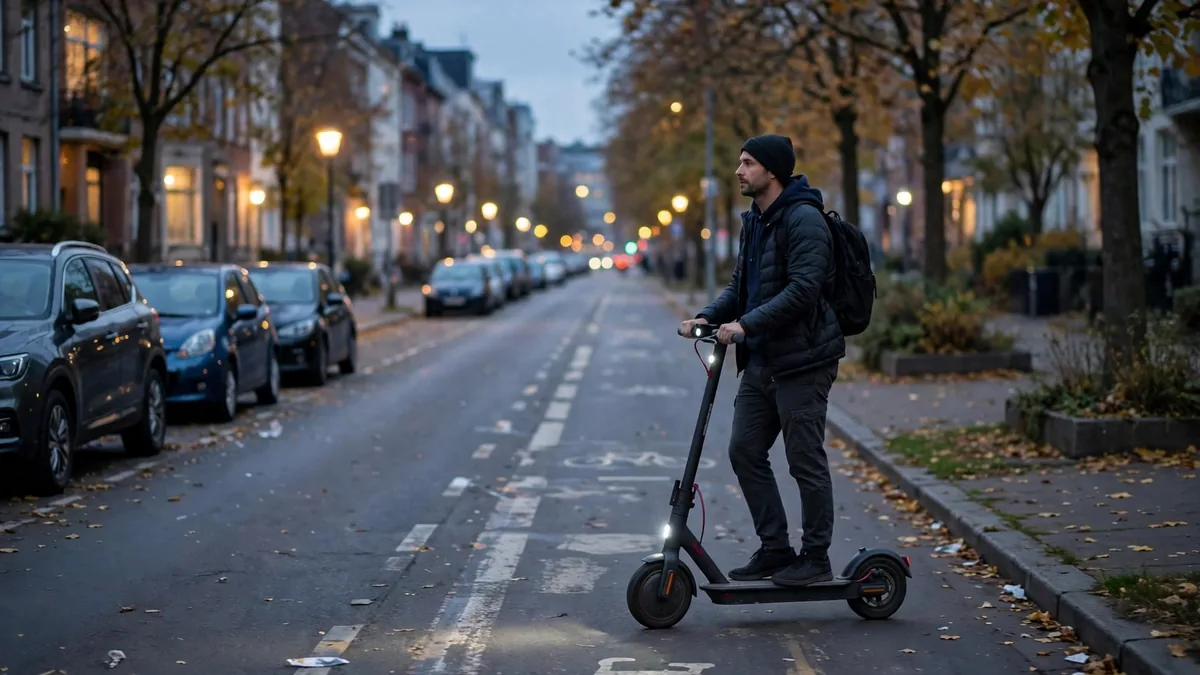
The battery bar said 42 percent when Leo left the office, and the ride home was only six kilometres. He had done it a hundred times. Halfway there, the bar dropped to a single red segment, the scooter slowed to a crawl on the last hill, and he pushed the final two blocks on foot, wondering what had gone wrong. Nothing had gone wrong. The scooter was doing exactly what its specification sheet said it would do, and the sheet had never promised the range Leo thought it had. That gap between the number on the box and the number on the road is the most misunderstood figure in electric scooters, and it comes down to a handful of specifications that most buyers never learn to read.
Scooter makers are not exactly lying about range. They are quoting a number measured under conditions you will probably never ride in: a light rider, a flat road, a warm day, a steady speed, and a brand-new battery. Your ride is none of those things. Once you understand the three numbers that actually decide how far you will go, and the test conditions hiding behind the headline figure, you can look at any specification sheet and work out your real range in about thirty seconds.
The Specs That Decide Range
Battery capacity: watt-hours, not volts
The single most important number is the battery capacity, measured in watt-hours, written as Wh. A watt-hour is one watt of power for one hour, and it is the size of the fuel tank. A scooter with a 500 Wh battery holds roughly twice the energy of one with a 250 Wh battery, and in the real world that means roughly twice the range. Ignore the voltage on its own: a 48-volt battery and a 36-volt battery can hold exactly the same energy if the amp-hour rating is different, and it is the watt-hours that tell you the truth. Some manufacturers quote only volts and amp-hours, in which case you multiply them together to get watt-hours. A 36-volt, 10-amp-hour pack is 360 Wh. A 48-volt, 12.5-amp-hour pack is 600 Wh. The second scooter carries almost seventy percent more energy, and no amount of clever marketing changes that.
Motor power: watts are about hills, not distance
The second number is the motor rating in watts, and it is the one buyers overvalue most. A 350-watt motor and a 1,000-watt motor can be fitted to scooters with identical batteries, and their range on flat ground at the same speed will be almost the same. The bigger motor simply drinks energy faster when you ask it to, which is exactly what happens on hills, at hard acceleration, and at top speed. Where motor power does matter for range is efficiency: a motor working well inside its comfort zone wastes less energy as heat than a small motor straining at its limit on every incline. So a slightly overpowered motor can actually deliver better real-world range on a hilly commute, while the same motor will drain the battery quickly if you ride everywhere at full throttle.
The hidden test conditions
The third thing to read is not a number at all but the small print under the headline range. Manufacturers typically test with a 70-kilogram rider on flat, smooth ground at a steady 15 to 20 kilometres per hour in temperatures around 25 degrees Celsius. Every difference from that test costs you range. A rider of 90 kilograms can lose 15 to 20 percent. Cold weather is brutal: a lithium battery at 5 degrees can lose a quarter of its usable capacity, which is why the same scooter feels like a different machine in January. Stop-start city riding costs more than a steady cruise, because every acceleration draws a surge of current. Even tyre pressure matters: soft tyres can quietly eat ten percent of your range through rolling resistance. Add these together and a scooter rated at 40 kilometres can honestly deliver 25 on a cold, hilly, stop-start commute with a heavier rider, and nobody has done anything wrong.
Regenerative braking: real, but small
Many scooters advertise regenerative braking, which feeds a little energy back into the battery when you slow down. It works, but the gain is modest. In city riding with frequent stops, regeneration typically recovers around five to ten percent of the energy used, which might add two or three kilometres to your range. It will never turn a short-range scooter into a long-range one, and it does nothing at all on a steady motorway-style cruise where you rarely brake. Treat it as a small bonus, not a reason to buy.
How to work out your real range
Here is the quick method. Start with the battery capacity in watt-hours and divide it by 15, which is roughly how many watt-hours a typical scooter uses per kilometre in mixed riding. A 500 Wh battery gives you about 33 kilometres in theory. Now apply the reality discounts: take off 20 percent if you are heavier than 75 kilograms, another 20 percent in cold weather, and another 15 percent if your route is hilly or full of traffic lights. A 500 Wh scooter that claims 45 kilometres on the box will deliver roughly 22 to 28 kilometres on a cold, hilly commute, and that is the number you should plan around. If your daily round trip is longer than that, you need a bigger battery, not a bigger motor. The frame that carries all of this matters too, which is why it is worth reading how an electric scooter frame is made, and the motor itself decides how efficiently that energy is spent, as explained in how an electric scooter motor works.
Key Specifications
| Specification | Typical Commuter Scooter |
|---|---|
| Battery capacity | 500 Wh |
| Motor power | 350 W nominal |
| Claimed range | 40 kilometres |
| Real-world range | 25 to 30 kilometres |
| Energy use | About 15 Wh per kilometre |
| Top speed | 25 kilometres per hour |
| Charge time | 5 to 7 hours |
| Rider weight limit | 100 kilograms |
How Much Does Range Cost?
Range is the most expensive thing you can buy on a scooter, because it is bought with battery cells. As an estimate, a basic commuter scooter with a 250 Wh battery and a claimed 25-kilometre range costs around $400 to $600. Step up to a 500 Wh battery and a claimed 40 kilometres and you are looking at roughly $700 to $1,000 as an estimate. Long-range machines with 1,000 Wh or more, claiming 70 to 100 kilometres, start at about $1,500 and climb quickly past $2,500 as an estimate. The pattern is simple: every extra ten kilometres of real range costs roughly $150 to $200, and the same logic applies across electric vehicles, which is why the longest-range EVs of 2027 are also the most expensive ones in their class. Pay for the range you actually ride, not the range that looks good on the box.
A Rare Fact
The longest-range electric scooter in the world is not sold as a commuter at all. Ultra-long-range scooters built for touring carry batteries bigger than some electric motorcycles, and their riders plan trips the way motorcyclists do, with charging stops and overnight stays. The record for a single charge on a production scooter sits well past 150 kilometres, achieved at a slow, steady speed on flat ground by a light rider, which is exactly the same set of test conditions the manufacturers use, just taken to its logical extreme. It proves the battery can do it. It also proves that the number on the box is a laboratory result, and your commute is not a laboratory.


