A ferry crossing a harbour usually looks the same everywhere: a blunt hull pushing through the water, a wide wake spreading behind it, and a slow, steady speed that rarely surprises anyone. A hydrofoil ferry breaks that picture completely. At cruising speed its hull rises out of the water altogether, and the whole vessel rides on thin legs that disappear beneath the surface. The wake shrinks to a ripple, the ride smooths out, and the ferry travels far faster than a conventional boat of the same size and power.
The effect is not a styling choice. It is the result of wings working underwater, and it has been carrying paying passengers since the middle of the last century. This is what a hydrofoil ferry is, how it works, and why it vanished from most routes before returning.
What a Hydrofoil Ferry Actually Is
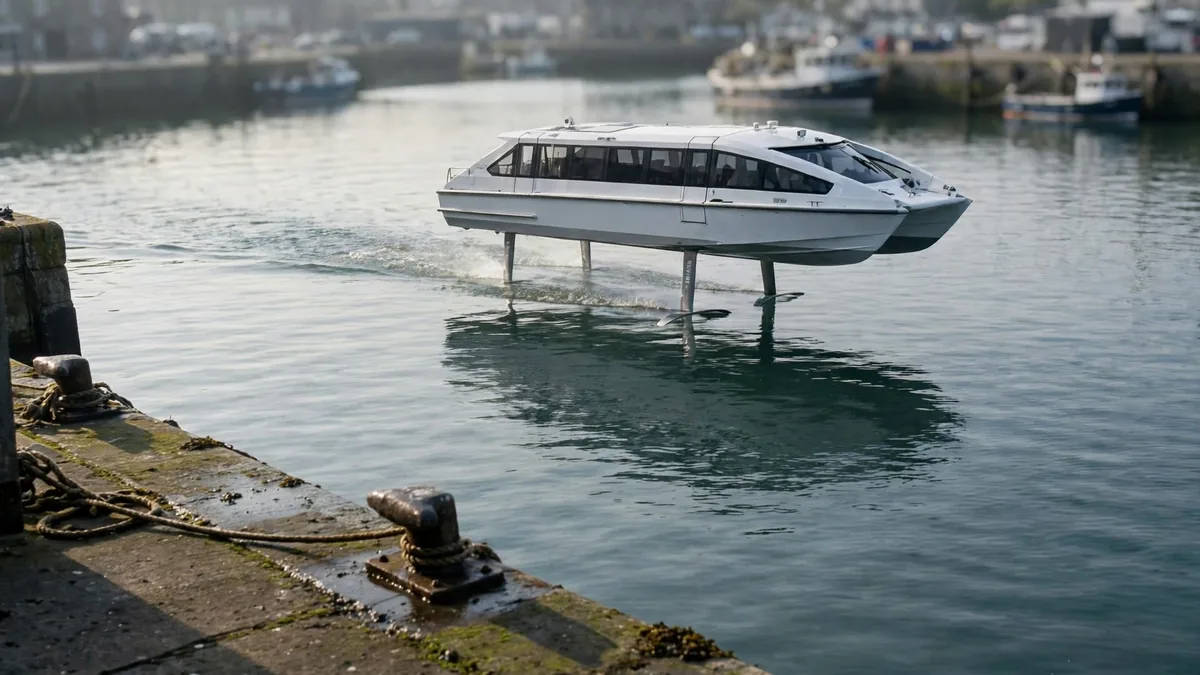
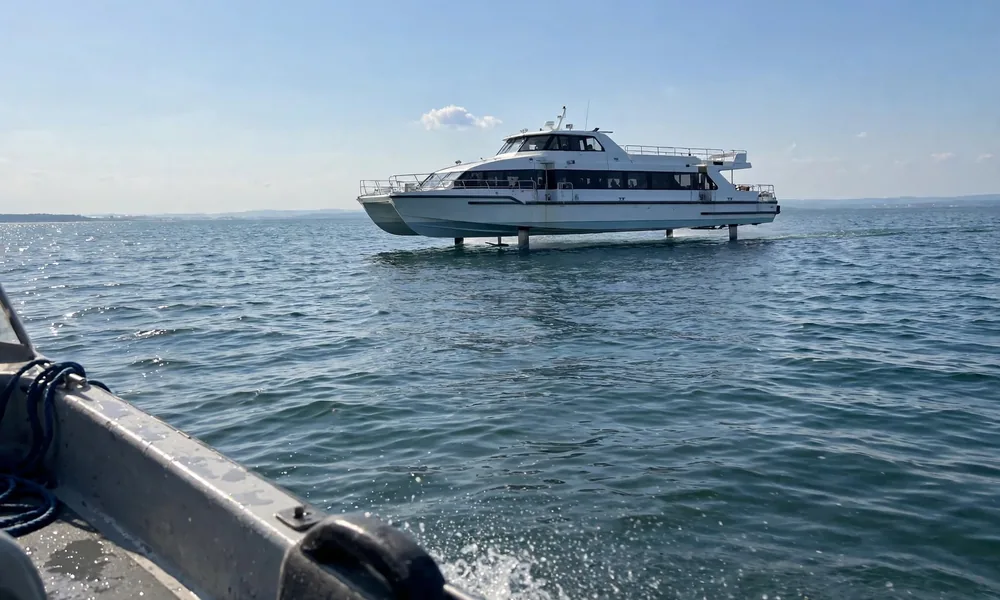
A hydrofoil ferry is a passenger vessel fitted with hydrofoils, shaped underwater wings mounted on struts beneath the hull. At low speed it behaves like any other ferry, floating on its hull and pushing water aside. As it accelerates, water flowing over the foils generates lift, just as air flowing over an aircraft wing generates lift. At a speed known as take-off, the lift equals the weight of the vessel, and the hull rises clear of the water. From that point only the foils and their struts remain submerged.
That drop in drag is the whole point. A normal hull wastes most of its engine power pushing water aside and making waves. A foilborne ferry wastes almost none of it that way, so the same power produces much more speed, or the same speed needs much less power. A hydrofoil ferry typically cruises at 35 to 45 knots, roughly twice the speed of a conventional ferry of similar size, while using less fuel per passenger at that speed than a fast catamaran would.
How the Foils Lift a Hull
A hydrofoil works like an aeroplane wing in a much denser fluid. Water is about 800 times denser than air, so a small wing can lift a heavy vessel. The foil is shaped so that water moves faster over one side than the other, creating lower pressure on one side and higher pressure on the other. The difference pushes the foil upward, and the struts carry that lift to the hull.
The Parts of a Hydrofoil Ferry
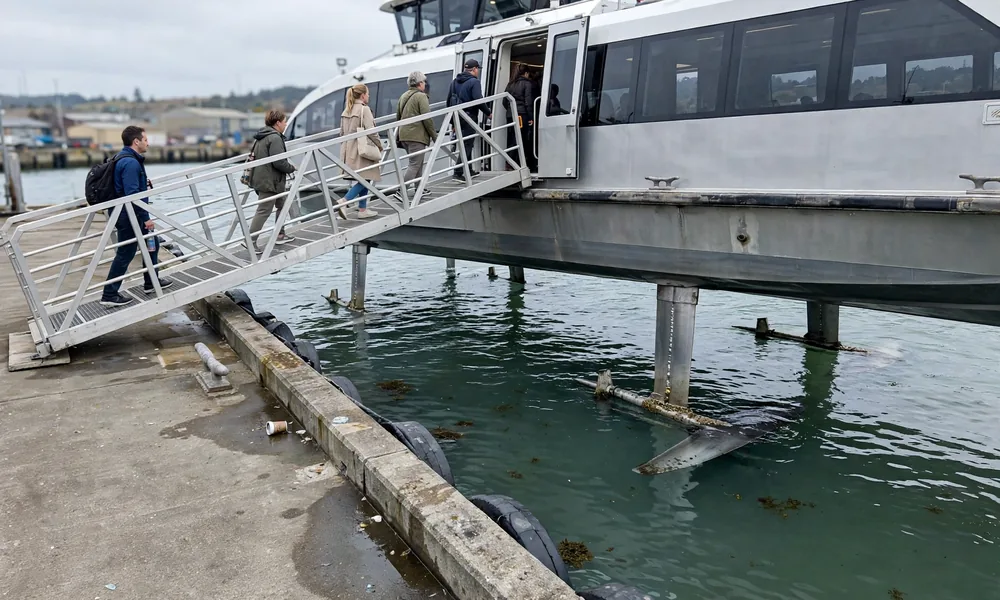
The visible difference is the foil system itself: a forward foil near the bow, an aft foil near the stern, and the struts that connect them to the hull. The foils are usually made from stainless steel or high-strength alloys, because they must survive constant immersion, impacts with floating debris, and erosion from fast-moving water. Cavitation, the formation of tiny vapour bubbles that collapse violently against the foil surface, slowly eats away at the metal, so foil blades are inspected and replaced far more often than a normal hull would need.
A Short History of Flying Ferries
The idea is older than the aeroplane. Italian inventor Enrico Forlanini built a small foiling boat that reached 42.5 miles per hour in 1906, and the first real hydrofoil ferries appeared in the 1950s, when the Supramar design from Switzerland went into service on Lake Maggiore and then on Mediterranean routes. The most famous of the type, the Boeing 929 Jetfoil, entered service in the 1970s and ran routes in Hong Kong, Japan, Hawaii and the English Channel, carrying more than 250 passengers at over 40 knots.
Why Hydrofoil Ferries Faded Away
If hydrofoil ferries were so fast, why did most of them disappear? The answer is cost and comfort. A foilborne ferry burns less fuel at high speed than a conventional fast ferry, but the vessel itself costs far more to build and far more to maintain. Foils corrode, cavitation wears them down, and a strike on a floating log can put a ferry out of service for weeks. The machinery is specialised, and few shipyards can repair it, so operators paid a premium for every overhaul.
Where They Still Run, and the Electric Revival
Hydrofoil ferries never vanished completely. They still run in places where speed matters more than comfort and the water is sheltered enough for foils to work well: parts of Italy and Greece, Russian rivers, and routes in Southeast Asia where a hydrofoil can cut a journey that takes hours by road down to a fraction of that time. The technology also survived in top-level sailing, and the engineering that keeps a racing yacht stable on its foils descends directly from ferry work.
The most important hydrofoil ferry in service today is electric. The Candela P-12, a Swedish-built vessel carrying 30 passengers, entered public service in Stockholm in 2024, cutting a 55-minute bus journey to 25 minutes by water while using a fraction of the energy a conventional electric ferry would need. A foiling electric ferry pairs hydrofoils with battery power, and the combination solves the problem that held electric ferries back: a normal electric hull wastes so much energy pushing water aside that its range is short, while a foilborne hull needs far less energy to go the same distance.
How They Compare with Other Fast Ferries
Against a conventional monohull ferry, a hydrofoil ferry is simply faster and smoother in calm water, at the price of higher build and maintenance costs. Against a catamaran, the comparison is closer. A modern fast catamaran is cheaper to build, easier to maintain and more comfortable in rough seas, which is why catamarans took most of the fast-ferry market. The hydrofoil wins on speed and energy use at high speed, and on wake: a foilborne ferry leaves almost no wash, which matters on rivers and in harbours where a large wake damages banks and moored boats. The best electric ferries ranked list shows how quickly this corner of the industry is moving, and foilborne designs feature in it for a reason.
The Limits Passengers Should Know
Hydrofoil ferries have real limits, and they explain why the type never took over. They need a minimum depth of water, because the foils hang well below the hull, and they cannot run in very shallow harbours or over sandbanks. They are sensitive to debris: a foil striking a log at 40 knots can be badly damaged, and routes must be surveyed and kept clear.
Weather is the final limit. In rough seas the foils can ventilate, drawing air down from the surface and losing lift suddenly, and the ride deteriorates fast. Operators cancel foil services in bad weather more readily than conventional services, which makes them unreliable on exposed routes. That is why the surviving services and the new electric ones cluster on rivers, lakes, bays and sheltered coastal routes, where the water stays calm enough for the foils to do their work. How ferry propulsion works explains the engines and waterjets behind all of this in more detail, and on a foilboat those choices matter more than anywhere else, because the propulsion system sits on the very part of the vessel that does the lifting.
So, What Is a Hydrofoil Ferry?
A hydrofoil ferry is a passenger vessel that flies above the water on underwater wings, trading the familiar drag of a hull for the lift of a foil. It is faster, smoother in calm water and more energy-efficient than any conventional ferry of its size, and it carries a history that runs from a 1906 experiment to a Stockholm commuter service in 2024. On the right route, sheltered water and passengers in a hurry, nothing else does the job quite like it.


