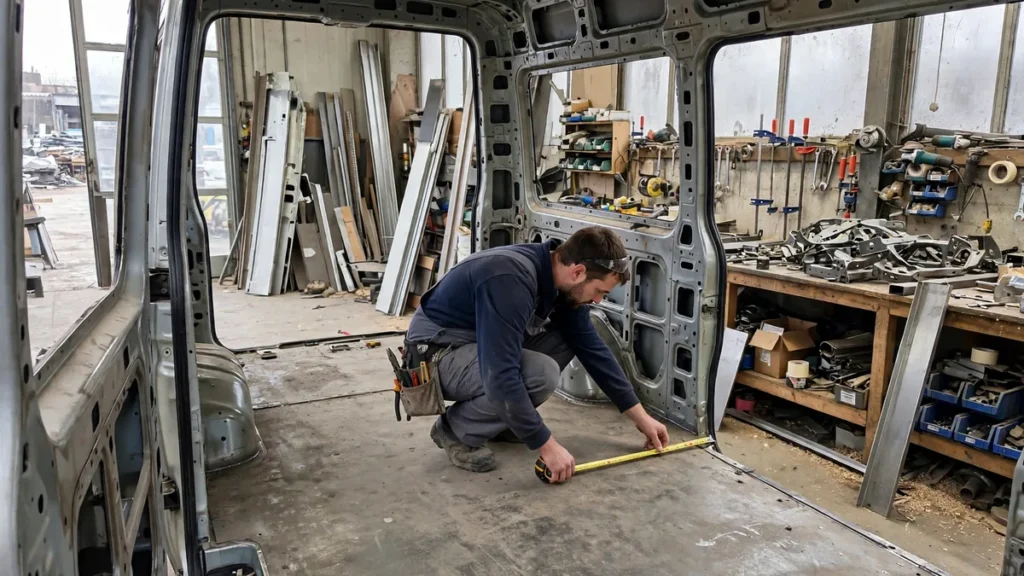
Watch a hypercar take a corner at speed and something looks wrong: the body stays almost flat while the wheels dance over the bumps. That is not magic, and it is not luck. It is an active suspension — a system that reads the road hundreds of times a second and pushes back against every bump, dive, and roll before you can feel it. Building one means joining hydraulics, electronics, and software into a single system that must never, ever fail at speed.
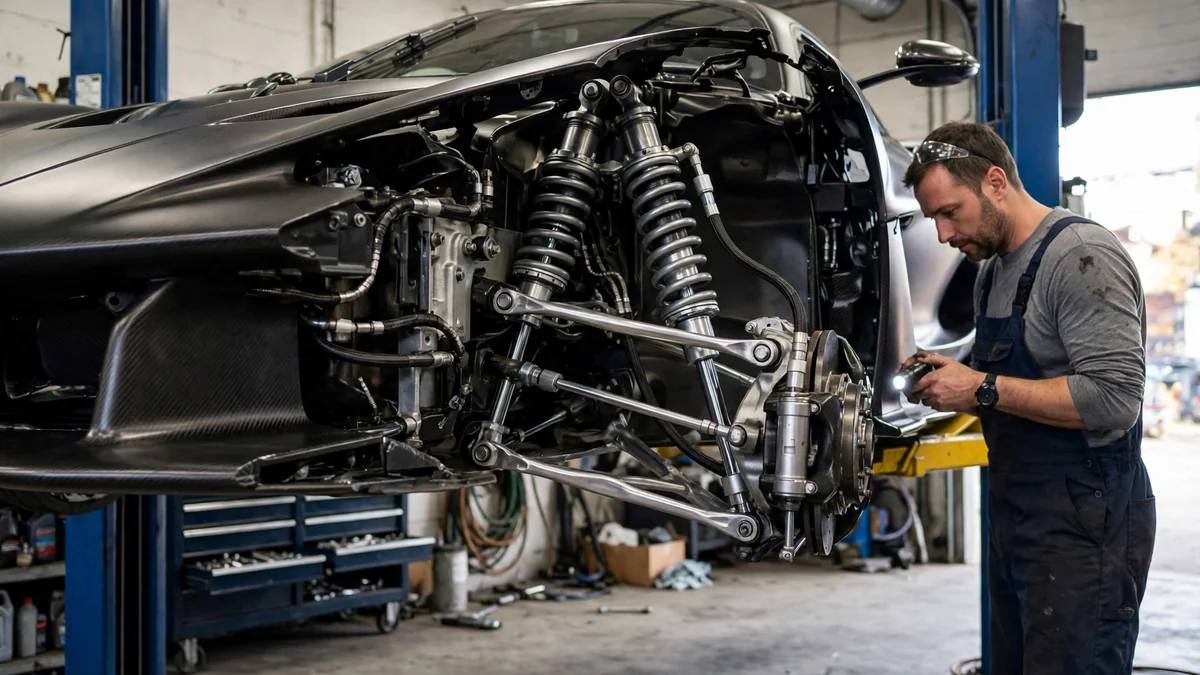
A normal suspension is a compromise: soft springs are comfortable but let the car lean, stiff springs handle well but shake you over every bump. An active system escapes that trade-off by changing its stiffness in real time. Sensors watch the wheels, the steering, and the brakes, and a computer tells each corner of the car what to do, many times a second. Here is how a hypercar’s active suspension is made.
How It’s Made
Step 1: Designing the system
Everything starts with a model of the whole car. Engineers simulate the suspension the way they simulate an engine, running the car through virtual corners, bumps, and braking zones to decide how stiff each corner should be at every moment. They choose the architecture — hydraulic actuators that replace the anti-roll bars, or fully active dampers with valves controlled by software — and they size the pumps, the accumulators, and the pipes. The design has to work when the car is cruising, when it is braking from 200 miles per hour, and when one wheel hits a pothole. It must also fail safely onto a drivable setup if pressure is lost.
Step 2: Machining the hardware
The heart of the system is the actuator: a precision hydraulic cylinder that can push a wheel up or down with thousands of newtons of force. Its parts are machined from steel and aluminium to tolerances measured in microns, because a hydraulic seal that leaks even slightly will let the system go soft. The damper bodies are honed to a mirror finish inside, the pistons are ground, and the valve blocks are drilled with tiny passages that meter oil flow. Each actuator is assembled in a clean room, filled with hydraulic fluid, and pressure-tested before it is allowed near a car. Cleanliness is treated like a religion.

Step 3: Building the control unit
While the hardware is machined, the electronics are built. The control unit is a rugged computer that reads accelerometers, ride-height sensors, steering angle, and brake pressure, and then decides what each actuator should do — all in a few milliseconds. Its circuit boards are assembled and soldered, then coated to protect them from heat, vibration, and moisture. The software is the real product, tuned on simulators and test rigs. The control unit is tested on a bench that pretends to be a car, feeding it fake sensor signals and checking that it answers correctly.
Step 4: Fitting it to the car
Installation happens on the production line, where the actuators, pump, and pipes are fitted to the chassis. The hydraulic lines are routed carefully, away from hot exhausts and moving parts, and every connection is torqued and checked for leaks. The sensors are mounted at each corner and calibrated, and the wiring loom is connected to the control unit. This is painstaking work, because the system is only as good as its weakest connection, and it shares the car with other precision assemblies — the gearbox, for instance, is built to the same standard, as dual-clutch gearbox materials engineering explains. Once fitted, the system is filled with fluid and bled of air.
Step 5: Calibrating the car
A fitted suspension is not finished until it is calibrated. The car is put on a rig that moves each wheel up and down while the system is running, and engineers check that every actuator responds correctly and that the ride height is exact. Then the car goes to the track, where test drivers run it through corners, bumps, and emergency stops while engineers watch the data and tune the software. Each driving mode — comfort, sport, and track — is calibrated separately. Calibration can take days of track time per car.

Step 6: Testing to destruction
Before the system is signed off, it is abused. Actuators are cycled millions of times on test rigs, far beyond what a car will ever see, and the hydraulics are run at extreme temperatures to check for leaks and fade. The car is driven over rough roads, through water, and in freezing conditions, because a suspension that only works in a warm factory is useless. If a component fails, the design is changed and the testing starts again. The brakes face the same treatment, as how carbon-ceramic brakes are made shows, and the suspension is held to the same standard: it must work perfectly on the worst day, at the highest speed, with no excuses.
Specs
| Specification | Typical figure |
|---|---|
| Reaction time | Adjustments in a few milliseconds |
| Actuator force | Several thousand newtons per corner |
| Hydraulic pressure | Up to about 200 bar |
| Sensors per car | Accelerometers, ride height, steering, brakes |
| Driving modes | Usually comfort, sport, and track |
| System weight | About 20–40 kilograms including pump and fluid |
| Control unit | Dedicated computer with bespoke software |
| Testing | Millions of rig cycles plus track calibration |
Price
An active suspension is one of the most expensive systems on a hypercar. As a factory option or as part of the car’s price, it is often estimated at $10,000 to $30,000, and a replacement actuator alone can cost several thousand dollars as an estimate. The cost comes from the precision machining, the hydraulic pump and accumulators, the sensors, and the hundreds of hours of software tuning and track calibration. These are estimates, and the real figure is usually hidden inside the car’s total price. Even so, buyers accept it, because the system is what lets a 200-mile-per-hour car ride like a luxury saloon on the way home.
A Rare Fact
Active suspension was banned from Formula 1 in 1994, just as it was getting brilliant — and that is exactly why it is so good today. The Williams FW14B of 1992 used a computer-controlled hydraulic suspension that kept the car level through every corner, and it was so effective that the rules were changed to outlaw it. The technology did not die; it went into road cars, where it has been refined ever since. Modern hypercar systems are faster, lighter, and smarter than the race car that was banned for being too good, and they do it all while carrying air conditioning, a stereo, and a boot full of luggage.
Active suspension is the invisible hand that keeps a hypercar flat, comfortable, and safe at the same time, and it is only one part of a machine where every system is engineered to the limit. The car it serves is built with the same obsession throughout, as how the Aston Martin Valkyrie is made shows. The next time a hypercar sweeps through a corner without leaning, remember the pump, the valves, and the computer that read the road a hundred times before you even noticed the bend.