Plug an electric car into a fast charger on a cold morning and two opposite jobs begin at once: the battery must be warmed so it can accept charge, and the motor must be kept cool so it does not cook itself. In summer the problem flips: the same system must pull heat out of a battery pack the size of a mattress while keeping the cabin comfortable. All of it happens silently, with no radiator grille, no fan belt and no drama, through pipes, plates and pumps hidden under the floor.
Thermal management is the quiet guardian of every electric car. A battery that runs too hot ages years in one summer, losing range it will never get back. A battery that runs too cold refuses to fast-charge and leaves you waiting twice as long. Whether a car still holds its range after a decade is largely decided by the materials moving heat inside it.

The Materials Behind the Thermal System
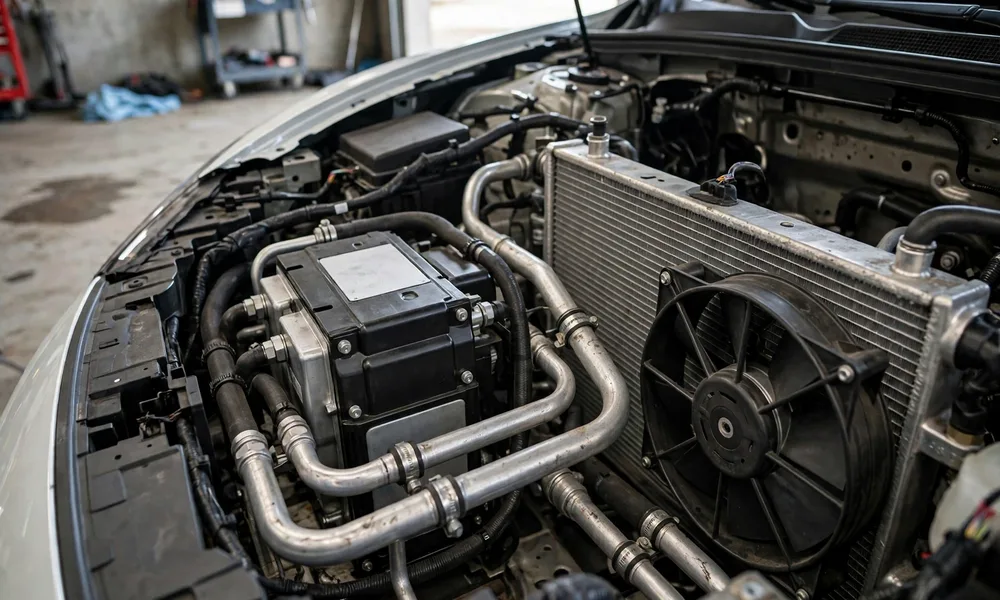
At the heart of the system sits the cold plate, a flat sheet of aluminium with serpentine channels machined or stamped into it, pressed against the battery cells so heat flows straight out of them. Aluminium is chosen because it conducts heat well, weighs little, and can be formed into thin channels that put coolant within millimetres of every cell. The coolant is a water-glycol mix, sometimes replaced by a dielectric fluid that can touch live cells without conducting electricity, pushed through the channels by an electric pump that runs only when needed.
Between the cells and the plate sits a thermal interface material, a soft silicone pad filled with ceramic particles that squashes into every microscopic gap, because even a hairline of air between cell and plate acts like a blanket. Heat leaving the battery is dumped through a radiator of brazed aluminium fins, or harvested by a heat pump that uses a refrigerant loop to warm the cabin in winter, and the network is joined by hoses of EPDM rubber and aluminium pipes that must survive a decade of heat, cold and vibration without leaking a drop. The same obsession with moving heat efficiently shapes the rest of the car, from the cells themselves, as in an EV battery pack, to the power electronics switching thousands of amps, as in an EV inverter.
How It Is Made
Building an EV thermal system is plumbing at aerospace tolerances: thin metal, tight seals, a network that must never leak. The process runs roughly like this.
- Stamp the cold plate. Aluminium sheet is stamped or machined into a plate with winding coolant channels, then brazed or friction-stir welded shut so it holds pressure.
- Fit the interface pads. Silicone thermal pads are cut to shape and laid on the plate, filling gaps between plate and cells.
- Assemble the pack. Battery modules are lowered onto the cold plate and clamped down, squeezing the pads into contact with every cell.
- Plumb the loop. Aluminium pipes and rubber hoses connect the plate to pump, radiator and heat pump, with quick-connect fittings sealing under pressure.
- Charge the refrigerant. The heat pump loop is evacuated, filled with refrigerant, and leak-tested with a sniffer that finds a hole smaller than a pinprick.
- Test hot and cold. Each finished car is run through hot and cold chambers while sensors watch every cell, and any pack with a hot spot or slow leak is sent back for rework.

Why These Materials Win
Aluminium wins because it is the best compromise in the car: it conducts heat nearly as well as copper at a third of the weight and a fraction of the cost, and it can be stamped into shapes copper never could. Silicone interface pads win because they stay soft from minus forty to plus two hundred degrees, squashing into gaps that would otherwise insulate cells. Water-glycol wins because it carries more heat per litre than any other cheap fluid, and dielectric fluids win where safety matters, because a leak touching a live cell must not start a fire.
The failures are instructive, too. A cold plate corroding from the inside clogs its channels and leaves one corner of the pack to overheat. A thermal pad that dries out and hardens stops conducting, and the cell behind it ages twice as fast as its neighbours. A refrigerant leak leaves the heat pump gasping and the cabin cold in winter. Engineers fight all three with corrosion inhibitors, better pads and tighter fittings, and the result keeps a thousand-kilogram battery within a few degrees of ideal on the hottest day of the year. It is the same materials logic that shapes the next generation of cells: the pack must stay cool yet light, which is why a solid-state battery is designed around thermal behaviour as much as chemistry, with every material chosen to keep heat moving in the right direction.
Specifications
| Specification | Detail |
|---|---|
| Cold plate | Stamped or machined aluminium, brazed shut |
| Coolant | Water-glycol mix or dielectric fluid |
| Interface material | Silicone pad filled with ceramic particles |
| Radiator | Brazed aluminium fins, front mounted |
| Heat pump | Refrigerant loop, heats cabin and battery |
| Pipes and hoses | Aluminium pipe, EPDM rubber hose |
| Target cell temperature | 20 to 40 degrees Celsius |
| Cooling capacity | 5 to 15 kilowatts of heat rejection |
Price
An EV thermal management system is one of the more expensive hidden systems in an electric car, yet priced like plumbing with a PhD. A replacement cold plate for a popular electric car typically sells as a spare for around $300 to $900 (estimate), while a complete heat pump module is estimated to cost several hundred dollars at volume (estimate). The real expense is not the aluminium but the engineering: every channel, pad and fitting is tuned to keep hundreds of cells within a few degrees of each other, because one hot cell would age the whole pack faster. That testing is why a well-cooled electric car still fast-charges quickly after years on the road.
Rare Fact
Some electric cars use their heat pump to scavenge waste heat from motor and power electronics and pump it into the battery on a cold morning, warming the pack with energy that would otherwise be wasted. On a freezing day this trick can cut heating energy by more than half, which is why a heat-pump car can travel noticeably further in winter than an identical car with a simple electric heater. The cleverest systems even use the battery as a thermal store, pre-heating it while the car is still plugged in at home, so not a mile of range is spent warming the pack on the road.
That is the hidden craft of EV thermal management: a plate of aluminium, a pad of silicone and a loop of refrigerant, keeping a tonne of batteries at the perfect temperature. You never see it, you never hear it, yet it decides whether your electric car still feels new after ten years or tired after three.