Step aboard a superyacht in the tropics, walk from the sun-baked deck into the main salon, and the air changes instantly: cool, dry, silent, as if the heat had been switched off at the door. Nobody thinks about how that happened. They notice the temperature, not the machine. Somewhere below deck, though, a system the size of a small lorry is working continuously — chilling water, pumping it through kilometres of pipe, drying the air in every cabin, and doing it all so quietly that guests never hear a fan. That invisibility is the most expensive thing about superyacht air conditioning.
A superyacht is a floating hotel in the harshest climate on Earth: steel and glass in full sun, surrounded by warm salt water, with dozens of people, kitchens, engines and electronics all adding heat. Keeping it cool is not a matter of bolting on a few air conditioners. It is a central engineering system, designed for the yacht from the keel up, built to marine standards, and expected to run for years without a failure that a guest would ever notice. The price reflects that.

Why Superyacht Air Conditioning Costs So Much
Air conditioning on a yacht is a system, not an appliance. It has a central plant, a distribution network, controls in every cabin, and redundancy at every level — and every part of it must survive salt, vibration and constant use.
A central chilled-water plant, built like a ship’s engine
Most large yachts use a chilled-water system: big marine compressors cool water to a few degrees above freezing, and pumps push that cold water through the yacht to fan-coil units in each cabin. The compressors are industrial machines, built to marine standards, resistant to corrosion and vibration, and sized to cool the whole yacht on the hottest day in the tropics with the engines running and the galley at full heat. The plant room is crowded with compressors, pumps, heat exchangers and sea-water cooling circuits, all piped in copper-nickel or stainless steel because ordinary pipe would corrode.
Kilometres of pipe, hidden and insulated
From the plant room, chilled-water pipes run to every cabin, salon, galley and crew space on the yacht — kilometres of pipe in total, each run insulated so that cold is not lost on the way and condensation does not drip into the joinery. The pipes must be routed around structure, tanks and cables, and every joint is a potential leak in a space full of fine wood and electronics. The air conditioning network is, in effect, a second plumbing system for the whole yacht, and it is priced like one.
Silence, engineered into every fan
The hardest requirement of yacht air conditioning is not cooling — it is silence. Guests expect to sleep in a cabin where the only sound is the sea, so every fan, every duct and every grille is designed to move large volumes of air without noise. Fans run slowly, ducts are oversized and lined with acoustic insulation, and the fan-coil units are mounted on vibration isolators so that no hum reaches the cabin.
Humidity, salt and the war against mould
Cooling the air is only half the job. In the tropics the air is wet, and a yacht that cools without drying will grow mould in its joinery, its carpets and its electronics within weeks. The system therefore dehumidifies as it cools, and it does so in every compartment, all day, every day. Fresh air is drawn in, filtered, dried and cooled, while stale air is extracted — and the balance must be maintained so that the yacht stays at a slight positive pressure, keeping humid sea air from leaking in through doors and hatches.

Redundancy: cooling that must never stop
If the air conditioning fails in the tropics, a superyacht becomes uninhabitable within hours, and the interior begins to suffer within days. So the system is built with redundancy: multiple compressors, so that one can fail or be serviced while the others carry the load; duplicate pumps; and controls that switch over automatically. The system is also designed to be serviced at sea, with parts that can be reached and replaced without dismantling the interior. That redundancy doubles much of the equipment cost, and it is money spent on an event that may never happen — which is precisely the point.
Specialist design, tiny volumes
Marine HVAC is a small, specialised field. The engineers who design yacht air conditioning understand heat loads, acoustics, humidity control and marine corrosion in combination, and there are not many of them. Each yacht’s system is designed from scratch for its own layout, its own glass areas and its own operating climate, and the design process takes months. The equipment is made in small numbers to marine standards, with no mass-market production line to bring the price down. Like everything else on a superyacht, the air conditioning is a one-off, and one-offs are expensive.
What Does Superyacht Air Conditioning Cost?
The air conditioning system on a 50-metre superyacht typically costs from around one million dollars (estimate) to two million dollars (estimate) installed, and on an 80-metre-plus yacht it can reach three million dollars (estimate) or more. The central plant — compressors, pumps and heat exchangers — accounts for several hundred thousand dollars (estimate), with the pipework, fan-coil units, ducting and controls making up the rest. Running costs are significant too: the system draws a large share of the yacht’s generator power, and annual servicing, filter changes and refrigerant work add tens of thousands of dollars (estimate) each year.
| Specification | Detail |
|---|---|
| System type | Central chilled-water plant with fan-coil units |
| Compressors | Multiple marine units, with redundancy |
| Chilled water | Cooled to a few degrees above freezing |
| Pipework | Kilometres of insulated copper-nickel or stainless pipe |
| Noise level | Designed for near-silence in guest cabins |
| Humidity control | Continuous dehumidification in every zone |
| System cost (estimate) | One to two million dollars on a 50-metre yacht |
| Annual servicing (estimate) | Tens of thousands of dollars |
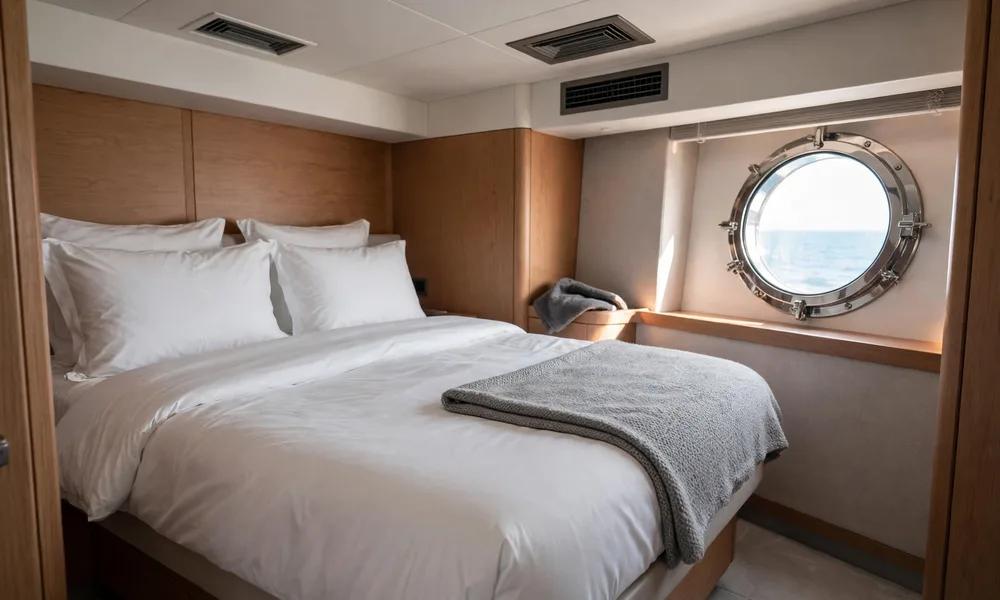
A Rare Fact
Superyacht air conditioning has a hidden enemy that has nothing to do with heat: the sea itself. The system is cooled by sea water, drawn in through intakes in the hull, and in warm tropical water that intake can clog with marine growth in a matter of weeks. Barnacles and weed inside a cooling circuit can strangle the flow and overheat the compressors, so yachts carry dosing systems that treat the sea water, and divers clean the intakes while the yacht is at anchor. It is a strange reality of yacht life: the machine that keeps you cool is cooled by the sea, and the sea is always trying to grow inside it.
Superyacht air conditioning costs so much because it is a central plant, a kilometres-long network, an acoustic engineering project and a humidity-control system, all built to marine standards, all redundant, and all expected to be silent and invisible. The thermal management in an electric vehicle faces the same physics at a smaller scale, and the engine room next door produces much of the heat the system must remove. Step from the heat into the cool of a superyacht salon, and you are feeling the result of millions of dollars of engineering — a result that is, by design, impossible to notice.