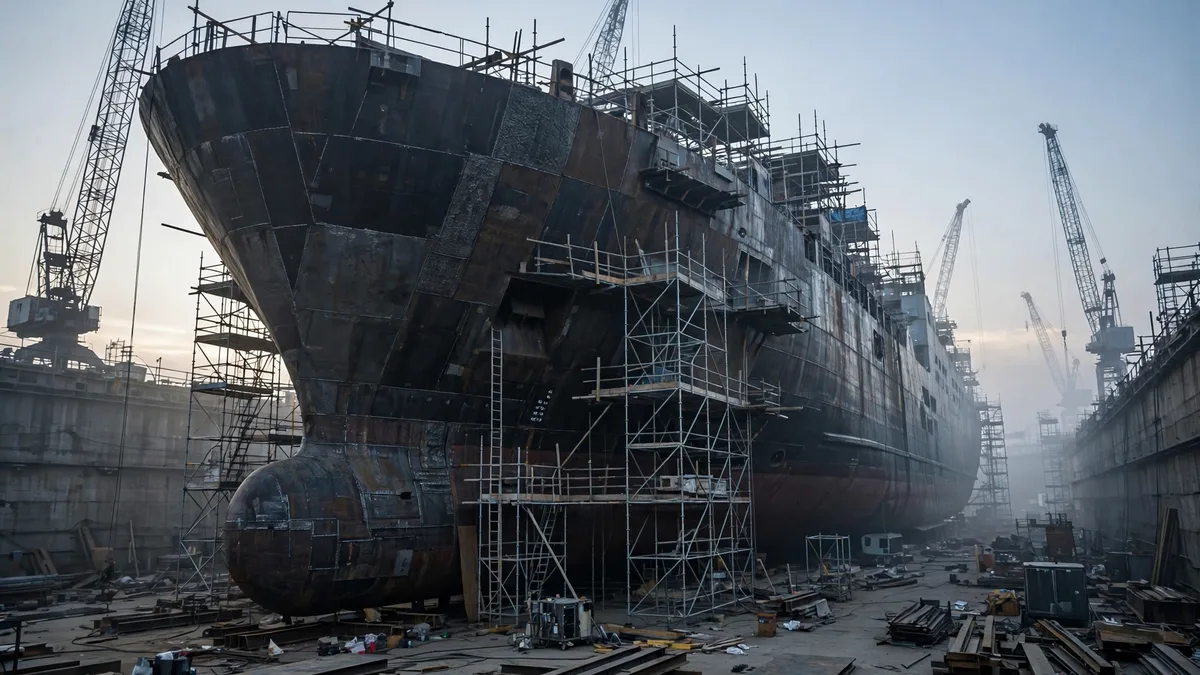
Stand in a dry dock at dawn and look up at a ferry hull, and the first thing you feel is small. The steel rises above you in a curve taller than a house, black with primer, braced by scaffolding and dotted with welders whose sparks fall like slow rain. Somewhere inside that shell are the decks where hundreds of passengers will sit with coffee, the car decks where trucks will park in neat rows, and the engine rooms that will push the whole mass across the water day after day for thirty years. It looks like a simple steel box. It is anything but.
A ferry hull is one of the largest moving structures most people will ever board, and it must survive a life that no other building endures: constant flexing in waves, salt water on every surface, collisions with quays, and a schedule that allows almost no rest. The cost of building it reflects that life. It is not the steel that is expensive, though there is a great deal of it. It is the shaping, the welding, the testing and the sheer scale of getting it right.
Why the Ferry Hull Costs So Much
A hull is the foundation of the ship. Everything else — the engines, the passenger decks, the ramps, the bridge — hangs from it or sits inside it, and if the hull is wrong, nothing else can be right. That responsibility drives every decision in its construction.
Thousands of tonnes of shaped steel
A modern large ferry can use ten thousand tonnes of steel or more, and almost none of it arrives in the shape it needs to be. Plates are cut by plasma or laser, then bent in enormous presses and rolling machines into compound curves that match the hull lines drawn by naval architects. The bow is the hardest part: steel that must curve in two directions at once, pressed and checked against templates again and again until it is fair. The work is done in a dry dock or a building hall the size of a cathedral, with cranes that lift whole sections weighing hundreds of tonnes.
Welding on a scale few trades ever see
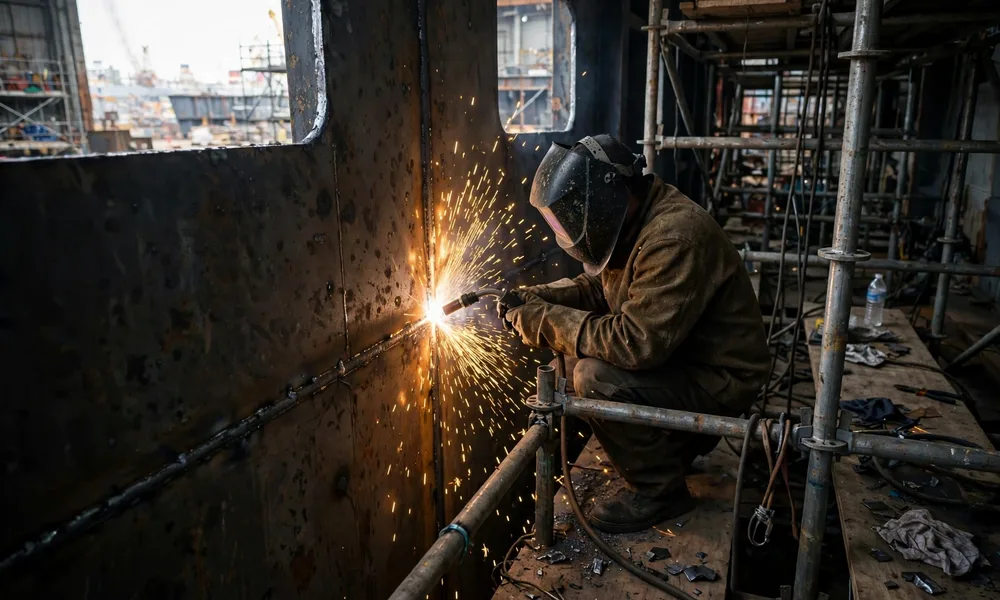
A ferry hull contains kilometres of weld, and every metre of it matters. The plates are fitted onto frames and stringers, tacked, welded, and then inspected — visually, with ultrasound, and with magnetic or dye-penetrant testing — because a hull fails at its welds before its steel ever yields. The ferry hull is, at its core, a welding project the size of a building, and the labour bill is the largest single cost in the build.
A shape that must be efficient and strong at once
Ferries live a double life. They must be fast enough to keep a timetable, economical enough to make money on short crossings, and strong enough to take a beating in rough weather and at the quay. The hull form is therefore a compromise worked out in towing tanks with scale models: a bow that cuts cleanly, a stern that carries the propellers and the vehicle ramps, and a flat bottom that lets the ferry sit upright in shallow water. Getting that shape right takes months of design and model testing before steel is even ordered, and changing it later would mean rebuilding the ship.
Ramps, doors and openings that weaken the shell
A ferry is full of holes: bow and stern doors for vehicles, side doors for passengers, openings for thrusters and stabilisers. Every opening interrupts the strength of the hull and must be reinforced with heavier steel and careful detailing, and the doors themselves are enormous watertight structures with their own hydraulics, seals and locking gear. The engineering of these openings — and the testing that proves them — is a major share of the hull’s cost, and it is work that only a few yards in the world do regularly.
Protection against the sea, applied by hand
Bare steel in salt water can lose a millimetre a year to corrosion, so a ferry hull is never left bare. The underwater plating gets epoxy primers and antifouling coatings several hundred microns thick, built up coat by coat, while the tanks and voids inside receive their own protective systems. Sacrificial anodes of zinc or aluminium are bolted below the waterline to corrode in place of the steel. The coatings are applied by hand in vast halls, and the work is inspected coat by coat, because a hull is only as durable as the paint that shields it.
Testing before a single passenger boards
When the hull is complete, it is tested in ways no passenger ever sees. Tanks are filled and pressure-tested, welds are re-inspected, the hull is measured for fairness, and the whole ship is inclined to check its stability. Sea trials follow: speed runs, turning tests, crash-stop tests and manoeuvring in harbour, all witnessed by the classification society that will certify the ship.
What Does a Ferry Hull Cost?
A complete large ferry can cost from around one hundred million dollars (estimate) to well over two hundred million (estimate), and the hull structure — steel, shaping, welding, coatings and testing — typically accounts for a large share of that figure, often tens of millions of dollars (estimate) on its own. The steel alone, at several thousand dollars per tonne (estimate) for marine-grade plate, runs into tens of millions before fabrication. Add the labour of thousands of shipyard workers over a year or more, the design and model testing, and the classification and sea trials, and the hull emerges as the single most expensive structure on the ship — the foundation on which the entire ferry depends.
| Specification | Detail |
|---|---|
| Hull steel | Marine-grade structural steel, thousands of tonnes |
| Typical length | Around 150–220 metres for a large ferry |
| Plate thickness | Around 12–25 mm on the shell, thicker at the bow |
| Welding | Kilometres of weld, inspected by ultrasound |
| Coatings | Epoxy primers plus antifouling, several hundred microns |
| Corrosion protection | Sacrificial zinc or aluminium anodes |
| Hull cost (estimate) | Tens of millions of dollars |
| Service life | Around 30 years with regular dry-docking |

A Rare Fact
Ferry hulls are built in blocks, and the largest blocks are so heavy that they are moved around the yard on self-propelled transporters with hundreds of wheels, crawling at walking pace. A single block can weigh more than a thousand tonnes — heavier than the entire ferry was a century ago — and the yard must move it, lift it with a gantry crane, and lower it onto its neighbours with millimetre accuracy. The join between two blocks is then welded from both sides and inspected along its full length.
A ferry hull costs so much because it is a building that moves, flexes and fights the sea every day of its life, built by thousands of hands and tested until a classification society is satisfied. The steel is the cheapest part; the shaping, the welding, the doors, the coatings and the trials are where the money goes. The container ship hull is built to the same principles at an even larger scale, and the icebreaker hull takes the same steel and makes it thicker still. A ferry simply has to do all of it while carrying a thousand people on a timetable — and that is why its hull is worth every dollar.


