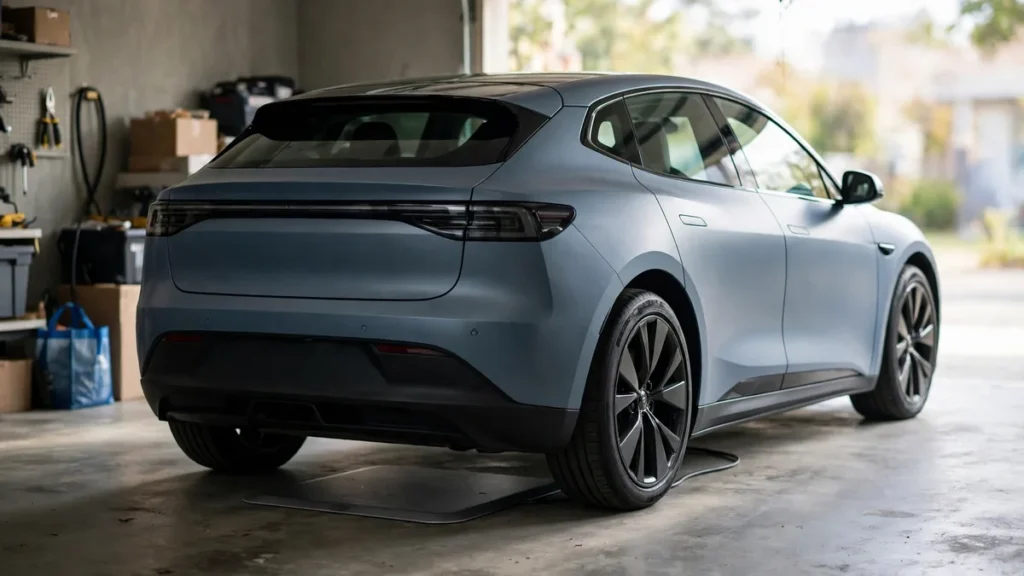
Imagine pulling into your driveway, switching off, and walking away while your car charges itself. No cable, no plug, no fumbling in the rain. That is the promise of wireless EV charging: a pad in the ground talks to a pad under the car, and electricity crosses the gap through thin air. It sounds like magic, but it is materials science — copper, ferrite, aluminium and resin, arranged so precisely that energy leaps a gap of twenty centimetres without a wire.
Wireless charging works by magnetic induction. An alternating current in the ground pad creates a magnetic field, and that field induces a current in the car’s receiver coil. The idea is old — it is how an electric toothbrush charges — but scaling it to move eleven kilowatts into a car battery is a materials problem of the first order. Every watt lost becomes heat, and heat is the enemy of everything in the system.

The Materials Behind EV Wireless Charging
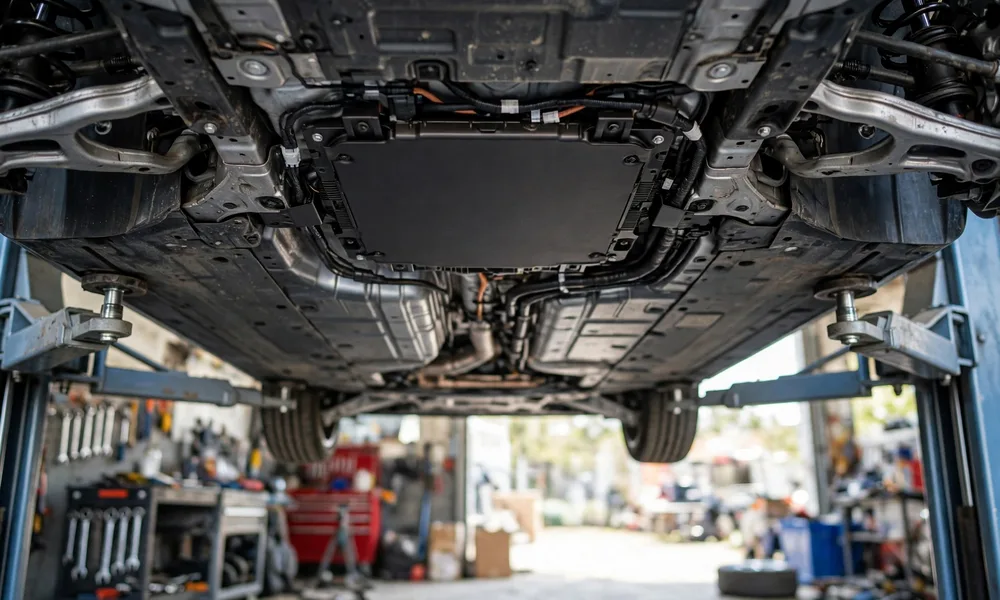
A wireless charging system has two halves: a ground pad buried in or laid on the driveway, and a receiver pad bolted under the car. Each half holds a coil of copper wire, a ferrite core that shapes the magnetic field, shielding that keeps the field where it belongs, and power electronics that convert the energy between alternating and direct current. The materials must survive weather, road salt, stones and the weight of a two-tonne car driving over them daily. The same field-shaping idea appears in the EV battery pack, where magnetic and thermal management also decide how well the system performs.
Step 1: Copper coils, wound for efficiency
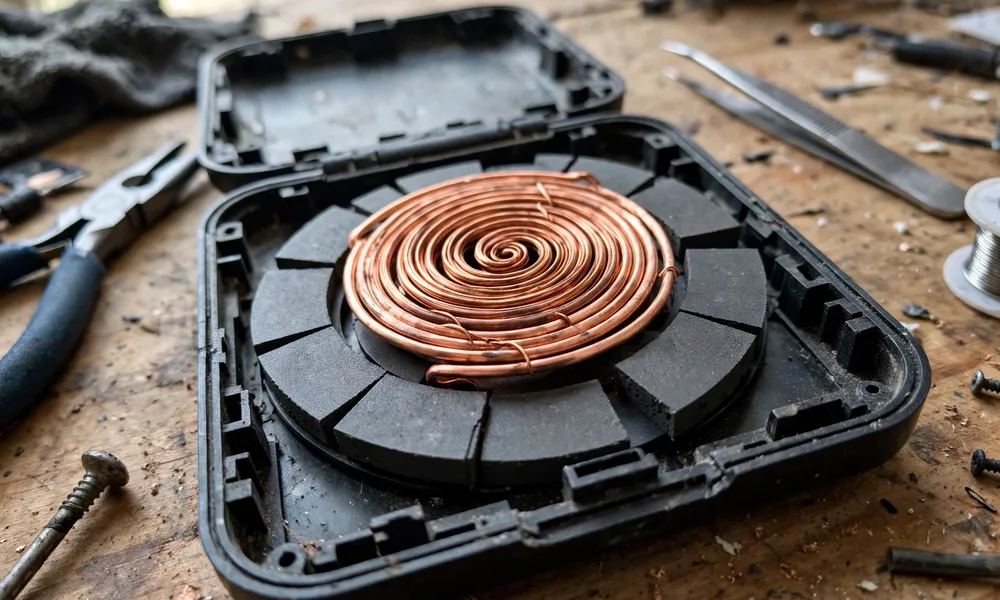
The coils are the heart of the system, and they are made from litz wire — copper wire made of hundreds of hair-fine strands, each individually insulated. At the high frequencies wireless charging uses, ordinary solid copper suffers from the skin effect, where current crowds to the surface of the wire and resistance rises. Litz wire defeats this by giving the current many small paths, keeping resistance low and efficiency high. The coils are wound flat, in a spiral, and potted in resin so they cannot move or vibrate loose.
Step 2: Ferrite cores shape the field
Behind each coil sits a layer of ferrite, a ceramic made from iron oxide mixed with manganese and zinc. Ferrite guides the magnetic field, concentrating it across the gap between the pads and away from the car’s steel body and the ground below. Without ferrite, the field would spread, efficiency would collapse, and stray magnetism could heat nearby metal. The ferrite tiles are brittle, so they are bonded to a backing plate and cushioned in resin, and their shape is tuned to the exact geometry of the coil.
Step 3: Shielding keeps the field in bounds
Even with ferrite, some magnetic field escapes, so both pads carry shielding. A layer of aluminium sits behind the ferrite, reflecting stray field back towards the gap and protecting the car’s electronics and the ground beneath. Aluminium is chosen because it is light, cheap and non-magnetic, yet highly conductive — eddy currents in the sheet oppose the stray field. The shielding must be thick enough to work and thin enough not to add useless weight under the car, a balance struck by testing, not guesswork.
Step 4: Power electronics and wide-bandgap semiconductors
The magnetic link is only half the story. The ground pad takes mains AC power and converts it to high-frequency AC for the coil; the car side converts it back to DC for the battery. Those conversions are done by inverters built from silicon carbide, a semiconductor that switches faster and wastes less energy as heat than ordinary silicon. Silicon carbide can also run hotter, which matters in a sealed pad under a car in summer.
Step 5: Resin potting and the weatherproof housing
The ground pad lives outside, in rain, frost, heat and road salt, and it is driven over daily. Its coils and electronics are sealed in polyurethane or epoxy resin, poured in liquid and cured solid, so water cannot reach anything. The housing is a tough polymer or aluminium enclosure, rated against dust and jets of water, and the top surface is a hard, non-slip material that can take the weight of a car tyre without cracking. A pad that lets in water does not just stop working — it becomes a safety hazard.
Step 6: Cooling, because lost watts become heat
Even a good wireless system is about 90 percent efficient, which means a kilowatt or more of heat at full power. That heat must go somewhere. The ground pad uses its aluminium housing as a heatsink, spreading warmth into the ground and the air, while the car-side receiver uses the vehicle’s existing cooling loop. Temperature sensors watch both pads, and if anything gets too hot the system throttles the power rather than risk damage. Heat management is the quiet discipline behind every EV component, from the EV charging port to the motor itself.
Step 7: Alignment, foreign objects and the final handshake
Wireless charging only works well when the two pads line up, so the system helps the driver park precisely, using sensors and dashboard guides. It also watches for foreign objects: a coin or a foil wrapper on the ground pad would heat up in the magnetic field, so the system detects it and refuses to start. Before a single watt flows, the car and the pad agree on power level and battery state over a short-range radio link. If anything is wrong, the system simply does not charge, and the driver gets a message instead of a surprise.
EV Wireless Charging at a Glance
| Specification | Detail |
|---|---|
| Coil wire | Litz wire, hundreds of insulated copper strands |
| Field shaping | Manganese-zinc ferrite tiles behind each coil |
| Shielding | Aluminium sheet behind the ferrite |
| Power electronics | Silicon carbide inverters |
| Typical power | 7 to 11 kW for home systems (estimate) |
| Efficiency | About 85 to 92 percent (estimate) |
| Air gap | About 10 to 25 cm between pads |
What Does It Cost?
A home wireless EV charging system costs roughly $2,500 to $4,500 (estimate) installed, including the ground pad, the car-side receiver and the electrical work — several times the price of a wired home charger. The premium pays for the litz coils, the ferrite, the silicon carbide electronics and the weatherproof housing, all of which cost more than a cable and a plug. Running costs are slightly higher too, because the 8 to 15 percent energy lost as heat (estimate) shows up on the electricity bill. For now it is a convenience purchase, much like the EV inverter was a premium part before it became standard.
A Rare Fact
A wireless charging pad can detect a coin sitting on it and refuse to charge — and it does so without a camera. The system watches the magnetic field itself: a coin disturbs the field in a characteristic way, and the pad senses the change in milliseconds. Some systems can even tell a living thing from a piece of metal, because a cat or a leaf changes the field differently from a coin. The pad feels what is sitting on it through magnetism alone, and it would rather not charge at all than heat up something that should not be heated.