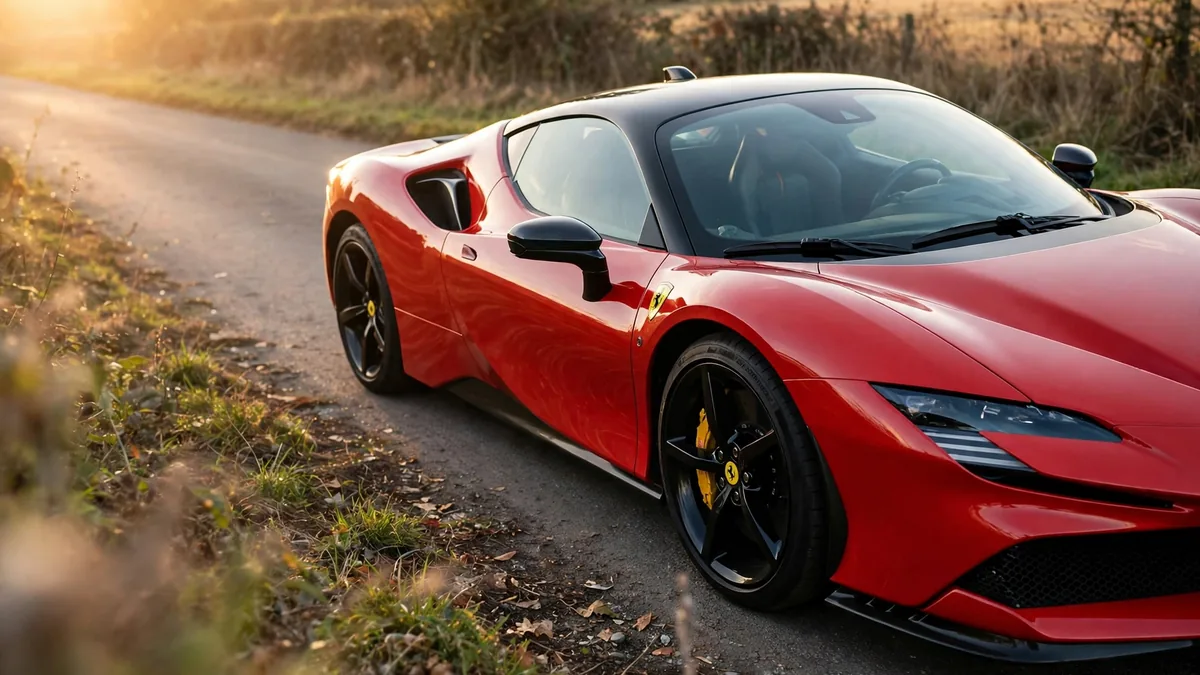
The Ferrari SF90’s specification sheet is short, but every number on it carries a story. The headline figure is 1,000 horsepower, or 1,000 CV in Ferrari’s own units, and it made the SF90 the most powerful road car the company had ever built when it arrived. The rest of the numbers explain how that figure is reached, and why it means more than a big number on a brochure.
Specs only make sense when you know what they measure. A horsepower figure means little without the weight it has to move, a battery size means little without knowing what it powers, and an acceleration time means little without knowing how it was achieved. This guide works through the SF90’s key figures one by one, in plain English, and explains what each one means on the road.
All figures below are the commonly quoted ones for the SF90 Stradale. Small differences appear between markets and model years, so treat them as rounded, representative values rather than exact engineering data.
Specs Explained
1. Combined output: 1,000 horsepower
The number everyone quotes first is the combined output: 1,000 CV, which works out at about 986 horsepower. It is the sum of everything pushing the car — the V8 engine and all three electric motors working together at full power. No single part makes that figure on its own, which is the point of a hybrid: the total is bigger than any one source. A thousand horsepower in a road car is still rare, and it puts the SF90 in the company of cars that cost far more. But the number is a peak, not a constant — it is available when the battery has charge and the systems are ready.
2. The V8’s share: around 780 horsepower
Most of that total comes from the engine: a 4.0-litre twin-turbocharged V8 making around 780 horsepower on its own. That is already more than many supercars manage from their entire powertrain, and it comes from a relatively small engine, helped by two turbochargers forcing extra air into the cylinders. The engine sits behind the seats and drives the rear wheels through an eight-speed dual-clutch gearbox. It is worth comparing with the other great engines of the hybrid era, and our look at the Lamborghini Revuelto V12’s specs shows how a very different philosophy — a big naturally aspirated V12 — reaches a similar kind of number.
3. The motors’ share: around 220 horsepower
The remaining power comes from the three electric motors, worth roughly 220 horsepower between them. Two drive the front wheels, one each, and the third sits beside the gearbox at the rear. The number looks small next to the V8’s, but motors are measured differently in practice: they deliver their torque instantly, from zero revs, which is exactly when the engine is weakest. So the motors’ contribution is felt most at launch and in the first moments of acceleration, where they make the car feel far stronger than the headline split suggests. They also give the car all-wheel drive and silent electric-only running, which no horsepower figure captures at all.
4. Battery: 7.9 kWh
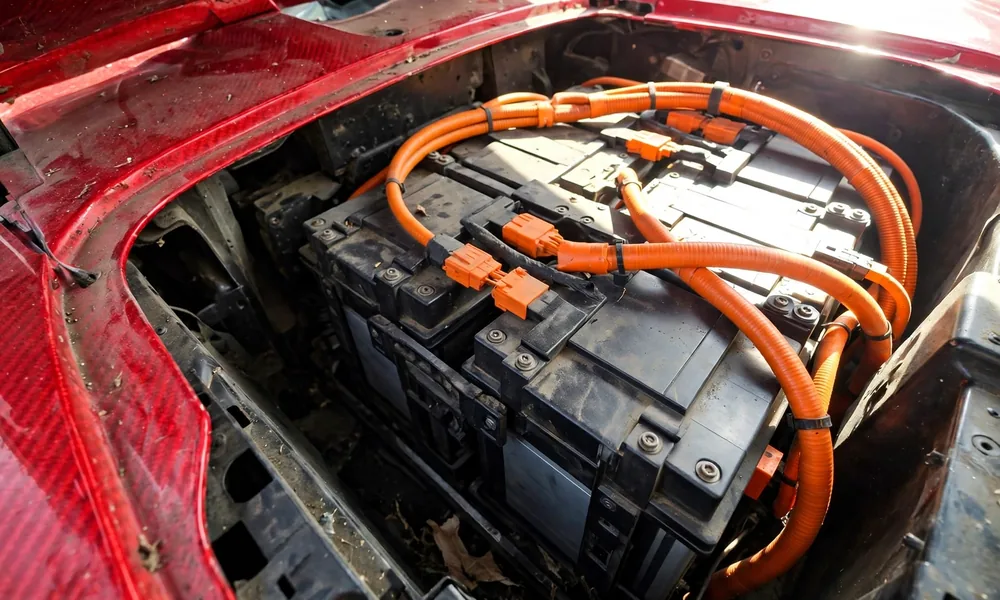
The battery holds about 7.9 kilowatt-hours of energy. A kilowatt-hour measures how much energy a battery can store, and the SF90 spends its small store in short, hard bursts. By electric-car standards it is small: a family electric car might carry ten times as much. But the SF90 is not trying to be an electric car. The pack exists to boost performance and to cover short electric-only trips, and keeping it small keeps it light — around 70 kilograms — which matters in a car where every kilogram hurts handling. It is liquid-cooled, because it charges and discharges in hard bursts.
5. Acceleration: 0 to 100 km/h in about 2.5 seconds
The SF90 reaches 100 km/h from a standstill in about 2.5 seconds, a figure that was among the quickest of any road car when it launched. Three things make it possible. First, the combined power is enormous. Second, the electric motors give instant torque from the first instant, so there is no waiting for the engine to build revs. Third, the front motors give all-wheel drive, so all that power can actually reach the road instead of spinning the rear tyres. The number is also a reminder that acceleration is a systems figure: it depends on the tyres, the grip, the launch control and the weight, not just the engine. A car with more power but rear-wheel drive alone can be slower off the line.
6. Top speed: about 340 km/h
Top speed is quoted at about 340 km/h, or roughly 211 mph. That is fast, but it is not the most extreme figure among hypercars, and that is deliberate. Top speed is mostly a matter of power against air resistance, and chasing it costs a lot: longer gearing, slippery bodywork, and a car tuned for a straight line rather than corners. Ferrari tuned the SF90 for the whole experience — acceleration, cornering and braking — rather than for a single top-speed number. On any real road or track, the acceleration figure matters far more than the last few km/h of top speed, because it is used at every corner exit, not once on a long straight.
7. Weight and balance: heavy battery, low centre of gravity
A hybrid supercar is heavy by supercar standards, and the SF90 is no exception — the battery, the motors and the power electronics add real weight over a petrol-only car. The figure most often quoted is a dry weight in the region of 1,570 kilograms, though exactly what is included varies by source. What matters more than the total is where the weight sits. The battery is mounted low, behind the seats, and the motors sit low at the front axle, so the centre of gravity stays low and central. That is why the car still handles like a Ferrari despite the extra mass. Keeping everything cool under that load is a job in itself, and the numbers behind it are explained in hypercar cooling system specs. The suspension has to manage all of it too, and hypercar suspension specs show what the numbers mean there.
The Numbers at a Glance
| Specification | Detail |
|---|---|
| Combined output | 1,000 CV, about 986 hp |
| V8 engine | 4.0-litre twin-turbo, about 780 hp |
| Electric motors | Three, about 220 hp combined |
| Battery | 7.9 kWh lithium-ion, liquid-cooled |
| 0 to 100 km/h | About 2.5 seconds |
| Top speed | About 340 km/h (211 mph) |
| Electric-only range | About 25 km in eDrive mode |

What the Numbers Mean
The battery is small because it is a booster, not a fuel tank, and the motors are modest in power but decisive in effect, because they act instantly. The most important number is still the first one — 1,000 horsepower — but now it should read less like a boast and more like a summary of a system: an engine, three motors, a battery and a computer, all arriving at the same answer at the same time.