A Ferrari SF90 looks like a normal supercar, but the way it moves is unlike any Ferrari before it. Under the body sit four power sources working at once: a twin-turbocharged V8 engine and three electric motors, all managed by computers that decide, many times a second, which source should do the work. The driver just presses the pedals, and the car sorts out the rest, blending petrol and electricity so smoothly that the handover is almost impossible to feel.
The SF90 was Ferrari’s first plug-in hybrid road car, and that matters because it changed what a Ferrari engine has to do. Before it, a Ferrari flagship was a big engine and a gearbox. The SF90 keeps the big engine but adds an electric system that can drive the car on its own, add power when the engine needs help, and recover energy every time the car slows down.
Understanding the system means following the power from its sources to the wheels, and seeing how the car’s driving modes change the recipe. Each part has a job, and none of them works alone.

How It Works
Step 1: The V8 does the heavy lifting
At the heart of the system is a 4.0-litre twin-turbocharged V8, mounted behind the seats, and it produces most of the car’s power on its own — around 780 horsepower in the usual quoted figures. It drives the rear wheels through an eight-speed dual-clutch gearbox, and it was designed from the start to share its job with electric motors. The turbos force extra air into the cylinders so a relatively small engine can make supercar power. When the car is cruising gently, the engine can shut off entirely and let the motors take over. The turbochargers themselves are a study in precision, and our look at how a hypercar turbocharger works explains the spinning heart of the system.
Step 2: Three motors, three different jobs
The SF90 carries three electric motors, and each one has a different job. Two sit on the front axle, one driving each front wheel, and together they give the car all-wheel drive without any mechanical connection to the engine. The third motor sits between the V8 and the gearbox at the rear, and its job is to add power to the rear wheels and to fill in the gaps in the engine’s delivery. Electric motors make their full torque instantly, from a standstill, so they can push the car forward while the turbos are still building pressure. The front motors also handle reversing — the SF90 has no reverse gear in its gearbox, because the front motors simply spin backwards.
Step 3: The battery in the middle
Between the seats and the engine sits a lithium-ion battery pack holding about 7.9 kilowatt-hours of energy, sealed in a liquid-cooled case. That is a small battery by electric-car standards, deliberately so: it is meant to boost performance and cover short electric-only trips. The pack weighs around 70 kilograms, and placing it low and central keeps the car’s centre of gravity down, which is what keeps the handling sharp. Liquid cooling matters because the battery works hard — it charges and discharges in sharp bursts every time the car accelerates or brakes — and a hot battery loses power and ages faster.
Step 4: Four driving modes, four different cars
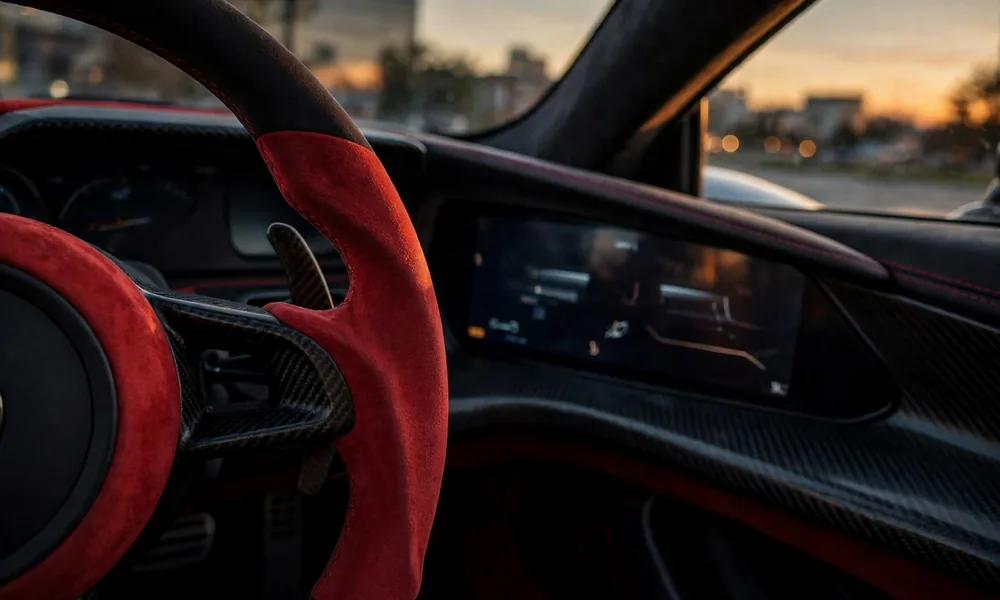
The driver chooses how the system behaves with a switch on the steering wheel, and the four modes feel like four different cars. In eDrive, the car runs on electricity alone, the V8 stays off, and it can cover roughly 25 kilometres in near silence. Hybrid is the default: the car mixes engine and motors on its own, choosing the most efficient combination for the road. Performance mode keeps the battery charged and the engine ready. Qualify is the maximum-attack setting, where the system spends the battery freely to give everything it has, lap after lap.
Step 5: Torque fill, the motors cover the turbos
A turbocharged engine has a weakness: when the driver asks for power suddenly, the turbos need a moment to spin up, and in that moment the engine feels flat. The SF90’s electric motors erase that moment. Because a motor makes torque instantly, the rear motor and the front motors can push the car forward while the turbos catch up, then hand over smoothly as the engine reaches full boost. Engineers call this torque fill, and it is one of the reasons the car feels so immediate — there is no waiting for power, only power.
Step 6: Braking that charges the battery
Every time the SF90 slows down, the electric motors turn into generators. Instead of wasting the car’s speed as heat in the brakes, the front motors resist the wheels and turn that motion back into electricity, feeding it into the battery. This is regenerative braking, and it is how the battery stays charged without the driver ever plugging in — though the car can also be plugged in to charge fully from the mains, which is what makes it a plug-in hybrid. The friction brakes still do the hard work at high speed and in emergencies, and blending the two kinds of braking so the pedal feels natural is one of the hardest jobs in the car’s software.
Step 7: The computer that conducts it all
None of this works without the control software, which is arguably the most complex part of the whole system. It watches the pedals, the steering, the speed of each wheel, the battery’s temperature and charge, and the engine’s state, and it recalculates the split of power hundreds of times a second. It also manages traction: because each front wheel has its own motor, the car can send more power to the wheel with grip and less to the one that is slipping. Splitting torque between wheels is an old engineering problem, and our look at how a hypercar differential works shows how the mechanical version of the same job is done. Keeping all of it cool is its own challenge, and the cooling system that protects the battery, motors and engine is explained in how a hypercar cooling system works.
The System at a Glance
| Part | What it does |
|---|---|
| V8 engine | 4.0-litre twin-turbo, drives the rear wheels |
| Front motors | Two motors, one per front wheel, all-wheel drive |
| Rear motor | Fills torque gaps and adds power at the rear |
| Battery | About 7.9 kWh, lithium-ion, liquid-cooled |
| Gearbox | Eight-speed dual-clutch, no reverse gear |
| Driving modes | eDrive, Hybrid, Performance, Qualify |

Why the System Works
The SF90’s hybrid system works because it never asks one power source to do everything. The engine provides the sustained power and the sound, the motors provide the instant response and the silent running, and the battery ties them together. Each part covers the others’ weaknesses: the motors hide turbo lag, the engine covers the battery’s small size, and the software keeps the whole arrangement invisible to the driver. That is the real achievement — not the headline power figure, but the fact that a car with four power sources feels like one machine. It is why the SF90 matters beyond its own sales: it proved that a hybrid Ferrari could still feel like a Ferrari.


