The road is empty and the air is still cold when the driver presses the starter button. For a second nothing happens, then the car clears its throat — a deep bark settling into a fast, metallic idle behind the seats. It is the sound of twelve cylinders adding up to a noise that feels bigger than the car itself.
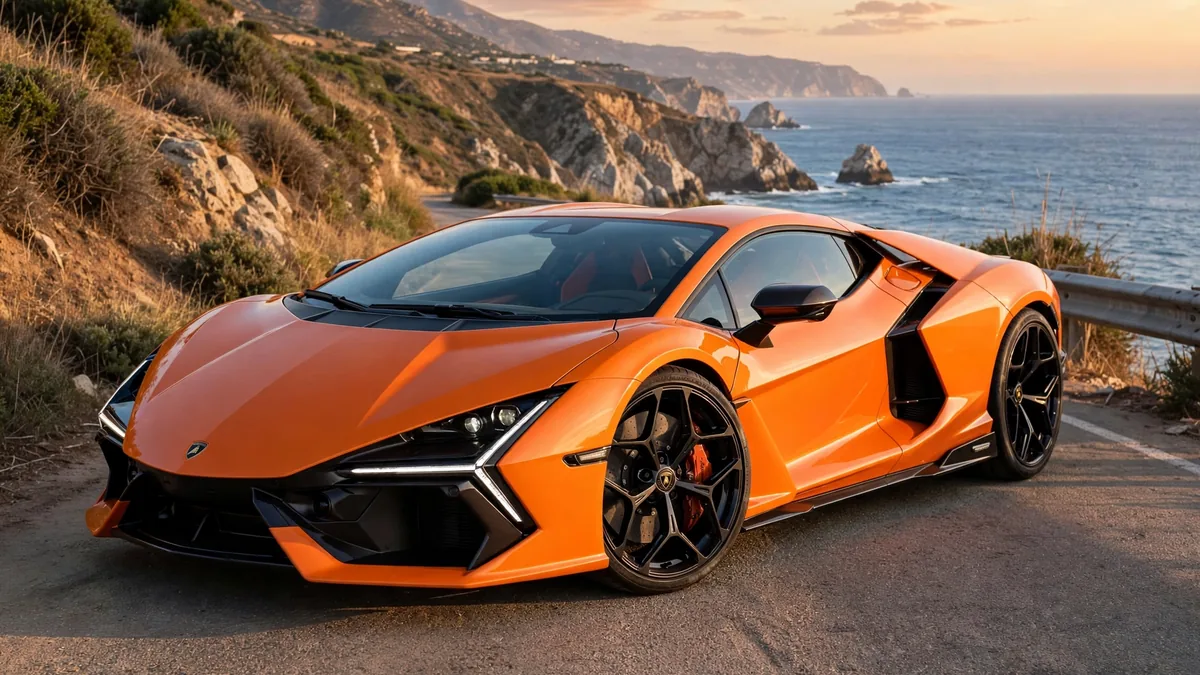
That car is the Lamborghini Revuelto, the flagship that replaced the Aventador and the first Lamborghini to pair its famous V12 with electric motors. It is a hybrid, but not one that apologises for it. The petrol engine still does the heavy lifting, still revs past 9,000 rpm, and still sits mid-car where every Lamborghini flagship engine has sat since the 1960s. The electric motors fill the gaps the engine cannot: instant torque at low revs and traction at the front wheels.
On paper the Revuelto is a wall of numbers: 1,015 horsepower, 6.5 litres, 9,500 rpm, 2.5 seconds. This guide takes them one at a time and explains what each one means in the driver’s seat.
How the Revuelto V12 Works
Step 1: Displacement and layout
The heart of the Revuelto is a 6.5-litre V12, codenamed L545, and it is an entirely new engine rather than a reworked Aventador unit. Twelve cylinders sit in two banks of six, angled at 60 degrees, and together they sweep 6,498 cubic centimetres of air and fuel with every cycle. That size matters because a naturally aspirated engine — one with no turbocharger forcing air in — can only make power by moving more air. The V layout keeps the engine short enough to fit behind the cabin, and the 60-degree angle gives it the smooth firing rhythm that sets a V12 apart from a V8 or V10. Building one by hand is a craft in its own right, as our guide to how a hypercar V12 engine is made explains.
Step 2: Power and revs
On its own, without any electric help, the V12 makes 825 horsepower at 9,250 rpm. Horsepower measures how fast the engine can do work, and high revs are how a naturally aspirated engine earns it. The engine spins to a redline of 9,500 rpm, which means each piston travels up and down more than 150 times every second at full throttle. To survive that, the pistons, rods and valves are made from light, strong materials, and the intake grows more efficient the faster it spins. Peak power arrives near the top of the rev range, which is why the car feels calm at low speed and violent above 7,000 rpm.
Step 3: Torque and the hybrid fill
Torque is the twisting force that actually pushes the car forward, and the V12 produces 725 Newton-metres of it at 6,750 rpm. That is a strong number, but it arrives late: a big naturally aspirated engine needs revs before it pulls hard. That is where the hybrid system earns its place. Three electric motors add torque instantly from zero revs, filling the gap before the V12 wakes up: two drive the front wheels, one sits inside the gearbox, and together they add 190 horsepower. The result pulls hard from a standstill all the way to the redline, with no flat spot in between.

Step 4: The gearbox and the electric motors
All of that power reaches the road through an eight-speed dual-clutch gearbox mounted behind the engine. A dual-clutch gearbox is two gearboxes in one case: one handles the odd gears, the other the even gears, handing over in milliseconds without breaking the flow of power. The gearbox also carries the third electric motor, which can drive the rear wheels alone at low speed and help the V12 at full throttle. The two front motors give the car all-wheel drive without a driveshaft through the cabin, and can send different power to each front wheel to help it turn. It is why the Revuelto can be both a silent electric car in a car park and a 1,015-horsepower supercar on an open road. The same obsession with squeezing power from every cylinder shaped the rival described in our guide to Bugatti W16 engine specs.
Step 5: Weight and power-to-weight
A supercar is judged as much by its weight as by its power, and the Revuelto weighs about 1,772 kilograms dry — the car without fluids, fuel or luggage. That is heavy for a Lamborghini: batteries, motors and extra cooling all add mass. What saves it is the power-to-weight ratio, which decides how fast a car feels. With 1,015 horsepower pushing 1,772 kilograms, each horsepower carries about 1.75 kilograms, a figure that puts the Revuelto among the quickest accelerating cars ever built. A carbon fibre monocoque tub keeps the structure stiff and light, so the suspension works instead of fighting a flexing body.
Step 6: Speed and acceleration
The numbers at the end of the brochure are the ones everyone remembers. Zero to 100 kilometres per hour takes 2.5 seconds, zero to 200 takes under seven seconds, and the top speed is over 350 kilometres per hour. The launch is so violent because the electric motors give full torque from rest while the V12 climbs to its power band, and all-wheel drive puts it on the road without wheelspin. Top speed is more about aerodynamics: above 300 kilometres per hour most of the engine’s effort goes into pushing air aside, and the active rear wing and underbody keep it planted. Numbers like these are why the car costs what it does, as explained in our guide to why the Lamborghini Revuelto V12 is so expensive.
Lamborghini Revuelto V12 Specs
| Specification | Typical range |
|---|---|
| Engine | 6.5-litre naturally aspirated V12 (L545) |
| Engine power | 825 horsepower at 9,250 rpm |
| Combined power | 1,015 horsepower with three electric motors |
| Torque | 725 Nm at 6,750 rpm |
| Redline | 9,500 rpm |
| 0 to 100 km/h | 2.5 seconds |
| Top speed | Over 350 km/h |
| Dry weight | About 1,772 kg |
What Does a Lamborghini Revuelto Cost?
A new Lamborghini Revuelto is estimated to cost from roughly $600,000 before options, with most cars leaving the factory closer to $700,000 once buyers add paint, trim and carbon fibre extras. In the UK the starting price is estimated at around £450,000. Prices are estimates only and vary by market, taxes and specification.
A Rare Fact
Lamborghini has built V12 engines without a break since 1963, when the 350 GT arrived with a 3.5-litre V12 designed by Giotto Bizzarrini. That makes it part of the longest-running V12 line in car history — more than sixty years of flagships, from the Miura to the Aventador. The Revuelto’s V12 is also the lightest the company has ever built, at 218 kilograms, despite being the most powerful. It is a fitting end to the story and a beginning at the same time: the first Lamborghini V12 to share its work with electric motors.
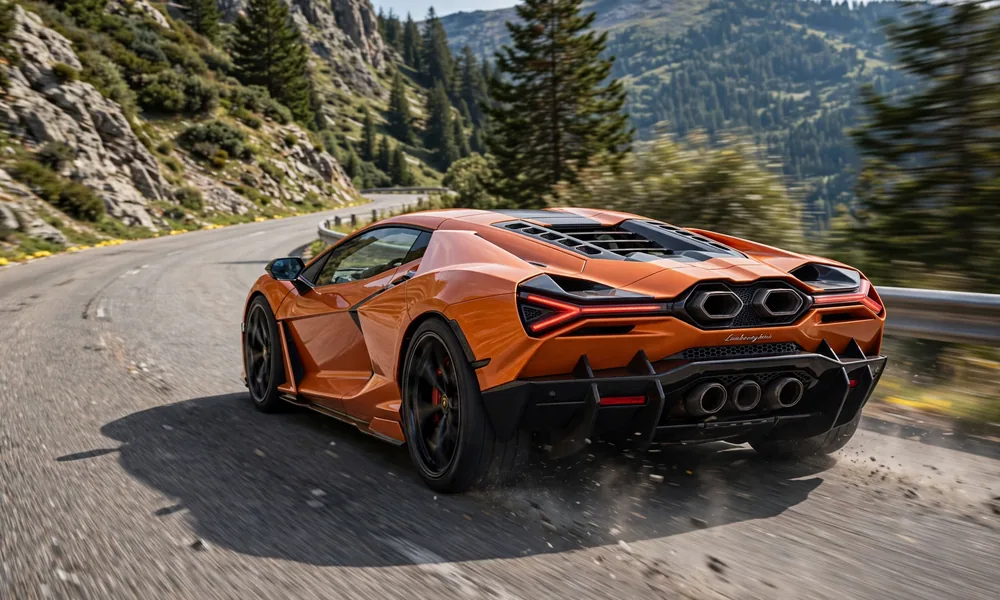
Strip away the hybrid system and the Revuelto is a simple idea: twelve cylinders, no turbochargers, and an engine that wants to rev. Displacement for breathing, revs for power, electric motors for the gaps, and a weight the power overwhelms. Then the spec sheet stops being a list and starts describing how the car feels.


