The hypercar comes over the crest at well over 200 kilometres an hour, and the road drops away beneath it. For a fraction of a second the car is light, almost airborne, and then the suspension catches it — not with a crash, but with a controlled, deliberate settling, as if the car had decided exactly how much of that landing to feel and how much to ignore. A moment later it is hard on the brakes for a hairpin, the nose dips a few millimetres, and it is gone around the corner, flat and level.
That composure is the suspension’s doing, and in a hypercar the suspension is not a set of springs bolted to a chassis. It is an active, thinking system — hydraulics, sensors, and software working together many times a second to keep the tyres pressed into the road and the body exactly where the engineers want it. The specification sheets list spring rates, damping curves, ride heights, and active systems that raise and lower the car by themselves. Those numbers decide how the car behaves at 350 kilometres an hour, how it rides over a pothole, and whether it can lap a circuit faster than anything else on the road. Here is what they mean.
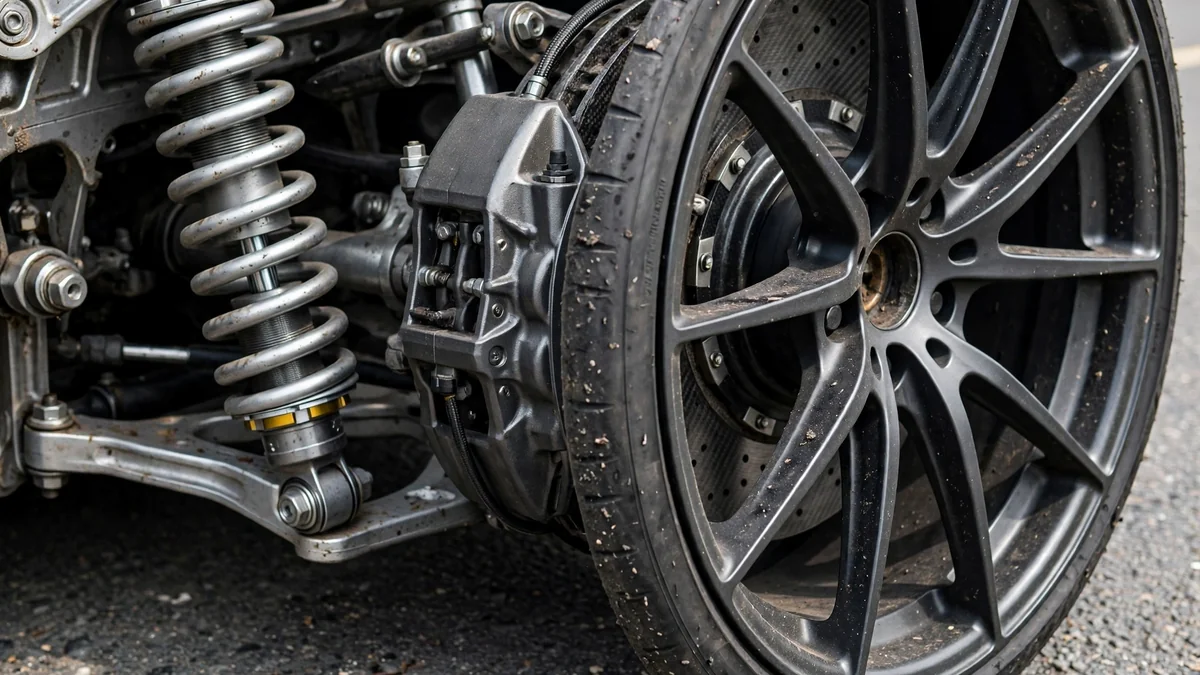
How It Works
Step 1: The chassis it hangs from
A hypercar’s suspension starts with the chassis, usually a carbon-fibre monocoque — a single rigid tub that the suspension bolts directly onto. The monocoque is so stiff it barely twists under load, which means the suspension does all the work of absorbing bumps and controlling body movement; there is no flex in the body to hide mistakes. That stiffness is why the suspension can be tuned so precisely. The engineering behind that structure is part of how hypercar suspension works.
Step 2: Pushrods and rockers
Most hypercars use pushrod suspension, borrowed directly from Formula 1. Instead of the spring and damper sitting upright beside the wheel, a slim pushrod runs from the wheel up to a rocker arm inside the body, and the spring and damper lie flat inside the chassis. When the wheel hits a bump, the pushrod pushes the rocker, and the rocker squeezes the spring. The advantages are aerodynamic — almost nothing sticks out into the airflow around the wheel — and packaging: the heavy parts sit low and inboard, keeping the centre of gravity down. The materials that make those parts light enough are covered in hypercar suspension materials engineering.
Step 3: Springs, and the heave spring
The springs are often titanium or high-strength steel, wound to a rate measured in hundreds of newtons per millimetre — far stiffer than any ordinary car. But a hypercar has a problem an ordinary car does not: at high speed, aerodynamic downforce presses the car down with tonnes of force, and the springs have to hold the car up against it. The answer is the heave spring, a third spring that works only when both wheels on an axle move together — as they do under downforce — while leaving the car soft enough over single-wheel bumps. One spring for bumps, another for downforce, and the car never has to choose between them.
Step 4: Dampers that think
The dampers are where the electronics live. In a modern hypercar they are adaptive, with valves controlled by a computer that reads the road many times a second from accelerometers on the wheels and the body. It softens over sharp bumps, stiffens under braking, and firms up on the outside in corners. Some systems connect the dampers across the car hydraulically, so roll and pitch are controlled without conventional anti-roll bars. The damper is no longer a passive tube of oil; it is an active part of the car’s brain, adjusting itself continuously to what the road and the driver are doing.
Step 5: Active ride height and aero
At speed, a hypercar lowers itself. Active suspension can drop the ride height by 30 to 50 millimetres in race mode, sealing the car closer to the road so the underbody aerodynamics work properly — the floor and diffuser need a precise gap to the ground to generate downforce. The suspension and the aerodynamics are one system, not two, and the ride height is a performance setting, not a fixed number. That integration is part of why these cars are so expensive to develop, as explained in why hypercar suspension is so expensive.
Step 6: The tyres and the final millimetres
All of this exists for one purpose: keeping the tyre in contact with the road. A hypercar’s tyres are enormous — 335 millimetres wide at the rear is common — and they generate the grip, but only if the suspension holds them flat against the tarmac. The geometry is designed so the tyre stays flat through the corner rather than rolling onto its edge. The suspension’s last job is the smallest one: the final millimetres of travel over a kerb or a bump, absorbed without upsetting the car. When it does not, even a thousand horsepower is useless, because power you cannot put through the tyres is just noise.

Hypercar Suspension Specs
| Specification | Typical range |
|---|---|
| Layout | Double wishbone with pushrod actuation, front and rear |
| Spring rate | About 200 to 600 N per mm depending on axle and mode |
| Damper type | Adaptive, electronically controlled, often hydraulically linked |
| Ride height | About 70 to 120 mm, adjustable by 30 to 50 mm in race mode |
| Spring material | Titanium or high-strength steel |
| Wheel travel | About 50 to 80 mm total |
| Anti-roll | Hydraulic or active systems, often no conventional roll bar |
| Rear tyre width | About 315 to 355 mm |
What Does Hypercar Suspension Cost?
Hypercar suspension is not sold as a standalone kit, so its cost is part of the car’s price — and these cars are estimated to cost roughly $1 million to $3 million, with some limited models estimated at $3 million to $5 million or more. The suspension system itself, including the dampers, springs, hydraulics, sensors, and control electronics, is estimated to account for roughly $50,000 to $150,000 of that cost on a typical hypercar. A single replacement adaptive damper is estimated to cost roughly $5,000 to $15,000, and a full corner — damper, spring, wishbones, and upright — can be estimated at $20,000 to $40,000.
A Rare Fact
The active suspension that hypercars use today was banned from Formula 1 for being too good. In the early 1990s, Williams built a car with fully active suspension that read the track and adjusted itself corner by corner, and in 1992 and 1993 it was so dominant that the sport changed the rules to outlaw it. The technology did not die — it went into road cars. The hydraulic systems on modern hypercars, which control ride height, roll, and pitch without conventional springs and bars doing all the work, are the direct descendants of that banned Formula 1 system. What was once too clever for racing is now what you get when you buy a road car with a seven-figure price tag.

Next time you see a hypercar flash past, low and level, remember that what you are looking at is not just power. It is a suspension system making a thousand decisions a second, so that the driver only has to make one: where to point it.


