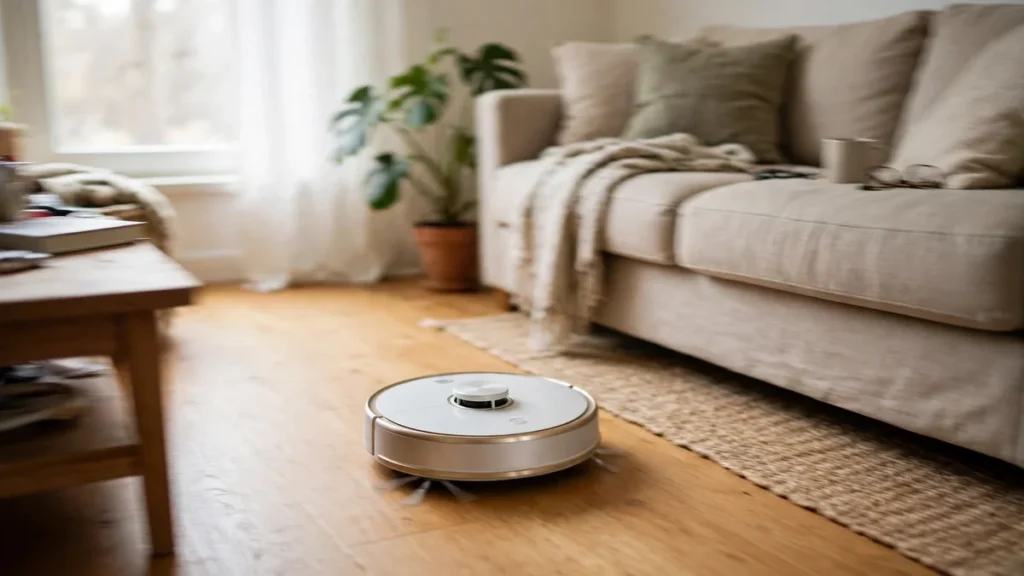
Watch a modern robot vacuum at work and it looks almost thoughtful. It rolls out of its dock, pauses, and then sets off in neat, parallel lines across the room, slipping around chair legs and never once bumping into the furniture. It is not guessing. On top of the little disc sits a small turret, spinning several times a second, firing thousands of invisible laser pulses and timing their return — a LiDAR sensor, building a map of your home accurate to a few centimetres, in the dark, while you sleep. That turret is the most expensive part of the vacuum, with the LiDAR module estimated to cost $50 to $150.
A robot vacuum LiDAR is expensive because it is a precision surveying instrument shrunk to the size of a biscuit, built to survive years of spinning in a dusty home, and asked to work perfectly in every room it has ever seen. Here is where the money goes.

Why It Costs So Much
1. The spinning laser module
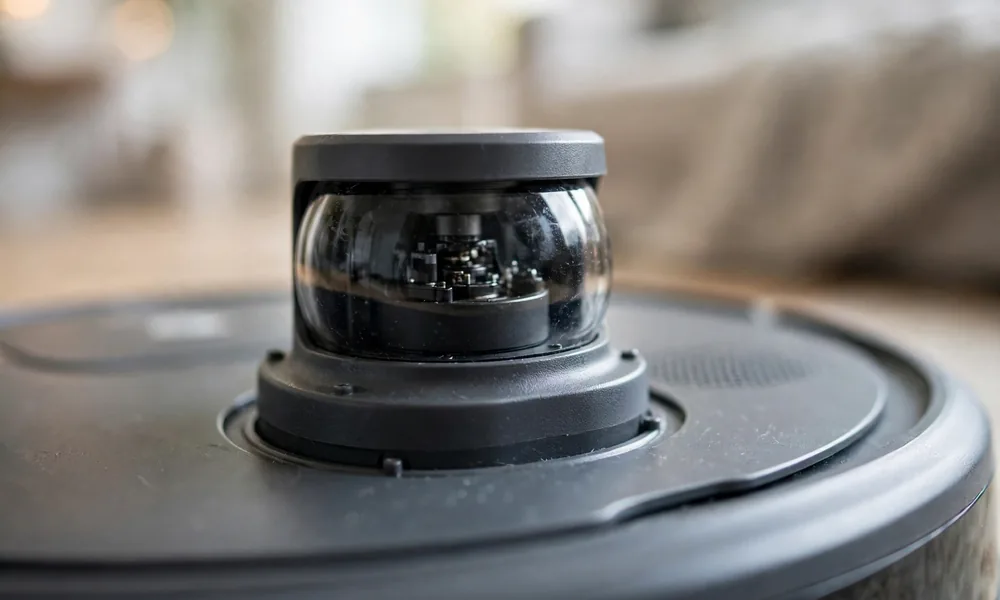
At the heart of the system is a small laser emitter and a receiver, mounted on a turret that spins to sweep the beam around the room. The laser fires pulses of infrared light, and the sensor measures how long each pulse takes to bounce back, converting that time into distance — thousands of measurements every second, stitched together into a 360-degree picture of the room. The emitter, optics, and receiver must be aligned with great precision, because a beam even slightly off will misjudge distances. The module is sealed against dust, balanced to spin smoothly, and driven by a tiny motor that must run for thousands of hours. Building a spinning laser rangefinder this small, this cheap, and this reliable is a feat that took years of engineering to achieve. The sensor’s wider family is worth knowing — see how a LiDAR sensor works for the principles behind it.
2. The mapping processor and software
Raw laser measurements are useless without a brain to interpret them. The vacuum carries a processor that runs SLAM software — simultaneous localisation and mapping — which turns a stream of distance readings into a floor plan, works out where the vacuum is inside that plan, and plots the most efficient cleaning route. Writing that software took years of research, and it must handle the chaos of a real home: moved furniture, open doors, rugs that look like steps, and mirrors that confuse the laser. The processor itself is a specialised chip, more powerful than the one in many household appliances, and it needs memory to store maps of several floors. The hardware is only half the cost; the years of software development behind it are the other half, and they are baked into the price of every unit.
3. Miniaturisation and durability
A robot vacuum’s LiDAR turret lives a hard life. It spins several times a second, every time the vacuum cleans, for years — tens of millions of rotations over its working life — while being bumped, shaken, and coated in household dust. The bearings must stay smooth, the optics must stay clean, and the motor must keep spinning at a constant speed, because any wobble or slowdown corrupts the map. Making a spinning assembly that small and that durable means precision bearings, careful balancing, and wear-resistant materials, and every unit is bench-tested before fitting. A turret that fails means a vacuum that wanders blindly, so manufacturers overbuild it — and charge for the privilege.
4. An eye-safe laser, calibrated to perfection
The laser in a robot vacuum is invisible infrared light, and it is aimed at floor level in homes full of people and pets, so it must be eye-safe by design — low power, carefully shaped, and certified to international laser safety standards. The laser’s power, wavelength, and beam shape are measured and documented, and the design is reviewed by safety bodies before it can be sold. On top of that, every unit is calibrated at the factory, because the sensor’s distance measurements depend on exact timing — light travels about 30 centimetres in a nanosecond, so the electronics must measure time with extraordinary precision. The calibration rigs, the safety testing, and the certification paperwork add real cost to a component that the owner never sees.
5. Sensor fusion: LiDAR does not work alone
LiDAR builds the map, but it cannot do everything. A robot vacuum also carries cliff sensors to stop it falling down stairs, bump sensors for the things the laser misses, carpet sensors to boost suction, and often a camera or a structured-light sensor to spot cables, socks, and pet accidents. All of these sensors feed into the same processor, and the software must combine them — sensor fusion — into a single picture of the world, deciding in real time which sensor to trust when they disagree. Designing and testing that fusion is a large part of the development cost, and it is why a LiDAR vacuum cleans in tidy lines while a cheaper bump-and-run vacuum wanders at random. The materials and the build of the LiDAR unit itself are covered in robot vacuum LiDAR materials explained — the full engineering story behind the turret.
6. Software updates and maps that live on
The cost does not end when the vacuum leaves the factory. Manufacturers keep updating the mapping software for years, fixing bugs, improving navigation, and adding features — room naming, no-go zones, multi-floor maps — all delivered over the air. Storing and processing those maps costs money to run. A LiDAR vacuum is not a one-time purchase of hardware; it is a product with a service behind it, and the price reflects years of ongoing software support. It is the same shift that has made other sensors expensive: the hardware is only the beginning, and the intelligence behind it is where the value — and the cost — now sits. Even a cinema-grade sensor carries the same lesson — see why a cinema camera sensor costs so much.

Specifications
| Property | Typical Robot Vacuum LiDAR |
|---|---|
| Range | ~6–8 m |
| Spin rate | ~5–10 revolutions per second |
| Measurement rate | Thousands of points per second |
| Mapping accuracy | ~2 cm |
| Laser class | Class 1, eye-safe infrared |
| Turret life | Tens of millions of rotations (estimated) |
| Processor | Specialised SLAM chip + memory |
| Works in darkness | Yes — laser needs no light |
What the Money Buys
The LiDAR module in a premium robot vacuum is estimated to cost $50 to $150, within a vacuum selling for an estimated $800 to $1,500 — all prices here are estimates, not quotes. What the money buys is a vacuum that cleans like it can see: neat rows instead of random wandering, no missed patches, no repeated passes over the same spot, and a map of your home you can edit on your phone, telling it to clean the kitchen after dinner and leave the bedroom alone. It buys a machine that works in the dark and finishes in half the time a blind vacuum takes. For a device that runs while you are out, that competence is the whole product — and the little spinning turret on top is what makes it possible.
Rare Fact
A robot vacuum’s LiDAR turret spins several times every second, firing thousands of laser pulses and timing each one’s return, to build a map of your home accurate to a couple of centimetres — and because it uses its own laser light, it maps just as well in pitch darkness as it does at noon.