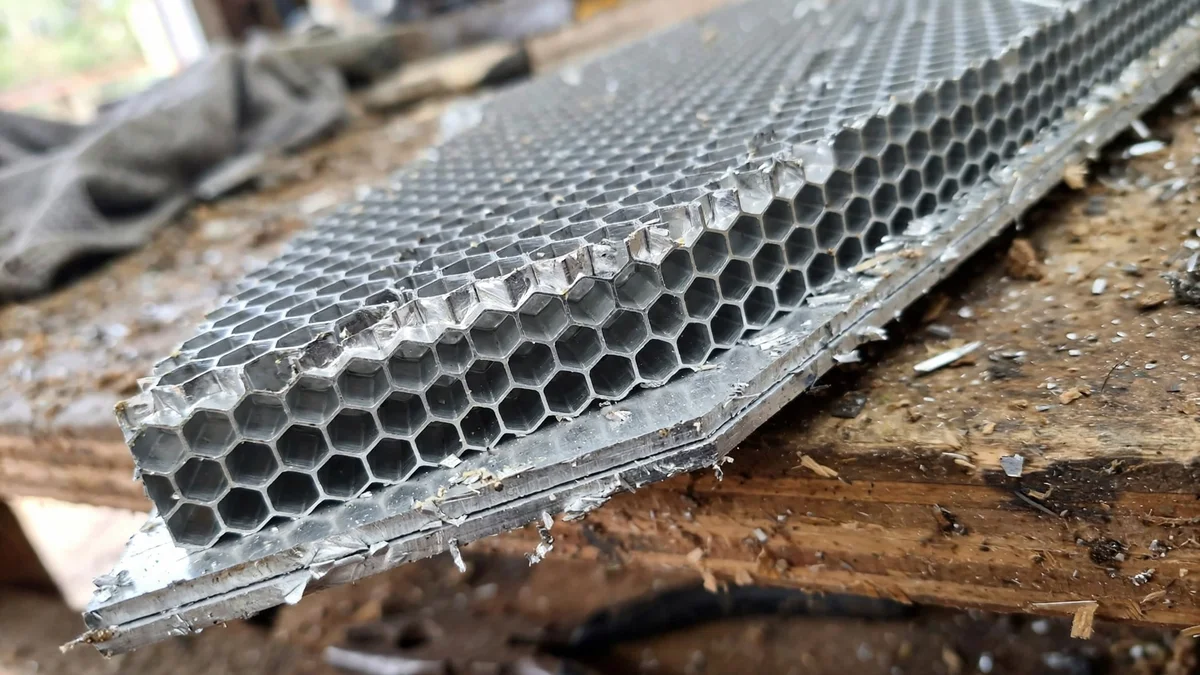
Pick up a panel of honeycomb core and your hands will argue with your eyes. It looks like it should weigh as much as a steel plate, yet it lifts like a sheet of cardboard. Tap it and it rings stiff and hard, almost like a drum skin pulled tight over a frame. That contradiction is the whole point of the material: a lattice of paper-thin metal walls, arranged in hexagons, that carries loads far out of proportion to its weight. Aircraft floors, satellite panels, racing car crash structures and even the doors of high-speed trains all lean on the same humble geometry that bees worked out millions of years ago.
The idea is simple enough to sketch on a napkin. A single thin sheet of aluminium buckles under almost no load at all. Fold that sheet into a repeating honeycomb, glue a skin to each face, and suddenly the same metal resists bending, crushing and shear with startling authority. The core does the clever work in the middle, holding the two skins apart so they act like the flanges of a beam, while the skins themselves take the tension and compression. Engineers call the result a sandwich panel, and it is one of the best strength-to-weight bargains in all of engineering.
What makes honeycomb core remarkable is how little material it actually contains. In a typical aerospace panel, more than ninety per cent of the core volume is empty air. The metal walls may be only a few hundredths of a millimetre thick, thinner than a human hair, yet the finished panel can support a person standing on it without flexing. That is why designers reach for it whenever every gram matters: a kilogram saved in an airliner is fuel saved on every flight it ever makes, and a kilogram saved in a satellite is a kilogram of extra instrument that can fly instead.
How It’s Made
Step 1: Rolling the foil
Everything starts with aluminium foil, rolled down to a thickness of around 0.03 to 0.07 millimetres. The alloy is usually a 3000-series or 5000-series grade chosen for formability and corrosion resistance, and the foil must be perfectly clean and flat. Any dent, crease or speck of oil will show up later as a weak cell or a failed bond, so the foil is handled in clean conditions and inspected as it unrolls from coils that can weigh hundreds of kilograms.
Step 2: Printing the adhesive lines
Next, narrow stripes of adhesive are printed along the foil in a precise repeating pattern. These stripes are the secret of the whole process: where two sheets are glued together, the honeycomb walls will be double thickness, and where they are not, the foil is free to stretch open. The spacing of the lines sets the cell size, commonly between three and twelve millimetres across, and the adhesive is chosen to survive the curing oven that comes later.
Step 3: Stacking and bonding the sheets
Dozens or hundreds of printed sheets are stacked into a thick block, aligned so that the adhesive lines of each sheet sit exactly over the lines of the one below. The stack goes into a heated press, where temperature and pressure cure the adhesive into a solid block known as a honeycomb block or HOB. At this stage the material looks like a solid slab of layered foil, and nothing about it suggests the delicate lattice hidden inside.
Step 4: Expanding the block
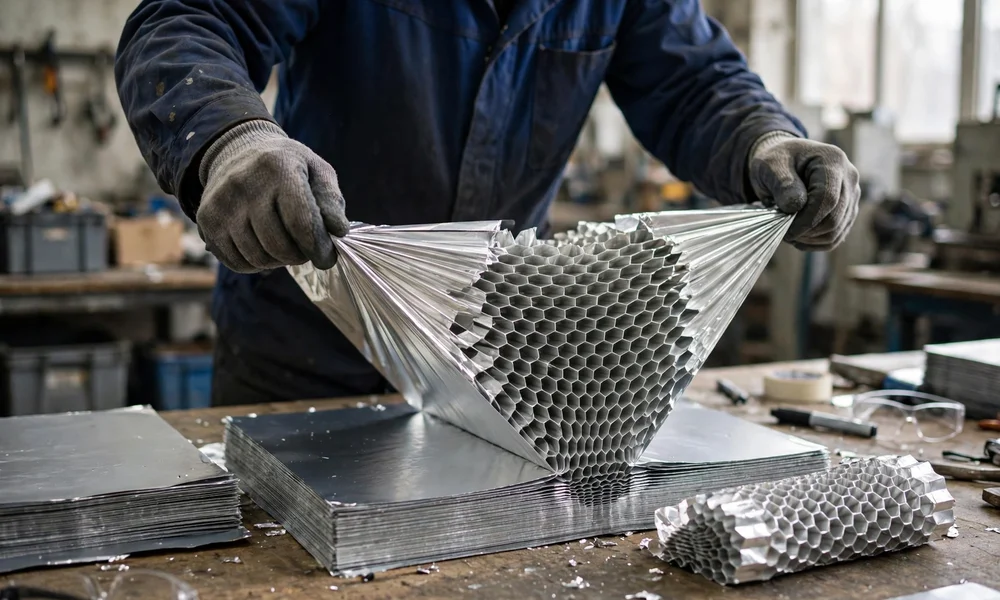
This is the moment of transformation. The cured block is sliced into slabs of the required core thickness, and each slab is pulled apart from both sides. The unglued sections of foil peel away from each other and open into hexagonal cells, while the glued lines hold firm and become the shared walls between neighbouring cells. Done slowly and evenly, the expansion produces a regular honeycomb; rushed, it tears the foil and ruins the slab. Some makers expand the core in a frame that holds the cell shape true while it sets.
Step 5: Bonding the skins
The expanded core is trimmed to size and bonded between two face sheets, usually aluminium, carbon fibre or fibreglass, using film adhesive. The sandwich is cured in an autoclave or heated press, where pressure forces the adhesive into every cell edge and heat sets it hard. The bond between core and skin is the most critical joint in the panel: if it fails, the skins peel away and the panel loses nearly all of its stiffness. Every panel is therefore checked for voids and weak bonds before it leaves the factory.
Step 6: Cutting, shaping and inspection
Finally, the sandwich panel is cut to shape, its edges are sealed or potted with filler so moisture cannot creep into the cells, and inserts are fitted wherever bolts or fasteners will pass through. Finished panels are weighed, measured and tested, often with ultrasound to confirm the core-to-skin bond across the whole area. Only then is the panel cleared for use in an aircraft floor, a spacecraft wall or a racing car tub.
Specifications
The numbers below describe a typical aluminium honeycomb core for aerospace use. Cell size, foil thickness and density trade against each other, so makers offer a wide catalogue of grades for different jobs.
| Property | Typical value |
|---|---|
| Cell size | 3 to 12 mm across |
| Foil thickness | 0.03 to 0.07 mm |
| Core density | 32 to 130 kg per cubic metre |
| Common alloys | 3003, 5052, 5056 aluminium |
| Compressive strength | 1 to 10 MPa, grade dependent |
| Typical panel thickness | 6 to 50 mm |
| Service temperature | Up to about 175 °C |

What It Costs
A square metre of aluminium honeycomb core costs roughly $40 to $180 as an estimate, depending on cell size, foil alloy and density, with aerospace-grade material at the upper end of that range. Finished sandwich panels cost considerably more once skins, adhesive, curing and inspection are included, and a certified aircraft floor panel can run into hundreds of dollars per square metre. The price is driven less by the raw metal, which is cheap, than by the precision of the printing, expansion and bonding steps.
A Rare Fact
Honeycomb core flew to the Moon. The Apollo lunar module used aluminium honeycomb in its structure and in the crushable landing gear footpads that absorbed the shock of touchdown, and honeycomb panels still form the floors and walls of the International Space Station. The same geometry also hides inside the wings of modern airliners, where it quietly carries the loads of every takeoff and landing. Few materials have served in so many extreme places while remaining, by volume, almost entirely empty space.
The lesson of honeycomb core is that clever geometry can beat brute material. Engineers who need strength without weight keep returning to the hexagon, and the materials behind honeycomb core show just how much performance can be squeezed from foil thinner than paper. The factory that builds honeycomb core turns that foil into panels for aircraft and spacecraft, while the specs of carbon fibre weave explain the skins that are so often bonded to it. Together, core and skin make a panel that is mostly air, yet strong enough to fly.


