Two hundred metres below the surface, the sea is black in every direction, and the submarine is blind. It cannot rise to look around without giving itself away, and it cannot send a signal without being heard. So a single steel tube climbs quietly through the sail, breaks the surface for a few seconds, and shows the crew the world above.
A submarine periscope is a telescope built like a pressure vessel. It is a column of steel and glass about ten metres long, packed with lenses, prisms, and sensors, and it must stay perfectly straight while the boat rolls beneath it. The optics inside must line up to a fraction of a hair’s width, because a tiny tilt would throw the image somewhere else entirely.
The modern periscope is expected to do far more than look. Yet the classic optical periscope is still fitted and still trusted, because glass and mirrors cannot be jammed. Here is how it works, step by step, from the first ray of light to the image in the operator’s eye.
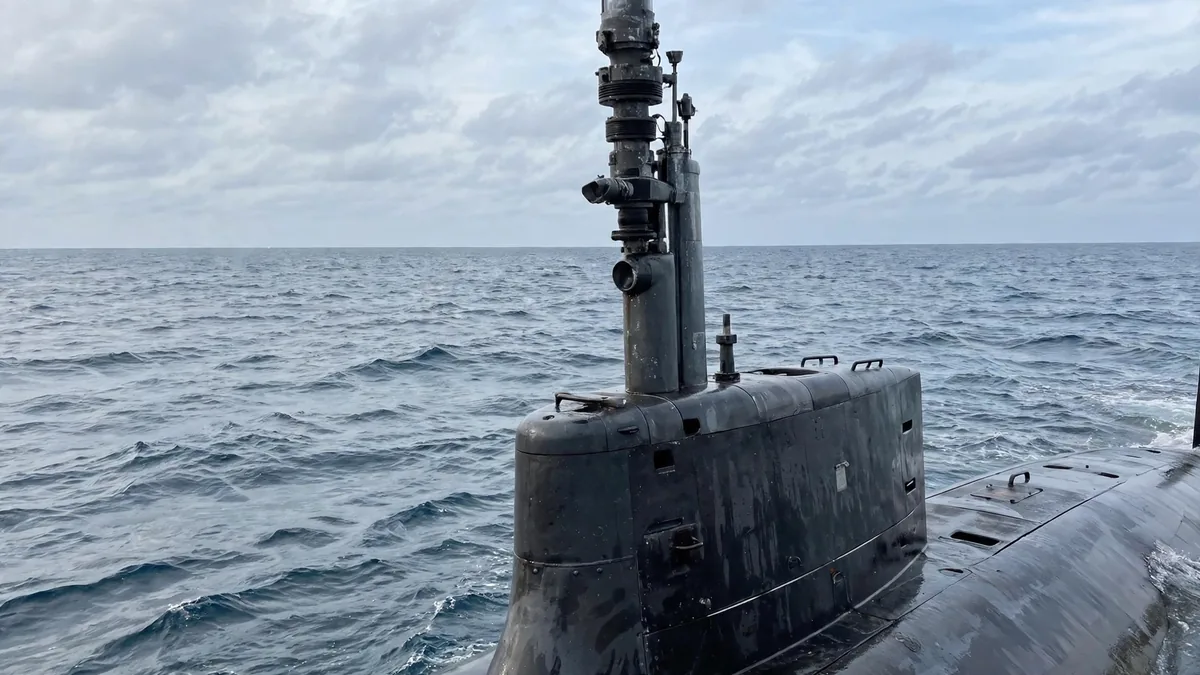
How a Submarine Periscope Works
Step 1: Light enters through the top window
Everything begins at the head of the periscope, the small housing that breaks the surface. A thick slab of optical glass, the top window, lets light in while keeping seawater out. The window is set into a steel housing with pressure-proof seals, and it is shaped so that spray runs off it rather than pooling on the glass. Behind the window sits a prism, a wedge of glass that bends the incoming light by ninety degrees and sends it straight down the tube.
Step 2: Prisms and lenses carry the image down the tube
Once the light turns downwards, it travels through the optical train, a series of lenses and prisms fitted inside the tube in strict order. Each lens bends the light a little, keeping the image sharp and upright as it travels several metres down to the control room. Between the lenses, relay prisms flip the image the right way up, because a simple set of lenses would deliver the picture upside down. The way the tube itself is built to survive the deep is explained in how a submarine pressure hull is made, a structure that must hold back the full weight of the ocean.
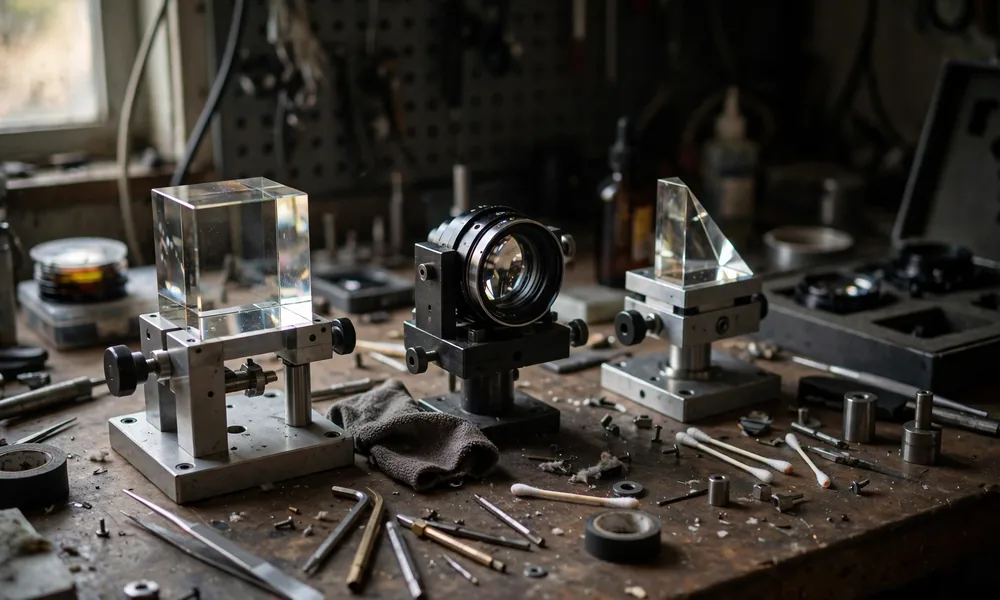
Step 3: Magnification brings distant ships closer
At the bottom of the tube, the eyepiece magnifies the image for the operator. Most periscopes offer two powers, a low magnification of about 1.5 times for sweeping the horizon and a high magnification of about 6 times for studying a single ship. The operator switches between them with a lever, and the change must be instant, because a contact spotted at low power may need a closer look within seconds. At high power, the field of view narrows sharply, so the operator must already know the bearing before zooming in, or the target will slip out of view.
Step 4: The mast is raised, trained, and lowered by machine
The periscope does not move by hand. A hydraulic or electric hoist raises and lowers the mast through the hull, and a training mechanism rotates it a full 360 degrees so the operator can sweep the horizon. The hoist must be fast, because a periscope left up for long is a mast that can be spotted by radar or by eye, and it must be silent, because vibration blurs the image and noise gives the boat away. When the observation is finished, the mast drops back into the sail in seconds, and the sea closes over the spot where it stood.
Step 5: Sensors in the head see what eyes cannot
A modern periscope head carries far more than glass. A thermal imaging camera sees the heat of a ship’s funnel or a helicopter’s engine at night, when the optical view is black. A laser rangefinder measures the distance to a target in a fraction of a second, replacing the old method of estimating range from the height of a ship’s mast. A few carry a satellite antenna, letting the boat receive messages without surfacing. All of these sensors must fit into a head no wider than a dinner plate, and all of them must keep working after being dunked in salt water. The boat’s other senses work alongside the periscope, and the way it listens to the sea is explained in how a submarine sonar array is made, a system that hears ships long before the periscope can see them.
Step 6: The image reaches the operator’s eye
The final step happens in the control room, where the operator stands at the eyepiece, or in newer boats, watches a screen. The operator calls out bearings and ranges, and the crew plots them on a chart, building a picture of every ship, coastline, and aircraft nearby. In an optronic mast, there is no eyepiece at all: cameras in the head send a digital picture down a cable, and several screens in the control room show it at once. Either way, the discipline is the same. The mast is raised for seconds, not minutes, the sweep is quick and methodical, and the periscope is down before anyone above the surface has a chance to notice it. The numbers behind the hull it passes through are listed in the submarine pressure hull specs explained, which shows how much pressure the boat is built to resist.
Submarine Periscope Specs
| Specification | Typical range |
|---|---|
| Overall length | About 8 to 12 metres, depending on the boat |
| Tube diameter | About 150 to 200 millimetres |
| Tube material | Stainless steel or nickel alloy |
| Optical system | Prisms and lenses, with thermal camera and laser rangefinder |
| Magnification | About 1.5x low power to 6x high power |
| Rotation | Full 360 degrees |
| Hoist | Hydraulic or electric, raises in seconds |
| Sealing | Nitrogen-filled, pressure-tested beyond operating depth |
What Does a Submarine Periscope Cost?
No navy publishes the price of a periscope, and each one is built to order for a specific class of boat, but the cost is estimated in the hundreds of thousands to a few million dollars per mast, with a full modern optronic mast estimated at several million dollars. The optics alone are estimated at a large share of that figure, because each lens is ground and polished by hand and the coatings are applied in vacuum chambers. All prices are estimates only and vary widely by boat class, sensor fit, and country.
A Rare Fact
The first practical submarine periscope was fitted to a French boat in the 1890s, and early versions were so dim that lookouts sometimes preferred to surface and use binoculars instead. The breakthrough came in the 1920s, when better glass and coatings made the image bright enough to use at dawn and dusk, the hours when submarines most needed to see.

A periscope is a strange object: a telescope built like a submarine, a piece of glassware wrapped in armour plate. It has to be strong enough to survive the deep, precise enough to read a ship’s name from miles away, and quiet enough to disappear in seconds.


