An electric car is, in one sense, a battery on wheels, and batteries are fussy about temperature. Too cold and they lose range; too hot and they age quickly, or worse. On a fast charger in summer, a battery pack can generate as much heat as a small house, and all of it has to go somewhere. The system that moves it is the EV thermal management system: a network of cooling plates, pumps, valves and radiators, plus a heat pump that can warm the cabin in winter without draining the battery. It is the car’s invisible climate control, and it works every second the car is running.
Building it means joining two worlds that rarely meet: the world of plumbing, with hoses, seals and coolant, and the world of electronics, with sensors and software deciding where every drop of heat should go. A leak in the wrong place can kill a battery, and a valve that sticks can leave a driver stranded. Here is how EV thermal management is made, step by step.
How EV Thermal Management Is Made
Step 1: Making the cooling plates
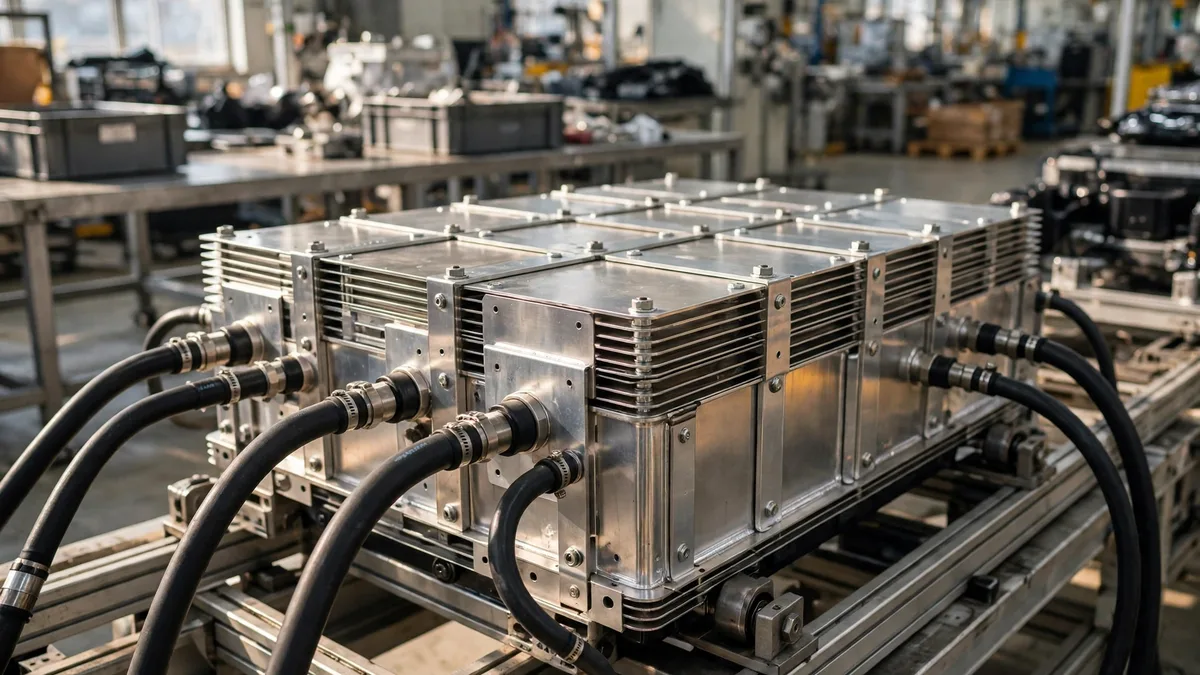
The heart of the system is the cooling plate, a flat aluminium panel that sits against the battery cells and carries coolant through channels inside it. The plates are made by stamping or extrusion, then the channels are formed by pressing, brazing or friction-stir welding two sheets together, leaving a serpentine path for the liquid. The plates are pressure-tested with air to find the smallest leak, because a plate that weeps coolant onto a battery is a failure waiting to happen. The battery pack these plates protect is built with equal care, as shown in how an EV battery pack is made, where hundreds of cells are assembled into a single sealed unit.
Step 2: Building the pump, valves and hoses
While the plates are made, the rest of the plumbing is built. Electric coolant pumps, small sealed units with brushless motors, are assembled and tested for flow and noise. Multi-way valves, which direct coolant to the battery, the motor or the cabin as needed, are machined from aluminium or high-temperature plastic and fitted with seals that must survive years of hot coolant. Hoses are moulded from rubber compounds that resist both heat and the glycol-based coolant, then cut to length and fitted with quick-connect couplings.
Step 3: Assembling the heat pump and chiller
The heat pump is the cleverest part of the system. It is a compact refrigeration unit, built around a compressor, a condenser and an evaporator, that can move heat in either direction: cooling the battery in summer, warming it and the cabin in winter. The compressor is assembled in a clean room, charged with refrigerant and sealed, then the whole unit is leak-tested with a sniffer that can detect a single escaping molecule of gas. Beside it sits the chiller, a small heat exchanger where the refrigerant loop meets the coolant loop, letting heat pass between them without the fluids ever mixing. How the cooling loop behaves once it is running is covered in how EV battery cooling works, which explains the flow of heat from cell to radiator.

Step 4: Fitting the system into the car
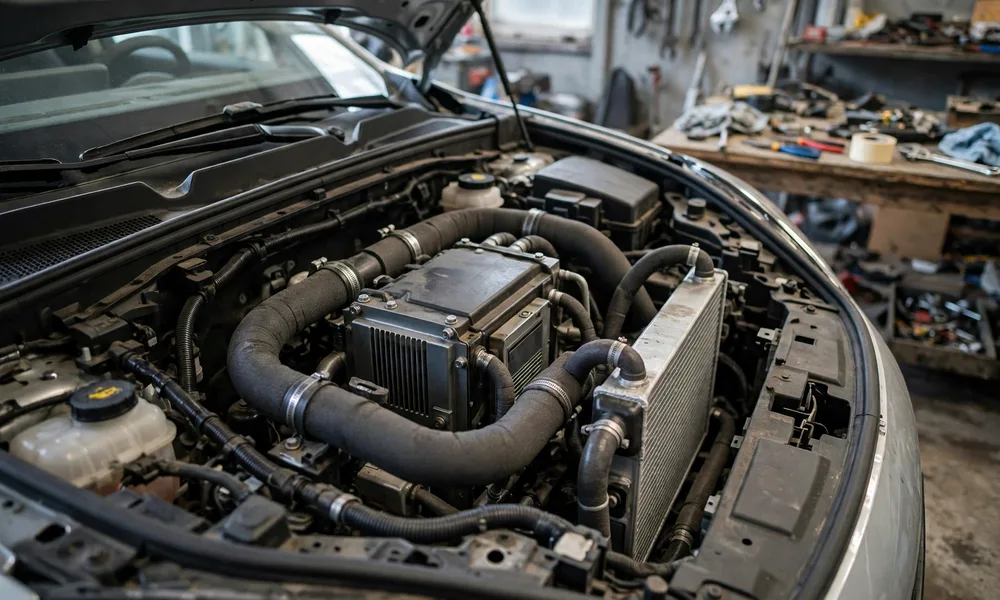
On the assembly line, the thermal system is fitted as a set of modules. The cooling plates are bolted to the battery pack and connected with hoses, the pump and valves are mounted on brackets in the front of the car, and the radiators are fitted behind the bumper where air can reach them. The heat pump unit goes into the front compartment, its refrigerant lines routed and clipped so they never rub against anything. Workers fill the coolant loop, then run a vacuum pump to pull out trapped air, because an air bubble in a cooling plate creates a hot spot on the battery.
Step 5: Sensors, software and calibration
Next the system gets its senses. Temperature sensors are placed on the battery modules, the motor, the coolant lines and the cabin, and their readings feed into the car’s thermal controller. Software decides, many times a second, where heat should go: to the radiator when the battery is hot, to the cabin when the driver is cold, to the battery itself when it needs warming before a fast charge. The calibration is done on test rigs that simulate a freezing morning and a desert afternoon, and engineers tune the valves and pump speeds until the battery stays in its narrow happy range, roughly 20 to 40 degrees Celsius, in both. The expense of all this hardware and tuning is the subject of why EV thermal management is so expensive, which breaks down where the cost sits.
Step 6: Final testing on the road
The last step is the road. Each car is driven through a test cycle that includes fast charging, hard acceleration and long climbs, while engineers watch the battery temperature on a screen. The system must keep the pack cool during a fast charge, when heat builds fastest, and warm it quickly on a cold morning, when range is at stake. Only when the system proves itself in the real world, not just on a rig, is the car signed off. From then on, the thermal system works silently for the life of the car, and most drivers will never know it is there.
EV Thermal Management Specifications
| Feature | Typical figure |
|---|---|
| Battery happy range | About 20–40°C |
| Coolant | Water-glycol mix |
| Cooling plates | Aluminium, brazed or welded channels |
| Heat pump | Reversible, heats and cools |
| Radiators | One or two, front mounted |
| Pumps | Electric, brushless, variable speed |
| Sensors | Temperature sensors on pack, motor and cabin |
| Fast-charge heat | Several kilowatts to remove |
What EV Thermal Management Costs
As an estimate, the thermal management system adds roughly $800 to $2,000 to the manufacturing cost of an electric car, depending on whether it uses a heat pump and how many cooling circuits it has. The heat pump, the chiller and the valves are the expensive parts, and the calibration time on test rigs adds more. It is a large sum for a system most buyers never see, but a car without it would charge slowly, lose range in winter and wear its battery out years early.
A Rare Fact
A heat pump can deliver three or four units of heat for every unit of electricity it uses, because it does not create heat, it moves it, borrowing warmth from the outside air or from the car’s own motor. That is why modern EVs can heat their cabins in winter without the huge range loss that early electric cars suffered.
Thermal management is the quiet guardian of the electric car: a web of plates, pumps and pipes that never appears in a brochure, yet decides how far the car goes, how fast it charges and how long its battery lasts. It is plumbing, refrigeration and software, built into a single system, and it works every time you drive.


