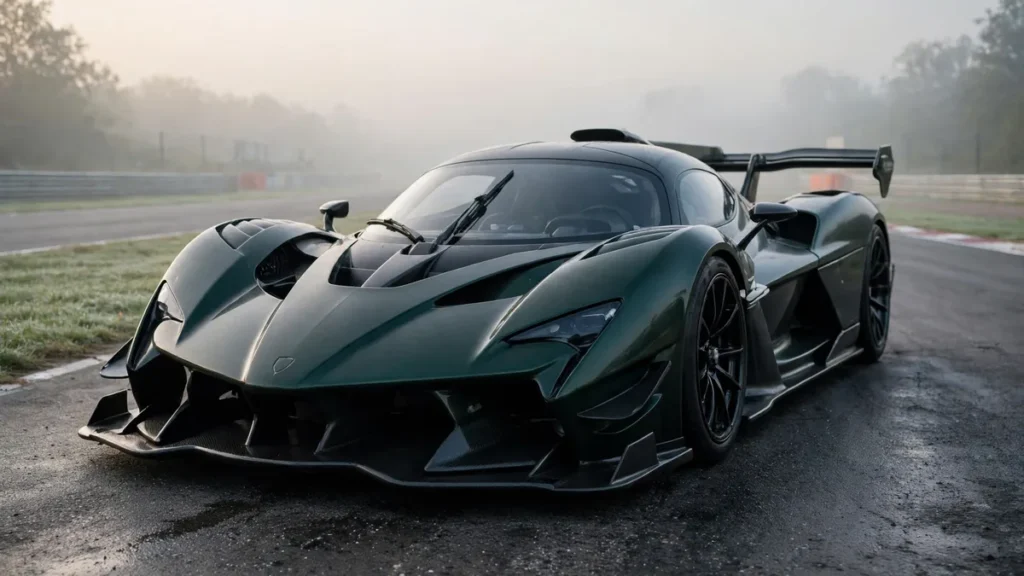
There is a moment in every great car factory when a machine stops looking like a collection of parts and starts looking like something alive. For the Aston Martin Valkyrie, that moment comes late, after months of work, when the low carbon body is lowered onto its chassis and the shape suddenly makes sense: a racing car that happens to be allowed on the road.
The Valkyrie was born from Formula One thinking. Adrian Newey, the most successful designer in the sport’s history, drew a car in which the air underneath matters more than the bodywork on top, and Aston Martin set out to build it in Gaydon, England. Only 150 road cars were planned, each one assembled largely by hand. This is how that car is made, from bare carbon fibre to a machine that revs past 11,000 rpm.
How It’s Made
Step 1: Laying up the carbon monocoque
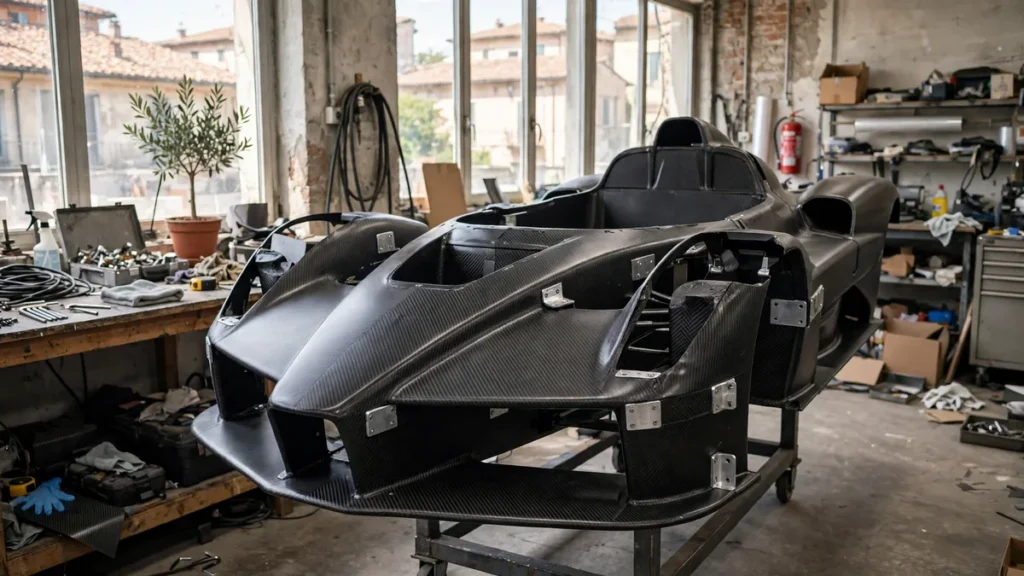
Everything starts with the monocoque, the single carbon fibre tub that is both the car’s structure and its safety cell. Sheets of carbon fibre prepreg — cloth already soaked in resin — are cut to patterns and laid by hand into a mould, layer after layer, each one placed at a precise angle so the finished tub is stiff in exactly the right directions. This is slow, skilled work: a misplaced layer can weaken the whole structure. When the lay-up is complete, the mould goes into an autoclave, a giant pressurised oven, where heat and pressure cure the resin and turn soft cloth into a shell stronger than steel at a fraction of the weight.
Step 2: Curing, trimming, and checking
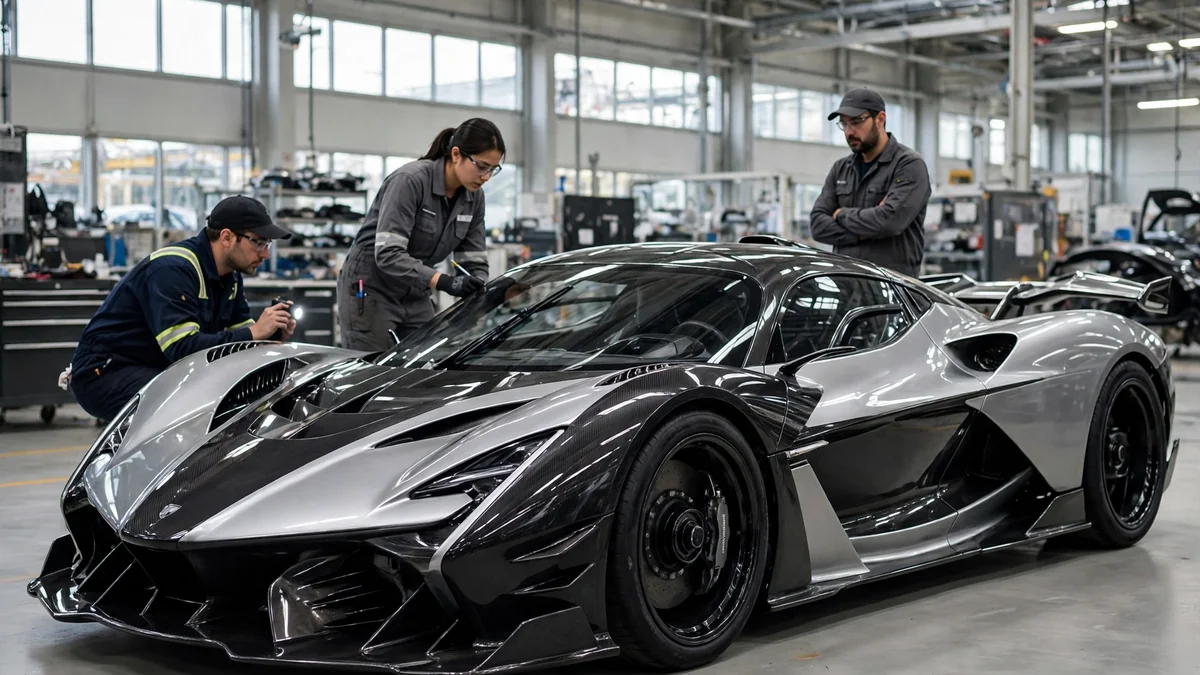
Out of the autoclave, the tub is trimmed and drilled, and every surface is inspected. Technicians use ultrasound and tap testing to hunt for voids or delamination hidden inside the laminate, because a flaw buried in carbon fibre cannot be seen with the naked eye. Mounting points for the suspension, engine, and bodywork are bonded in, and the tub is measured against its digital model to make sure it is true to within fractions of a millimetre. A tub that fails inspection does not get repaired and hoped for the best — it is set aside. At this level, there is no room for doubt in the part everything else bolts to.
Step 3: Building the V12 heart
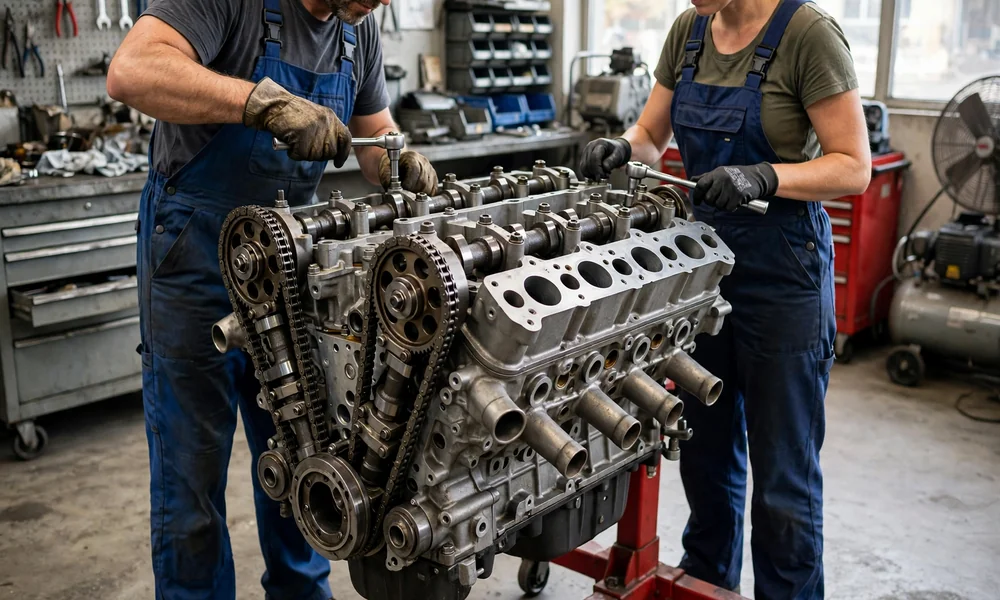
The Valkyrie’s engine is a 6.5-litre naturally aspirated V12 built by Cosworth, and it is made the old-fashioned way: by people, one at a time. Each engine is assembled by a small team of builders who fit the crankshaft, pistons, and cylinder heads, torquing every fastener to an exact figure and recording it. The engine revs to around 11,000 rpm, which means its moving parts must be light, perfectly balanced, and finished to tolerances a human hair would ruin. Before it ever meets the car, each engine is run on a dynamometer, where its power and behaviour are measured and logged.
Step 4: Fitting the hybrid system and gearbox
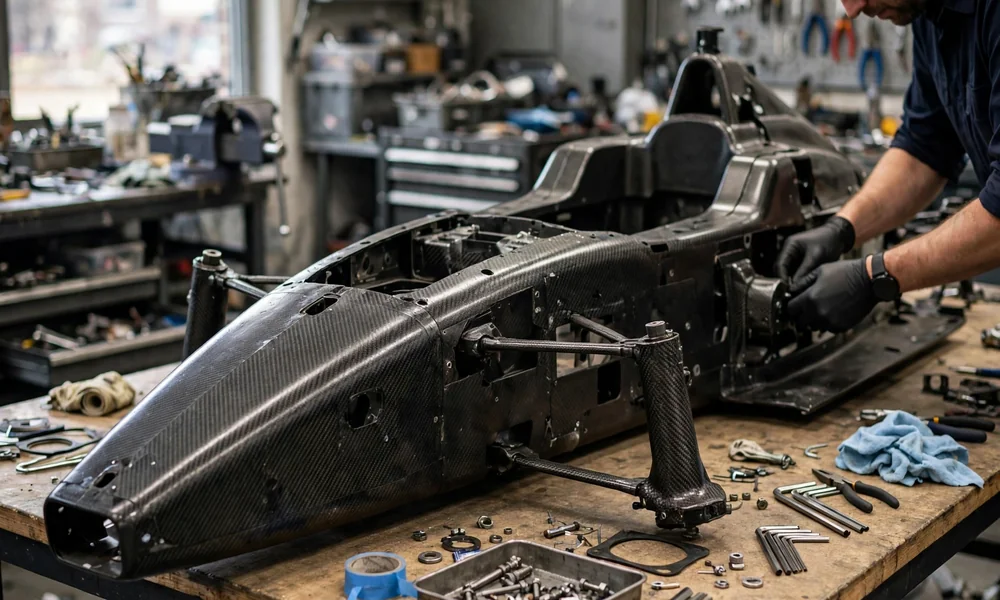
Behind the driver’s shoulders sits a hybrid system that adds electric power to the V12’s output, along with a seven-speed single-clutch gearbox built for racing rather than comfort. The battery and power electronics are fitted into the tub, where their weight sits low and central, and cooling circuits are routed to keep them at working temperature. Wiring looms, which in this car are as carefully routed as fuel lines, are laid in by hand. The gearbox bolts directly to the engine, and the whole assembly is designed so that the drivetrain is a stressed part of the car — it carries loads, rather than merely sitting inside a frame.
Step 5: Shaping the body and the air
The bodywork is where the Valkyrie looks most alien, and every curve exists to manage air. Panels are made from carbon fibre, trimmed and fitted to the tub with gaps measured in millimetres. Underneath, the floor is shaped into tunnels that pull the car down onto the road as speed rises — the car generates enormous downforce, far more than its own weight at speed. The shape of the bodywork echoes what is found in how a hypercar aerodynamic body is made, where the air beneath the car does as much work as the wings on top. Technicians fit the panels, check the shut lines by eye and by gauge, and refine them until the car looks carved from a single piece.
Step 6: Assembly, testing, and sign-off
Finally, the car comes together: suspension, brakes, cooling, and the cockpit, with its racing-style seat moulded to the owner’s body and its steering wheel crowded with controls. The Valkyrie’s cockpit is so tight that the pedals and wheel are adjusted to the driver, not the other way around. Once assembled, each car is tested — first on rigs and rollers, then on the road and track — and every system is checked and re-checked. Only when the car passes its full sign-off does it leave Gaydon.
Specs
| Specification | Typical figure |
|---|---|
| Engine | 6.5-litre naturally aspirated V12, plus hybrid assist |
| Total power | Around 1,160 hp combined |
| Maximum revs | Around 11,000 rpm |
| Weight | About 1,030 kg dry |
| Body structure | Carbon fibre monocoque |
| Gearbox | Seven-speed single-clutch |
| Top speed | About 217 mph |
| Production run | 150 road cars planned |
Price
The Valkyrie was sold for around £2 million to £3 million when new, though as an estimate that figure varies with specification and the market for the few cars that change hands. These are estimates, and the real cost of building one is buried inside Aston Martin’s accounts: the carbon tooling, the bespoke Cosworth engine programme, and hundreds of hours of hand assembly per car.
A Rare Fact
One of the strangest things about the Valkyrie is that its makers had to design the car around a problem no road car had faced before: at full speed, it makes so much downforce that it could, in theory, drive upside down on a ceiling. The figure most often quoted is around 1,800 kg of downforce — far more than the car weighs — which means the body and suspension had to be built to survive forces that would tear an ordinary car apart. The same obsession with air that shaped the carbon fibre weave at the heart of the car runs through every surface, and the V12 itself, built in the tradition of engines like the one in how the Lamborghini Revuelto V12 is made, is part of that same uncompromising brief. A car that could drive on a ceiling is not a stunt; it is what happens when aerodynamics is allowed to lead the design.
From cloth and resin to a machine that chases Formula One cars on a track, the Valkyrie is proof that the most extraordinary road cars are still made slowly, by hand, and by people who care about a tenth of a millimetre. It is not a car that was designed and then built. It was built, step by step, into the design.