Three kilometres down, sunlight has been gone for a long time. The water is black, near freezing, and pressing in from every side with a force that would crush a car flat in seconds. Yet inside a small metal sphere, a pilot sits in shirtsleeves, watching a crab pick its way across the seabed through a thick round window. A deep-sea submersible is the only machine that makes that moment possible: a pressure-proof room, a battery, a propeller, and a set of lights, wrapped in engineering so careful that a single flaw at depth leaves no room for a second chance.
Only a handful of vehicles in the world can carry people to the deepest parts of the ocean, and each one is built almost by hand. There is no production line for submersibles. A team of welders, machinists, and engineers spends months, sometimes years, shaping metal that must survive pressures of hundreds of atmospheres, then testing it again and again before anyone climbs inside. This is how a deep-sea submersible is made, from raw metal to its first dive.
How It’s Made
Step 1: Designing the pressure hull
Everything starts with the pressure hull, the sphere or cylinder where the crew sits. A sphere is the strongest shape against outside pressure because the force is spread evenly over its surface, with no corners to concentrate stress. Engineers choose the diving depth first, then work backwards: the deeper the rating, the thicker the hull must be. Most crewed submersibles use titanium or high-strength steel, metals that stay strong and do not become brittle in cold water. Computer models simulate the hull under crushing load, and the design is checked against the way real hulls have behaved, including the lessons captured in our guide to submarine pressure hull materials engineering. Nothing is built until the numbers say the hull will hold with a wide margin.
Step 2: Forming the sphere
The hull begins as flat plates of titanium or steel, which are pressed and rolled into curved panels. For a spherical hull, two hemispheres are formed separately, each one shaped in a giant press and then machined so its rim is perfectly round. A sphere that is out of round by even a millimetre will bend unevenly under pressure, so the panels are measured with laser scanners as they take shape. The viewport opening, the hatch ring, and the penetrations for cables and pipes are cut into the metal before the halves meet.
Step 3: Welding and heat treatment
The two hemispheres are joined by a single circumferential weld, laid down in many slow passes by welders working inside a clean, temperature-controlled shop. Titanium welding is especially demanding: the hot metal must be shielded from air with argon gas, or it becomes brittle. After welding, the whole hull goes into a furnace for stress-relieving heat treatment, which relaxes the internal strains left by the weld. Then the hull is machined again, inside and out, until its wall thickness is uniform all the way around. The material science behind the hull matters as much as its shape, as explained in our look at deep-sea submersible materials engineering.
Step 4: Fitting the viewport and hatch
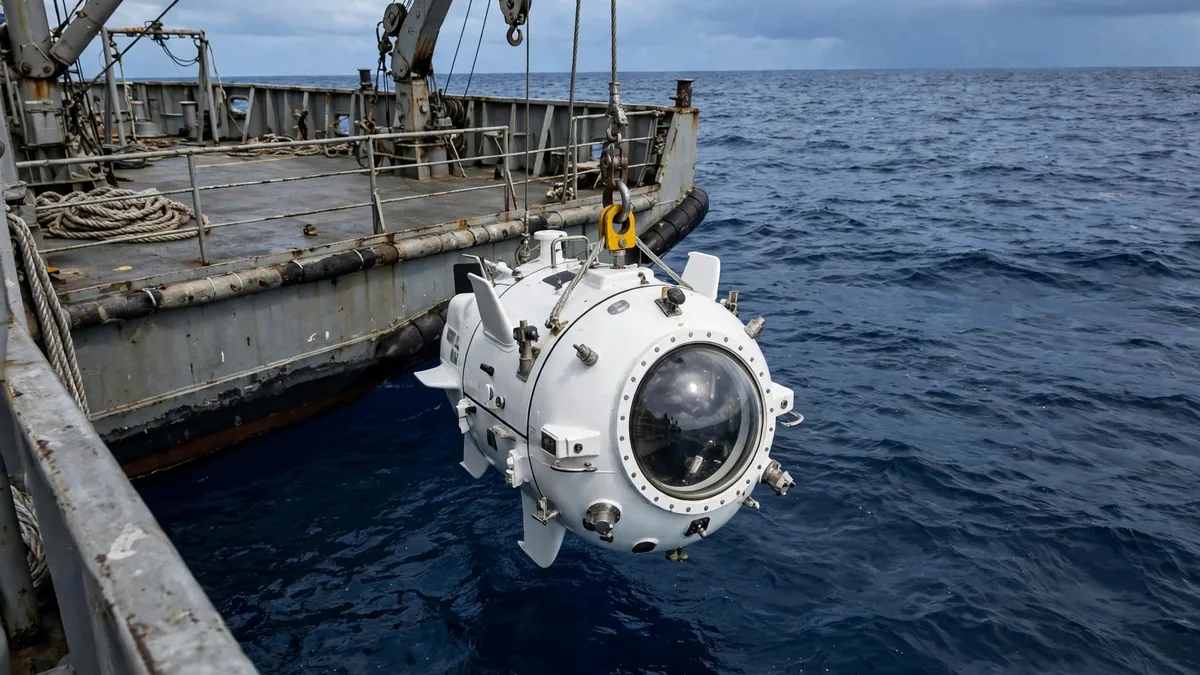
The viewport is a thick disc of acrylic, conical in shape so that water pressure wedges it tighter into its seat the deeper the submersible goes. It is polished until it is optically clear, then seated with seals that must stay watertight across huge temperature swings. The hatch is a steel or titanium lid with a ring of bolts and a rubber seal, designed to be opened from the inside so that pressure holds it shut rather than forcing it open. Every penetration through the hull, for power cables, lights, and sensors, gets its own pressure-proof fitting, each one tested on its own before it is trusted in the hull.

Step 5: Installing propulsion, power, and life support
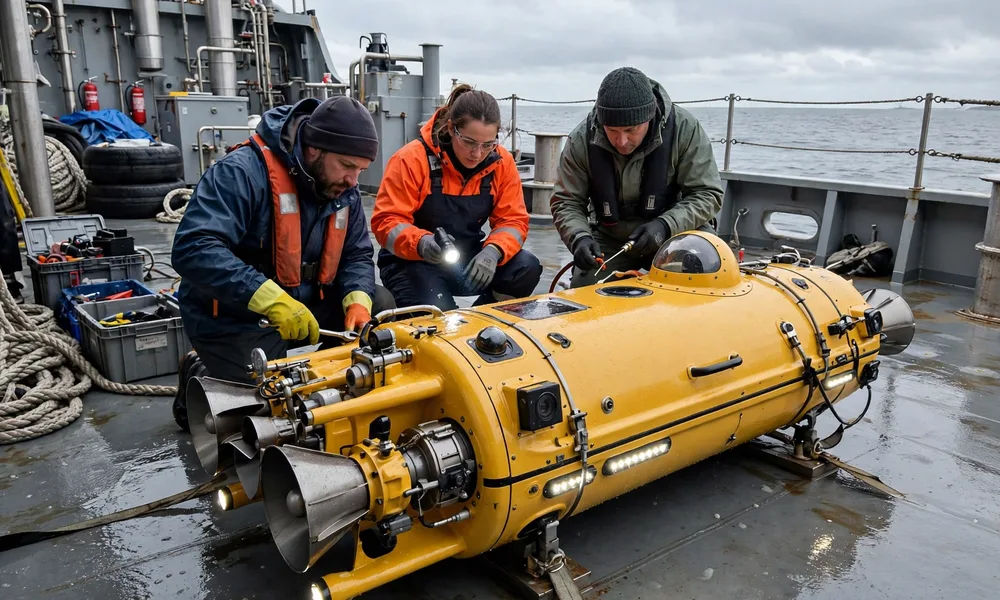
With the hull sealed, the builders fit the systems that keep the crew alive and moving. Electric thrusters, usually mounted outside the hull in protective housings, give the pilot fine control in all directions. Batteries, often lithium-ion packs in their own pressure-proof cases, sit in the free-flooding spaces between the hull and the outer fairing. Inside, the life-support system scrubs carbon dioxide from the air, adds oxygen from tanks, and monitors temperature and humidity. Ballast tanks and drop weights let the pilot sink, hover, and return to the surface, and an emergency weight can be released to bring the vehicle up even if all power is lost. The full capability of the finished vehicle is summarised in our guide to deep-sea submersible specs explained.
Step 6: Pressure testing and sea trials
No submersible carries people until it has been proven empty. The finished hull is lowered into a pressure chamber and taken to pressures beyond its rated depth, while strain gauges glued to the metal report every tiny flex. Then the whole vehicle goes to sea: first in shallow water, then deeper, with each dive checking the thrusters, the communications, the lights, and the life support. Only after a series of uncrewed and then shallow crewed dives does the submersible earn its deep rating, and it is inspected after every deep dive.
Specs
| Specification | Detail |
|---|---|
| Pressure hull | Spherical titanium or high-strength steel, machined to uniform wall thickness |
| Typical crew | 2 to 3 people in the pressure hull |
| Depth rating | Research vehicles commonly rated to 4,500–6,500 metres; a few reach full ocean depth near 11,000 metres |
| Viewport | Conical acrylic disc, pressure-seated and polished optically clear |
| Propulsion | Electric thrusters in external housings for fine manoeuvring |
| Power | Lithium-ion battery packs in pressure-proof cases |
| Life support | Carbon dioxide scrubbers, oxygen supply, temperature and humidity control |
| Emergency systems | Releasable drop weights for an unpowered return to the surface |
Price
A crewed deep-sea submersible is one of the most expensive small vehicles ever built, because almost every part is custom-made and tested far beyond normal standards. A research submersible rated to several thousand metres typically costs tens of millions of dollars to design and build (estimate, based on published costs of comparable research submersibles), with the pressure hull, certification, and testing accounting for a large share. Operating costs add up too: every deep dive needs a dedicated support ship, a trained crew, and hours of inspection and maintenance afterwards. That is why deep submersibles are run by research institutes and specialist operators rather than sold to the public.
Rare Fact
The acrylic viewport of a deep submersible gets stronger as it goes deeper, in a sense. Its conical shape means that rising water pressure pushes the disc more firmly into its seat instead of pushing it out, so the seal actually improves with depth. The same trick would not work with a flat window, which is why every crewed submersible uses a tapered viewport. Early bathyscaphes proved the principle in the 1950s, and the design has barely changed since: when the ocean itself is doing the sealing, engineers are happy to let it.


