There is a craft that neither floats like a boat nor flies like a plane, but rides on a cushion of air a few centimetres above the water, the sand or the marsh. It hums, it sprays, and it glides over surfaces that would stop any ordinary vessel dead. The secret is not the fan on its back or the engine under its deck. It is the flexible curtain that hangs around its belly, trapping the air beneath it. That curtain is the skirt, and it is the hardest-working, most replaced and least celebrated part of the whole machine.
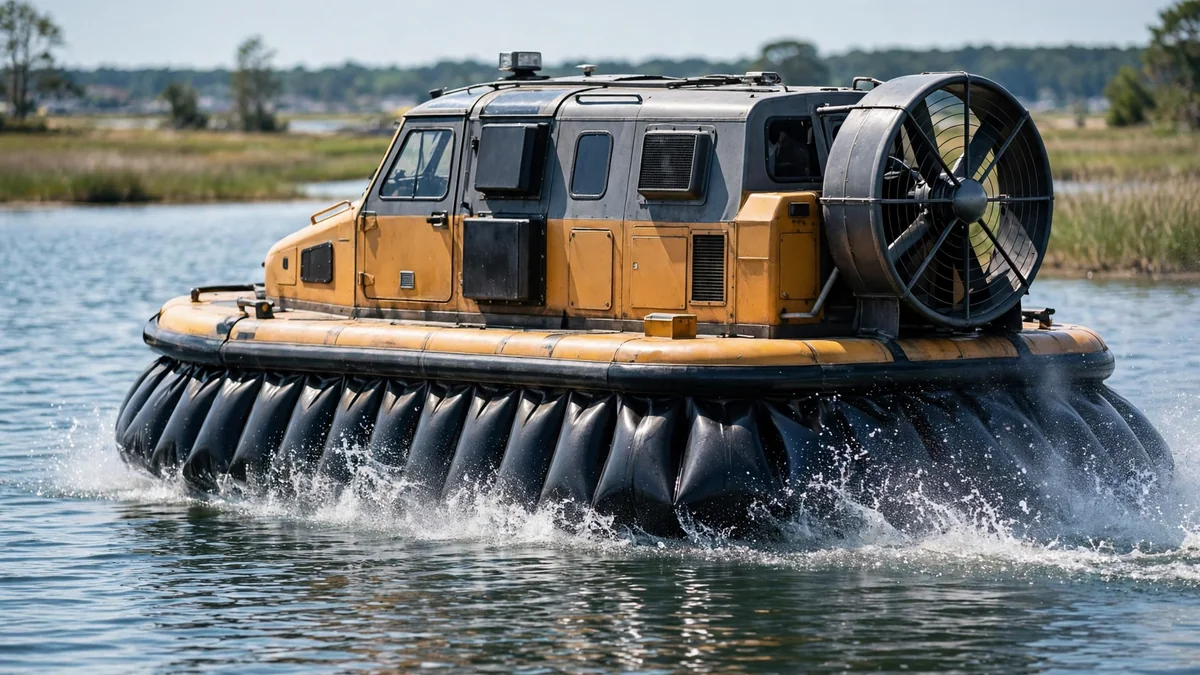
The Key Specifications
The first number is the material. A hovercraft skirt is made from rubberised fabric, usually nylon cloth coated with natural or synthetic rubber, and the choice of coating decides how the skirt behaves. The fabric gives it strength, the rubber gives it waterproofing and grip, and together they make a sheet that can bend thousands of times without tearing. Some skirts add extra layers on the parts that touch the ground most, and some use polyurethane coatings for better resistance to oil and sunlight. The material is always a compromise: thicker rubber lasts longer, but it is heavier and stiffer, and a stiff skirt rides badly over waves.
The second number is the depth. The skirt hangs roughly half a metre to a metre below the hull on a typical craft, and that is an estimate, because skirt depth varies with the size of the vehicle. Depth decides how high the craft can ride and how big an obstacle it can cross. A deeper skirt lets the craft clear larger waves and rougher ground, but it also needs more air to fill it, and more power to keep the cushion inflated. Designers size the skirt to the job: a small rescue craft that works on beaches needs a different depth from a large passenger ferry that crosses open water.
The third number is the shape, and it is where the real ingenuity lives. Most modern skirts are not a single curtain but a ring of separate segments called fingers, each one hanging down like a flap and able to move on its own. When the craft rides over a wave, the fingers on one side lift and let the air escape in a controlled way, while the fingers on the other side stay down and hold the cushion in. That independent movement is what lets a hovercraft ride smoothly over uneven ground instead of bouncing from crest to crest.
Cushion pressure is the fourth number, and it is surprisingly gentle. The air under a hovercraft is only slightly above the pressure of the air around it, roughly enough to support the craft’s weight spread across the whole area of the cushion. It spreads its weight across a wide, soft pillow of air, and that is the whole point of the design. The same thinking about spreading load and surviving rough contact shapes the hulls of working boats too, including the tough, shallow-draft ferry hull, which also has to cope with constant bumps and scrapes at the waterline.

The Specifications at a Glance
| Specification | Typical figure | What it means |
|---|---|---|
| Material | Rubberised nylon fabric | Strong, waterproof and flexible |
| Skirt depth | 0.5–1 m (estimate) | Decides wave height the craft can cross |
| Segment design | Separate fingers | Each finger moves on its own over waves |
| Cushion pressure | Only slightly above air pressure | Weight spread across a wide soft pillow |
| Skirt weight | Several hundred kg on a large craft (estimate) | Heavy for fabric, light for the job it does |
| Working life | Hundreds of hours (estimate) | Fastest-wearing part of the craft |
| Coating options | Rubber or polyurethane | Trade-off between toughness and weight |
| Repair method | Fingers replaced individually | A torn finger is a quick swap, not a rebuild |
How the Specs Matter in Use
In service, the skirt’s numbers show up as a feeling: the ride. A deep, well-shaped skirt gives a smooth, level ride over choppy water, because the fingers absorb the waves instead of passing them to the passengers. A worn or stiff skirt gives a bumpy, noisy ride, and the crew can feel the difference before any instrument shows it. That is why operators inspect the skirt after every run, looking for tears, worn patches and fingers that have gone stiff with age. A skirt in good condition is the difference between a craft that glides and a craft that slams.
The segmented design is what makes repair practical. When a finger tears on a rock or a piece of debris, the crew does not replace the whole skirt. They unbolt the damaged finger and fit a new one, a job that can take minutes rather than days. It is the same philosophy that guides the hulls of ships built for ice and rough water, where the icebreaker hull is shaped and strengthened to take punishment and keep working, rather than to avoid it entirely.
Terrain decides everything else. On smooth water, the skirt barely touches the surface and the craft is efficient and quiet. On sand, the skirt drags and wears quickly, and the crew must accept that every beach landing costs a little of the skirt’s life. Operators choose their routes with the skirt in mind, the way a driver chooses a road with the tyres in mind, and they carry spare fingers the way a driver carries a spare wheel. The specification that looks most boring on paper, the working life in hours, is the one that shapes the operating budget, because skirts are a regular, planned cost, not a surprise.
Understanding the skirt also explains how a hovercraft skirt works as a system rather than a single part. The lift fan, the cushion and the skirt form a loop: the fan supplies air, the cushion lifts the craft, and the skirt holds the air in while letting just enough escape to keep the ride stable. Change any one of the three and the others must change too. A bigger fan allows a deeper skirt, a deeper skirt allows a rougher ride, and a rougher ride demands a tougher material. The specifications are not separate numbers. They are a single balance, tuned to the water, the load and the job.

A Rare Fact
Here is a detail that surprises almost everyone who first learns it: a hovercraft skirt is deliberately designed to leak. If the skirt sealed perfectly, the cushion would become stiff and the craft would bounce violently over every wave, like a ball on a hard floor. Instead, the fingers are shaped to let a controlled amount of air escape, especially on the side where a wave is lifting the craft.
That is the real measure of the design. The numbers in the table describe rubber, depth and pressure, but what they add up to is freedom of movement: a craft that can go where boats cannot float and vehicles cannot drive. The skirt makes that possible, not by being strong in the way steel is strong, but by being flexible, replaceable and cleverly imperfect. It wears out, it tears, and it is swapped finger by finger, and in return it gives a hovercraft the one ability no other vehicle has: to ride on air, over almost anything.


