Three kilometres down, the ocean stops being scenery and starts being a press. The water above weighs on every square centimetre with the force of a small car, and the darkness is total. The only thing between a research crew and that pressure is a hollow ball of metal barely wider than a dining table, and everything about the way that ball is built comes down to one idea: a sphere has no weak corner to crush.
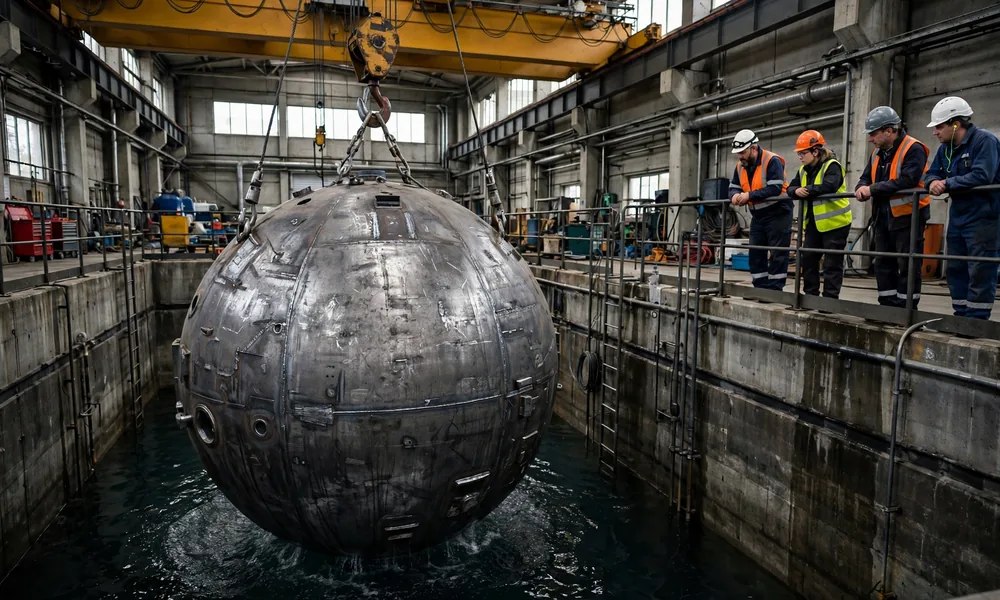
That ball is the research submersible sphere, the pressure hull of the small craft that carry scientists to hydrothermal vents, cold seeps and the abyssal plain. It is a diving bell with a job to do, built in a factory that looks more like a forge crossed with a watchmaker’s bench than a shipyard.
Building one takes months, and almost nothing about the process is fast. Plates are formed, welded, machined, measured and tested in a slow loop, because a flaw the size of a grain of sand can become a failure at depth. Our guide to how a research submersible sphere is made explains the shape and the science behind it; this is the factory floor version — the steps, the machines and the tests a sphere must survive before it ever touches the sea.

Building a Research Submersible Sphere
Step 1: Choosing the metal
The work starts before any cutting, with a decision about the metal itself. Most research spheres are built from high-strength steel or a titanium alloy, and the choice is a trade between weight, cost and depth. Titanium is lighter for the same strength and resists corrosion in salt water, but it is expensive and harder to weld. Steel is cheaper and easier to work, but heavier, and every extra kilo of hull is a kilo of buoyancy the submersible must carry or cancel out with foam. Engineers settle the question with calculations first: the target depth sets the pressure, the pressure sets the wall thickness, and the thickness sets the weight.
Step 2: Forming the plates
A sphere cannot be rolled from a single sheet, so the factory builds it from curved panels, like the segments of an orange. Thick plates are heated and pressed in a giant hydraulic press, a slow squeeze that bends the metal into a spherical curve without thinning it at the edges. Each panel is formed slightly over-size and then trimmed, because the curve has to be right to within a millimetre or two across the whole panel. Workers check the shape with templates and laser measurement, and a panel that does not match the curve goes back to the press.

Step 3: Welding the shell
Once the panels fit, they are welded together in a slow sequence, and the order matters as much as the welding itself. The welders work in short passes, alternating around the sphere so the heat does not pull the shell out of shape, and the whole hull is turned on a rotator so the weld is always made in the best position. Titanium welding is done under a shield of inert gas, because hot titanium grabs oxygen from the air and turns brittle. Every seam is then ground smooth inside and out, and the welds are inspected with ultrasound and dye tests that can find a crack too small to see.
Step 4: Machining the openings
A perfect sealed ball would be useless, so the factory cuts openings for the hatch, the viewports and the penetrators that carry cables and pipes through the hull. Each opening is a weak point by definition, so each one gets a heavy forged ring welded in and machined flat to a tolerance a human hair would fail. The hatch itself is a thick disc of the same metal, hinged and sealed with O-rings, and the viewports are cones of acrylic many centimetres thick, polished until they are clear.
Step 5: Heat treatment and stress relief
All that welding leaves the metal full of locked-in stress, and a stressed hull can crack without warning, so the finished sphere goes into a furnace. It is heated slowly to a set temperature, held there for hours, and then cooled at a controlled rate, a process that lets the metal relax and evens out the stresses from welding and forming. After the furnace, the sphere is measured again in full, because heat can move a shell by millimetres. The sphere that comes out of this step is round, calm and ready for the hardest test of all.
Step 6: Pressure testing and final checks
The last step is the one no sphere skips: the pressure test. The sphere is sealed, lowered into a test chamber, and the water pressure is raised past the depth it will ever dive to, usually to about one and a half times its rated working pressure. Engineers watch strain gauges glued to the hull, listening for the tiny sounds of metal settling and measuring how much the sphere shrinks under load. It should flex by millimetres and spring back. If it does, the sphere is drained, dried, inspected one more time and fitted with its frame, buoyancy and equipment. The deep-sea craft that carries it follows the same discipline, as described in our guide to how a deep-sea submersible is made and our guide to inside deep-sea submersible production.
Research Submersible Sphere Specs
| Specification | Typical range |
|---|---|
| Hull material | High-strength steel or titanium alloy |
| Inside diameter | About 2 to 2.5 metres for a two or three person sphere |
| Wall thickness | About 60 to 90 mm, depending on depth rating and material |
| Rated depth | About 3,000 to 6,500 metres for modern research spheres |
| Working pressure | About 300 to 650 bar at rated depth |
| Proof test pressure | About 1.5 times the rated working pressure |
| Viewport material | Acrylic, conical, several centimetres thick |
| Build time | Several months from plate to tested sphere |
What Does a Research Submersible Sphere Cost?
A finished research submersible sphere is estimated to cost roughly $1.5 million to $4 million, depending on size, material and depth rating, with titanium spheres at the upper end of that range. Prices are estimates only and vary by builder, material prices and certification requirements.
A Rare Fact
The first vehicle to reach the deepest part of the ocean carried its crew in a steel sphere just over two metres across. A sphere is the strongest possible shape for a pressure hull because the water pushes evenly on every part of it at once, with no flat panel to bend and no corner to concentrate the load. That is why, more than sixty years later, the deepest-diving crewed vehicles on Earth still put their people inside a ball.
The sphere is the quietest piece of engineering on a research submersible and the most important. It has no engine, no screen and no moving parts, and its whole job is to stay round under a weight of water no person could ever survive unprotected. The factory that builds it works slowly for a reason: every panel, every weld and every test is a promise that the ball will come back up. When it does, the sphere has done the one thing it was built to do — keep the ocean out.