Press the accelerator in a modern performance car and the gear changes happen before you can blink. There is no pause, no lurch, no moment where the engine seems to lose its breath. That seamless surge is the work of a dual-clutch gearbox, and inside its compact metal case sits one of the most intricate pieces of machinery ever fitted to a road car. Two clutches, two sets of gears, and a brain that is always one step ahead of the driver.
The idea is beautifully simple and brutally hard to build. Instead of one clutch and one set of gears, a dual-clutch gearbox has two of each, working in parallel. One clutch handles the odd gears, the other handles the even gears, and while you are accelerating in third, fourth is already engaged and waiting. When the moment comes, one clutch opens and the other closes, and the gear changes in a fraction of a second. Simple to describe; fiendish to manufacture.
Every part inside must survive heat, friction, and forces that would tear lesser machinery apart, while fitting into a space barely bigger than a suitcase. Gears are cut to tolerances measured in microns, clutch plates are stacked like cards, and the whole assembly is tested until it can shift hundreds of thousands of times without complaint. This is how it is made.
How It Is Made
Step 1: Forging and casting the case
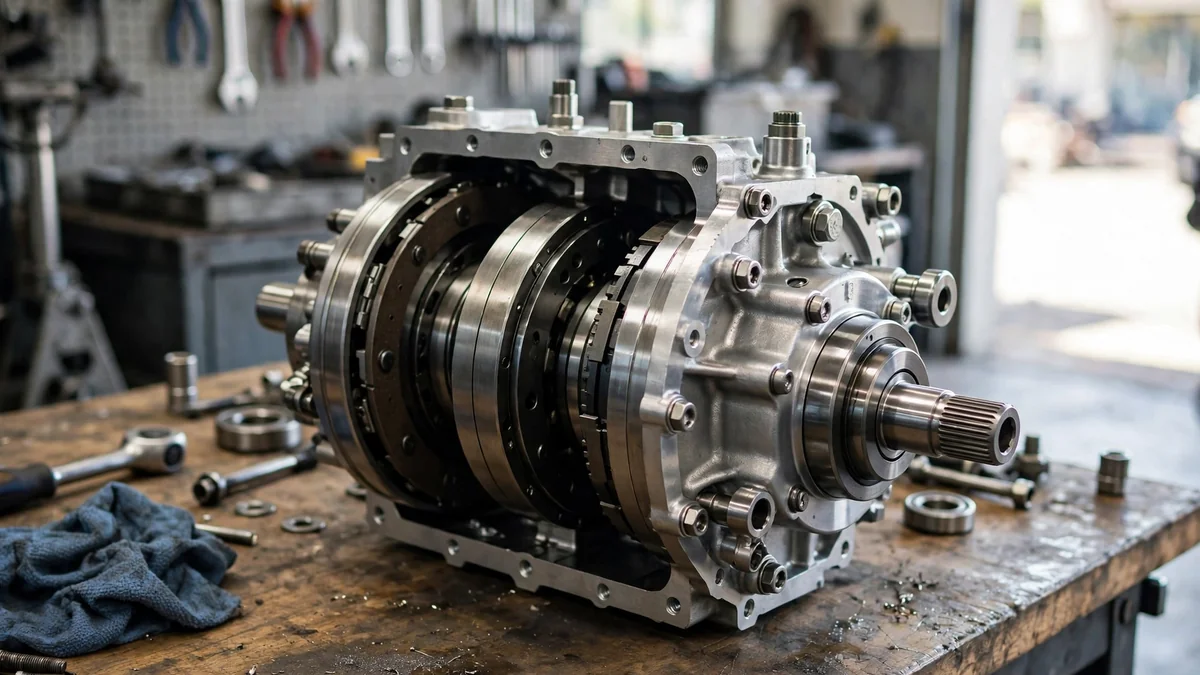
It begins with the case, the aluminium housing that holds everything together. Molten aluminium is cast or forged into the rough shape of the casing, then machined on computer-controlled mills that cut bearing seats and mounting faces to within a few microns. The case has to be light, because every kilogram hurts performance, but also rigid enough that the gears inside never flex out of alignment under full-throttle load. After machining, each case is pressure-tested for leaks and measured against its design, because a case that is even slightly out of true will wear its gears unevenly for the rest of its life.
Step 2: Cutting the gears
The gears are the soul of the gearbox, and they start life as blanks of high-strength steel. Each blank is cut on a gear-hobbing machine, where a rotating cutter carves the teeth one by one, then ground to a mirror finish so the teeth mesh silently and wear slowly. The two gear shafts are built separately — one hollow shaft carrying the odd gears, one solid shaft running inside it carrying the even gears — a nested arrangement that is the signature trick of the dual-clutch design. Every tooth is measured, because a gear that is a few microns too thick will whine, and one too thin will fail. The same obsession with gear precision drives the single-clutch world too, as seen in how a hypercar gearbox is made, where gears are built to survive racing.
Step 3: Building the two clutch packs
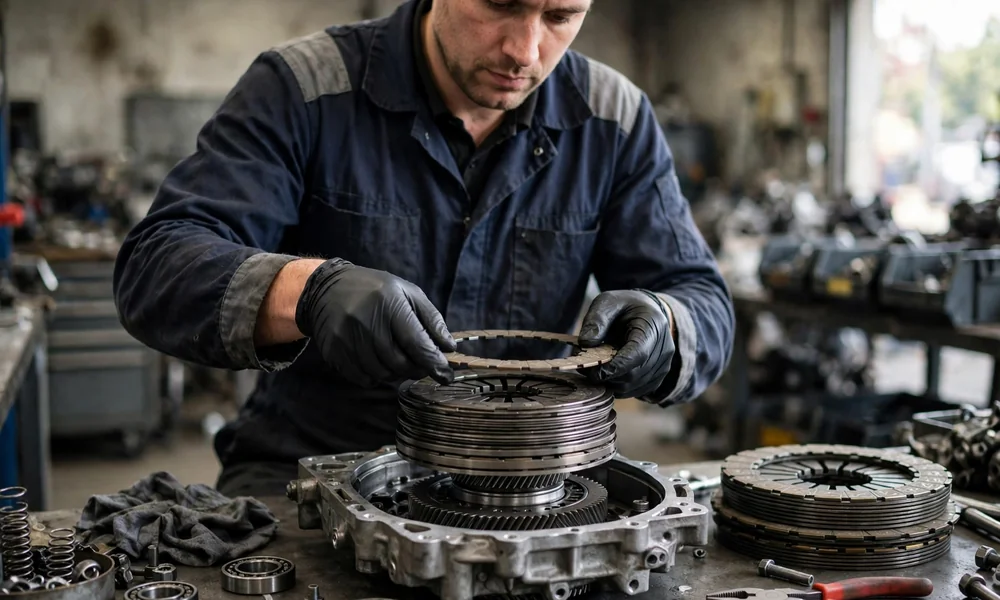
Next come the clutches: two multi-plate packs, one inside the other, that connect the engine to each gear shaft. Each pack is a stack of alternating steel plates and friction plates, the friction plates lined with a material that grips hard when squeezed yet slips smoothly when it needs to. The plates are stamped, heat-treated, and checked for flatness, because a warped plate shudders on every shift. The packs are assembled in a clean area, lubricated with transmission fluid, and tested for clamping force — the squeeze that lets a clutch hold hundreds of horsepower without slipping.
Step 4: Machining the shafts and synchronisers
The input and output shafts are turned on lathes and ground to their final dimensions, then fitted with synchronisers, the small brass or steel rings that match gear speeds before engagement. In a dual-clutch gearbox the synchronisers do less work than in a manual, because the next gear is already spinning, but they still have to be perfect. Bearings are pressed onto the shafts with measured force, and each shaft assembly is balanced, spinning at high speed to check for vibration. A shaft that is even slightly out of balance will hum through the car at motorway speed.
Step 5: Assembling the gearbox
Assembly is where it all comes together, and it is done largely by hand. Technicians lower the gear shafts into the case, fit the clutch packs, connect the hydraulic actuators and the mechatronic control unit — the electronic brain that decides when to shift — and bolt the case halves together to an exact torque. The mechatronic unit is the part that makes the gearbox feel intelligent: it reads speed, throttle, and driving style, and pre-selects the next gear before the driver even asks. Its valves and sensors are assembled in a dust-free area, because a single particle in a hydraulic valve can cause a harsh shift. The control logic that ties it together is the same kind of thinking behind how a dual-clutch gearbox works, where timing is everything.
Step 6: Testing on the rig and the road
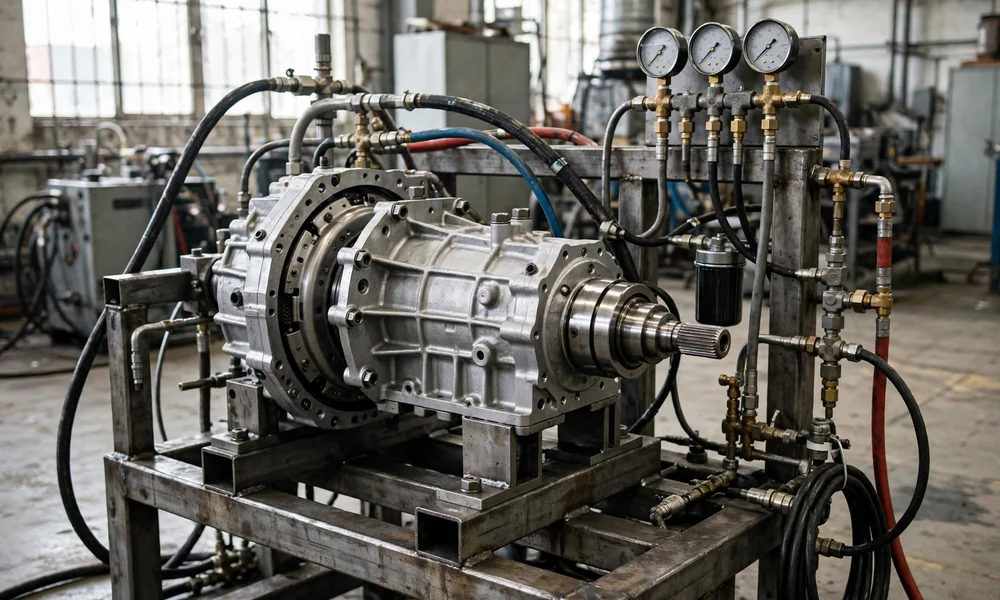
No gearbox leaves the factory untested. Each unit is mounted on a test rig, filled with fluid, and run through thousands of simulated shifts while sensors listen for noise, measure shift times, and check for leaks. The rig can simulate a lifetime of driving in hours, and any unit that shifts slowly, slips, or runs hot is pulled apart and rebuilt. A sample of gearboxes also goes into test cars for real-road driving, because no rig can fully reproduce a cold morning start or a mountain descent. Only after passing both does a gearbox earn its place in a car.
Specs
| Specification | Typical value |
|---|---|
| Clutches | 2 multi-plate packs (odd / even gears) |
| Typical gear count | 7 or 8 speeds |
| Shift time | About 8–100 milliseconds |
| Gear material | High-strength alloy steel, ground teeth |
| Case material | Cast or forged aluminium |
| Control unit | Mechatronic unit with hydraulic actuators |
| Lubrication | Specialist dual-clutch transmission fluid |
| Typical torque capacity | About 250–750 Nm depending on design |
What Does It Cost?
A dual-clutch gearbox is one of the most expensive parts of a performance car, and it is almost never sold separately. A car fitted with one typically costs from around $40,000 for a hot hatch to well over $200,000 for a supercar, and those are approximate retail prices for the whole vehicle. As a replacement part, a dual-clutch unit is estimated at roughly $5,000–$15,000, an estimate that varies widely by model and maker, before labour. The cost reflects what is inside: precision-ground gears, two clutch packs, and a mechatronic brain that took years to develop. Servicing matters too — fluid and filter changes at the maker’s intervals are what keep the shifts fast and the clutches healthy. For the wider family of performance transmissions, how a hypercar gearbox works shows how the same ideas are pushed further still.
A Rare Fact
Here is the detail most people miss: the dual-clutch gearbox was invented for racing in the 1980s, but it was too fragile and too expensive for road cars, and it sat on the shelf for nearly twenty years before electronics caught up. The idea needed computers fast enough to control two clutches in milliseconds and sensors cheap enough to put in every car. When it finally arrived in production cars in the early 2000s, it was the electronics, not the gears, that had made it possible. The gearbox had been waiting for its brain.


