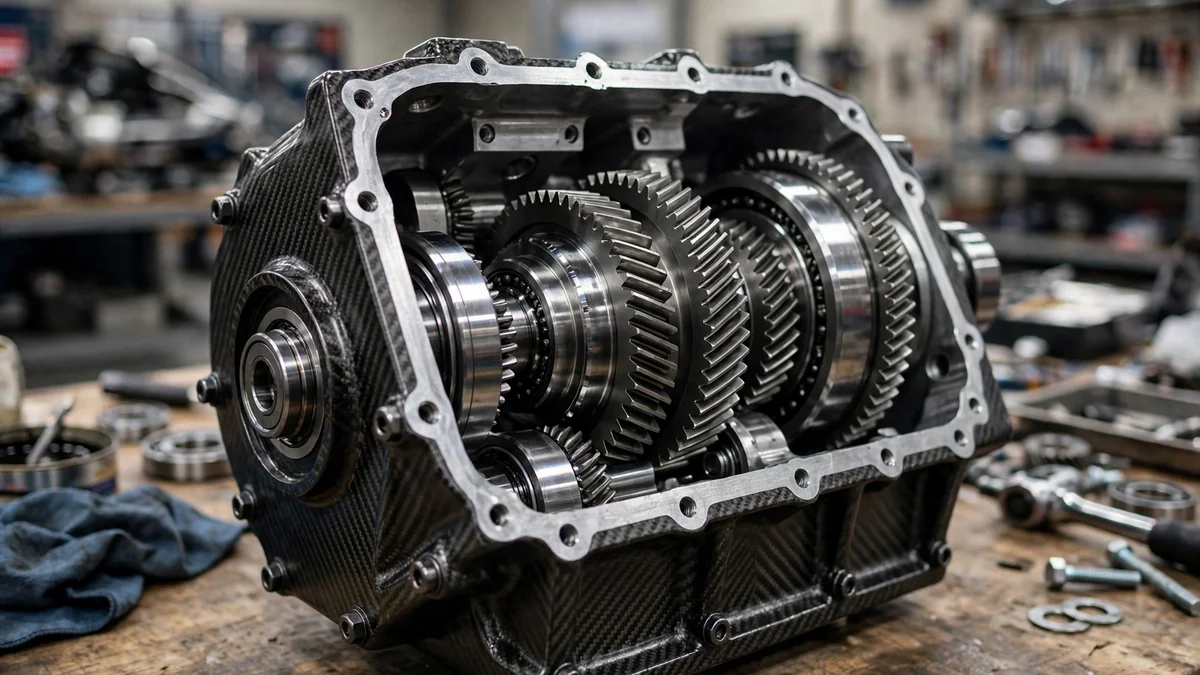
A hypercar can hit 200 miles per hour, and then it has to do it again, gear after gear, lap after lap, without missing a single shift. The engine gets the glory, but the gearbox does the translating — taking a spinning crankshaft and turning it into speed the tyres can actually use. At full throttle, a hypercar gearbox changes gear in a fraction of a second, hundreds of times in a single race, while handling more torque than a lorry engine produces.
There is no room for softness in a machine like this. The gears are cut from steel so hard it blunts ordinary tools, the casing is machined from a solid block of metal, and the whole assembly weighs less than a suitcase. Every part inside it must survive heat, shock, and forces that would tear a normal gearbox apart in minutes. Yet it has to shift so smoothly that the driver barely feels it.
Building one is a slow, exacting craft. Each gear is cut, hardened, ground, and measured to tolerances finer than a human hair, then assembled by hand and tested under loads greater than it will ever face on the road. This is how a hypercar gearbox is made.
How It’s Made
Step 1: Designing the gear ratios on the computer
Long before any metal is cut, the gearbox exists only as numbers. Engineers study the engine’s power curve, the car’s weight, the tyre grip, and the tracks it will race on, then choose seven or eight gear ratios that keep the engine in its strongest rev range at every speed. They simulate thousands of shifts, checking that no gear change will shock the drivetrain or break traction. The layout is decided too: a sequential box, where gears are selected in order with a paddle, and often a dual-clutch design, where the next gear is already waiting before the driver asks for it. The principles are shared with the dual-clutch gearbox, the system that made lightning-fast shifts possible in road cars.
Step 2: Forging the gears from alloy steel
The gears begin as billets of high-strength alloy steel, heated until they glow and pressed into rough blanks in a forge. Forging squeezes the metal’s grain structure into line, making the finished gear far tougher than one cut from a plain bar. Each blank is roughly shaped, then left to cool slowly. The choice of steel matters enormously: it must be hard enough to resist wear at the teeth, yet tough enough not to crack when a full-throttle shift slams torque through it. Only a handful of steel grades in the world meet both demands at once.
Step 3: Cutting the teeth on gear machines
Next, the blanks go to gear-cutting machines, where rotating cutters carve the teeth to exact profiles. The teeth are helical — cut at an angle — so they mesh gradually and run quietly at speed, and each one is shaped to spread the load across its full face. After cutting, the gears are heat-treated in a furnace: hardened to give the teeth a wear-resistant skin, then tempered to keep the core tough. Finally, they are ground to a mirror finish, removing just microns of material until every tooth measures true. The precision is on a par with the hypercar V12 engine, where every moving part is finished to the same microscopic standard.
Step 4: Machining the casing from a solid billet
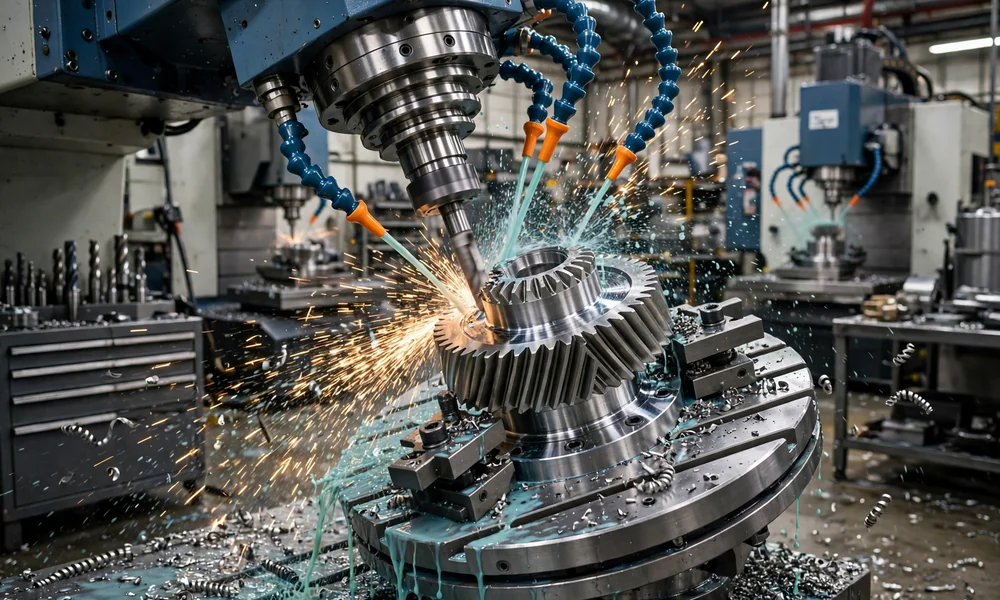
While the gears are being finished, the casing is machined from a solid block of aluminium or magnesium alloy. A five-axis milling machine carves away most of the block, leaving a stiff, lightweight shell with bearing seats, oil galleries, and mounting faces. The casing must hold the gear shafts in perfect alignment under enormous loads, and it must shed heat — a gearbox working hard on track can get hot enough to cook its oil. Every casing is checked with measuring probes that can spot an error smaller than a speck of dust.
Step 5: Assembling the clutch packs and shift mechanism
In a dual-clutch gearbox, the gears are only half the story. Two multi-plate clutch packs — one for odd gears, one for even — sit inside the casing, each bathed in oil and controlled by hydraulics. Technicians assemble the clutch plates by hand, measuring the clearance of each stack, because a pack a fraction too tight will drag and overheat, while one too loose will slip under power. The shift mechanism follows: hydraulic actuators, selector forks, and sensors that tell the car’s computer exactly which gear is engaged, hundreds of times a second.
Step 6: Shimming, testing, and the first full-power run
Assembly is where the gearbox becomes a precision instrument. The gear shafts are fitted into the casing with shims — paper-thin washers — that set the exact spacing between meshing teeth. Too tight and the gears will overheat; too loose and they will clunk and chip. Technicians measure the backlash with dial gauges until it falls inside a window of hundredths of a millimetre. Then the finished gearbox goes to a test rig, where it is run through every gear under full load, sometimes for hours, while engineers listen for noise and watch oil temperature. Only when it shifts flawlessly, thousands of times, is it bolted to the engine. The materials inside it are just as specialised, as hypercar gearbox materials explains.
| Main material | Forged alloy steel gears in a machined aluminium or magnesium casing |
| Typical weight | About 70 to 90 kilograms, including clutches and oil |
| Number of gears | Seven or eight forward speeds, plus reverse |
| Shift time | As little as 50 to 80 milliseconds in the fastest boxes |
| Gear tolerance | Teeth ground to within a few microns |
| Torque capacity | More than 1,000 newton-metres in the most powerful cars |
| Clutch type | Dual wet multi-plate clutches, hydraulically controlled |
| Lubrication | Special synthetic oil, pumped and cooled under pressure |
What Does a Hypercar Gearbox Cost?
A hypercar gearbox is a bespoke part, built for one model in tiny numbers, so there is no catalogue price. A complete sequential or dual-clutch unit is estimated at roughly $60,000 to $150,000, depending on the car, and that figure excludes the years of engineering and testing behind the design. Rebuilds are part of ownership too: clutch packs wear with hard use, and a full service can cost several thousand dollars. For a racing team, the gearbox is one of the most expensive single components on the car after the engine itself.
A Rare Fact
The first dual-clutch gearboxes were not built for speed at all. The idea was patented in the 1930s and first used in racing in the 1980s, but it was Porsche’s work at Le Mans that proved it could survive endurance racing — and even then, the system was so complex that it took two more decades before it reached road cars. Today, the same idea shifts gears faster than a driver can blink, in cars that anyone with the money can buy.

The gearbox will never be the part a hypercar owner photographs. It has no badge, no exhaust note, no visible drama. But every launch without wheelspin, every shift that lands exactly when the driver asks, and every lap that feels effortless comes down to this box of steel doing its sums in silence. It is the translator between an engine’s fury and the road — and one of the hardest machines on the car to make.