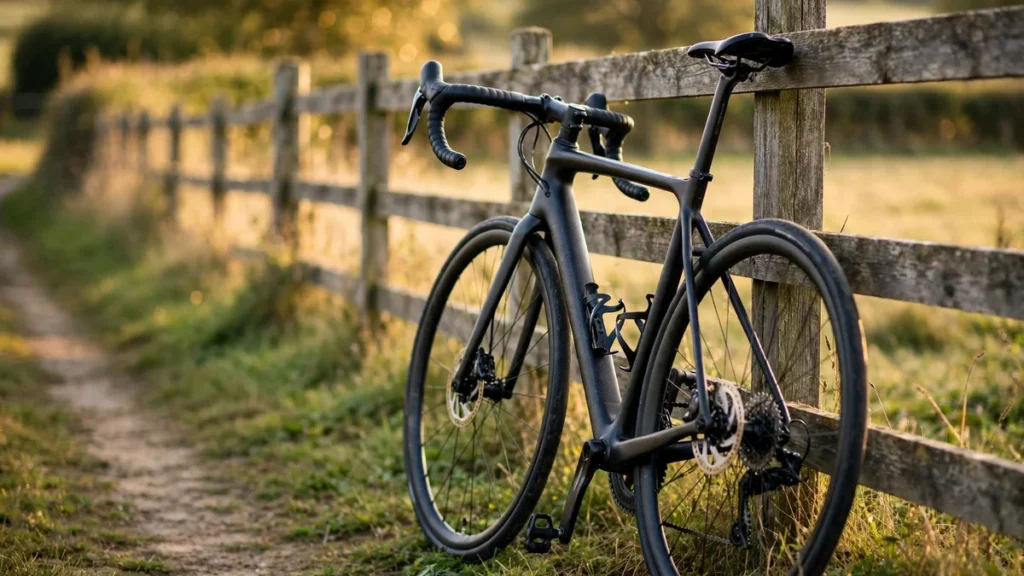
Pick up a carbon fibre e-bike and the first thing you notice is how little of it there seems to be. The frame feels almost too light for the job it has to do, yet it carries a motor, a battery, a rider and a set of gears over potholes, kerbs and muddy trails without complaint. Hold it a moment longer and you start to notice the second thing: the frame is not a set of tubes welded together, but a single flowing shape, with the battery hidden inside the down tube and the motor tucked into the bottom bracket as if the frame had grown around them.
That shape is the point. An e-bike carbon frame works by turning the frame itself into a tuned structure, stiff where the motor pushes, forgiving where the rider sits, and light everywhere else. The fibres inside it are laid in different directions for different jobs, and the frame is cured as one piece in a mould. This is how it works, from the first sheet of cloth to a motor-assisted ride up a steep hill.

How an E-Bike Carbon Frame Works
Step 1: Fibres are laid for different jobs
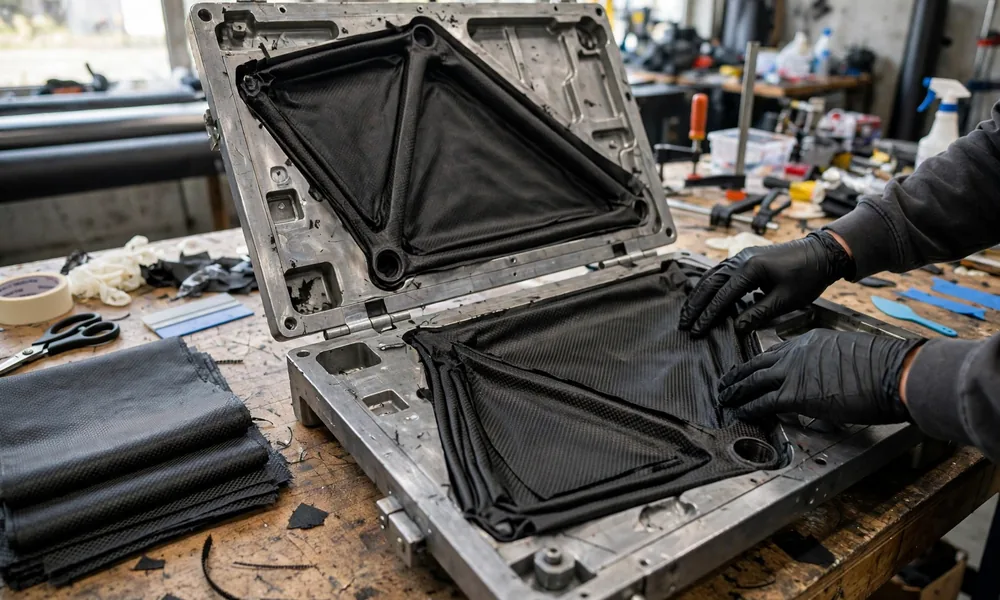
A carbon frame starts as sheets of carbon fibre cloth, and the direction of the fibres in each sheet decides what that part of the frame will do. Fibres running along a tube resist bending, fibres wrapped around it resist twisting, and fibres laid diagonally spread the load from a single point. The down tube, which carries the battery and takes the pull of the chain, gets extra layers running lengthwise, while the seat stays get fewer, so they can flex a little and soften the ride. Nothing about the layup is random; each layer is cut to a pattern and placed by hand, and the pattern is what turns cloth into a frame.
Step 2: The frame is cured in a mould
Once the layers are stacked, they are placed into a two-part mould shaped like the finished frame, with an inflatable bladder inside to press the fibres against the mould walls. The mould goes into an oven, where heat hardens the resin that binds the fibres together, and the bladder pressure squeezes out air so the finished frame is dense and free of voids. The cure takes hours and follows a careful temperature curve, because a frame cured too quickly can trap bubbles that become weak spots. When the mould opens, the frame comes out as a single piece, already carrying its cable routes and mounting points. The same layup discipline shapes carbon structures across the industry, as the carbon fibre weave guide shows.
Step 3: The battery hides in the down tube
The biggest difference between an e-bike frame and an ordinary bike frame is the battery, and on most modern e-bikes it lives inside the down tube. The tube is made wider and deeper than a normal bike’s, with a removable cover on its underside, and the battery slides in along a rail and locks into a connector at the base. Hiding the battery this way keeps the weight low and central, which is exactly where a bike wants its weight, and it protects the cells from weather and knocks. The cells inside that tube and the range they deliver are covered in the e-bike battery guide.
Step 4: The motor mounts at the bottom bracket
Most carbon e-bikes use a mid-drive motor, a compact unit that bolts into a reinforced shell at the bottom bracket, where the pedals meet the frame. The motor drives the chainring directly, so its power flows through the same chain and gears as the rider’s legs, and the frame has to be strong enough to handle the combined torque. That shell is the most heavily reinforced part of the frame, with extra layers wrapped around it and metal inserts cured in place for the motor bolts. The motor’s own torque sensor reads how hard the rider is pedalling and matches it. The unit that does that work is explained in the e-bike mid-drive motor guide.
Step 5: Stiffness and comfort are tuned together
A good e-bike frame is stiff in some directions and deliberately flexible in others. The bottom bracket area and the head tube are built stiff, so none of the motor’s power is lost to the frame flexing, and the steering stays precise at speed. The seat stays and the fork, by contrast, are laid up to flex a little, soaking up vibration from rough roads before it reaches the rider. This tuning is the real skill in carbon frame design: the same material can be made to feel harsh or smooth depending on how the fibres are arranged.
Step 6: The frame carries the whole system
When the bike is finished, the frame does more than hold the parts together. It routes the cables and brake hoses internally, keeping them out of the weather, and it carries the mounting points for the display and lights. Every load the bike meets — the motor’s torque, the rider’s weight, the shock of a pothole — travels through the frame, and the frame spreads it out so no single point takes the full force. A well-made carbon frame can last for years of hard riding, but it does need care: a sharp impact that would only dent a metal frame can crack carbon, and a cracked frame should always be inspected by a specialist before the bike is ridden again.

E-Bike Carbon Frame at a Glance
| Specification | Detail |
|---|---|
| Material | Carbon fibre cloth in epoxy resin, laid in directional layers |
| Frame weight | Approximately 2 to 3 kilograms for a mid-drive e-bike frame |
| Battery position | Inside the down tube, removable through an underside cover |
| Motor position | Mid-drive unit bolted into the bottom bracket shell |
| Typical motor power | 250 watts nominal in most markets, with higher peak output |
| Typical range | Approximately 60 to 120 kilometres per charge, depending on assist level |
| Main advantage | Very light for its stiffness, tuned ride feel, clean integration |
| Main drawback | Expensive, vulnerable to sharp impacts, specialist repairs |
| Main uses | Commuting, trail riding, touring, cargo e-bikes |
What Does It Cost?
A carbon e-bike frame is a large share of the price of the whole bike. As rough estimates, a complete carbon fibre e-bike typically costs from around 2,500 to 6,000 dollars depending on the motor, battery and components, while a replacement frame alone usually runs from about 1,000 to 2,500 dollars. Those figures are estimates, not quotes.
A Rare Fact
Carbon fibre bicycle frames were once banned from professional racing, not because they were unsafe but because officials were unsure how to judge them. The ban was lifted in the 1990s, and within a decade carbon had taken over the top level of the sport completely. The same layup thinking that won races now shapes the frames that carry motors and batteries.
An e-bike carbon frame works because it is not just a lighter version of a metal frame. It is a structure designed fibre by fibre for the loads a motor adds, and that is why it can be both feather-light and strong enough to carry a battery, a motor and a rider up the steepest hill in town.