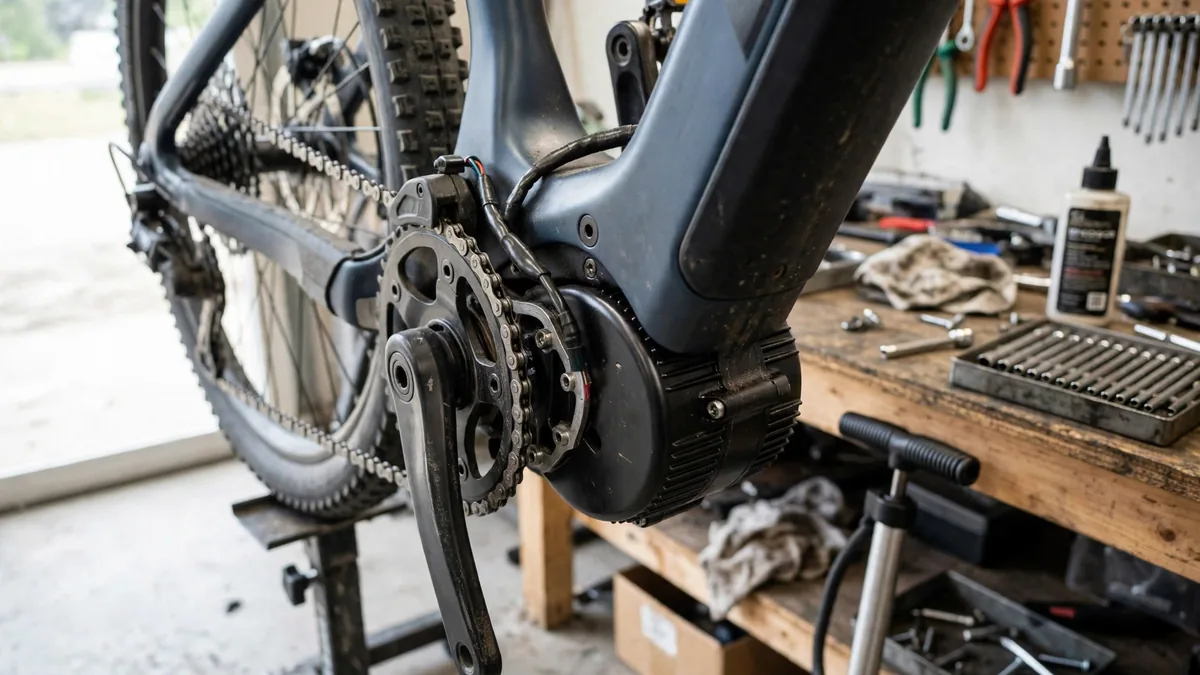
Pedal an electric bike up a steep hill and something remarkable happens: your legs feel stronger than they are. The bike seems to read your effort and add exactly the right amount of power, smoothly and silently, as if an invisible rider were pushing with you. That feeling comes from a motor no bigger than a grapefruit, tucked into the frame where the pedals meet. It is called a mid-drive motor, and it is one of the most cleverly engineered parts on any electric bike.
A mid-drive motor sits at the heart of the bike, driving the crank directly so its power flows through the gears, just like your legs do. Inside its compact housing are copper windings wound by machine, rare-earth magnets, a gearbox the size of a pocket watch, sensors that measure your pedalling force a thousand times a second, and electronics that decide how much help to give. Building one means winding wire thinner than a hair, machining gears to the width of a fingerprint, and sealing everything against rain, mud, and dust.
Millions of these motors are made every year, yet each one is a small masterpiece of precision engineering. This is how an e-bike mid-drive motor is made.
How It’s Made
Step 1: Stamping the laminations and winding the stator
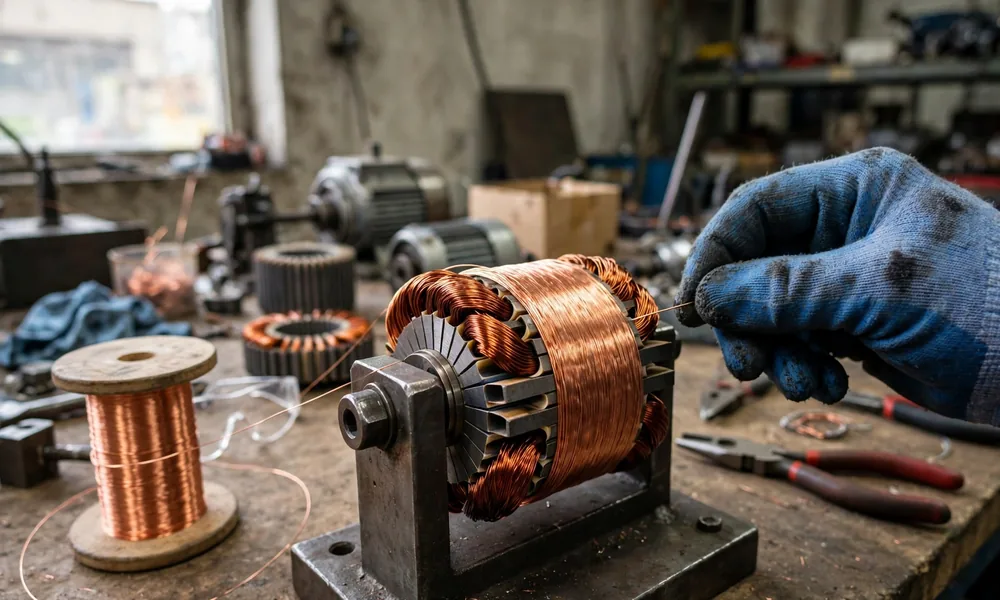
The motor begins as a stack of thin steel sheets, each one stamped out like a coin and coated to stop electricity flowing between them. These laminations are stacked into a ring called the stator, with slots around its inside edge. Then a machine winds copper wire into those slots, coil after coil, with the wire laid so precisely that every turn sits exactly where it should. The copper is coated in a thin layer of enamel insulation, and the finished winding is dipped in varnish and baked hard so it cannot move or vibrate. The way the finished motor turns that electricity into motion is covered in how an e-bike mid-drive motor works.
Step 2: Making the rotor and fitting the magnets
While the stator is wound, the rotor is built. It is a steel core on a shaft, and around it sit curved magnets made from neodymium, one of the strongest magnetic materials known. Each magnet is glued and banded into place with its poles arranged in an exact alternating pattern, because a single magnet facing the wrong way would weaken the motor. The rotor is then balanced on a spinning rig, with tiny amounts of metal removed until it runs without vibration at thousands of revolutions per minute.
Step 3: Machining the gearbox
An electric motor spins far too fast to drive pedals directly, so a gearbox sits between the motor and the crank. Its gears are cut from hardened steel on precision hobbing machines, with teeth so small that a dozen of them fit across a thumbnail. The gears run in a planetary arrangement, sharing the load between several small gears instead of one big one, which keeps the whole unit compact. Each gear is heat-treated to harden its surface, then ground smooth and measured. Similar precision gear work goes into how an e-bike gearbox is made, where the same tiny teeth carry a rider’s power.
Step 4: Adding the torque sensor and electronics
The part that makes a mid-drive motor feel natural is its torque sensor. A strain gauge bonded to the crank shaft measures how hard the rider is pedalling, thousands of times a second, and sends that signal to a controller board. The controller is a small circuit board crowded with chips, capacitors, and power transistors, assembled by machines that place each component to a fraction of a millimetre and solder them in a reflow oven. Firmware on the board decides how much assistance to give and how smoothly to ramp it up, so the power arrives as a gentle push rather than a shove.
Step 5: Assembling and sealing the housing
The stator, rotor, gearbox, sensor, and controller are fitted into a housing cast from aluminium alloy, which doubles as a heat sink to carry warmth away from the motor. Bearings are pressed onto the shafts, seals are fitted at every opening, and the housing halves are bolted together with a gasket that keeps out water and dust. The crank axle passes through the centre, with its own seals to stop mud working in from the pedals. The battery that feeds the motor is built to similarly strict standards, as described in e-bike battery specs.
Step 6: Testing under load and final inspection
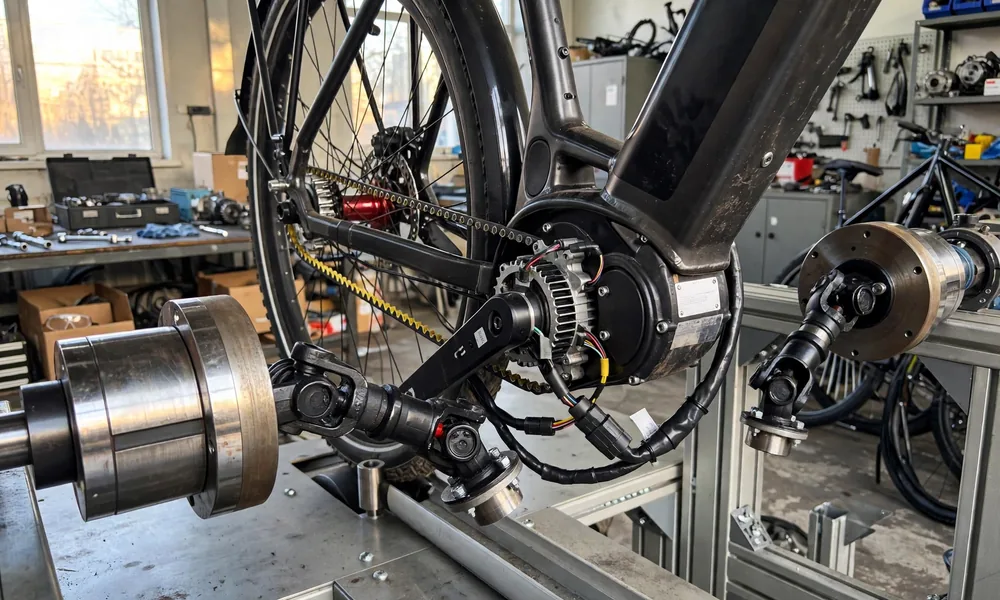
Every motor is tested before it leaves the factory. It is mounted on a dynamometer that spins it against a known load while instruments measure its power, efficiency, torque, and temperature. The torque sensor is checked to make sure its readings are smooth and accurate, and the motor is run through its full speed range listening for unusual noise, which can reveal a bad bearing or a winding fault.
| Main materials | Laminated steel stator, copper windings, neodymium magnets, hardened steel gears |
| Typical power | 250 watts rated in Europe, with peak output of 500 to 600 watts |
| Typical torque | About 50 to 90 newton metres at the crank |
| Motor speed | Several thousand revolutions per minute, geared down to pedalling speed |
| Gearbox type | Planetary gears in hardened steel, sealed for life |
| Torque sensing | Strain gauge on the crank shaft, sampled thousands of times per second |
| Sealing | Gasketed aluminium housing tested against water and dust |
| Typical weight | About 2.5 to 4 kilograms for the complete unit |
What Does an E-Bike Mid-Drive Motor Cost?
A mid-drive motor is one of the most expensive parts of an electric bike. A complete unit from a major maker is estimated at roughly $400 to $900 as a replacement part, and it accounts for a large share of the price of a finished e-bike, which often sells for $2,000 to $5,000 or more. The cost reflects the copper windings, rare-earth magnets, precision gearbox, and electronics inside, plus the testing every unit goes through. For a rider who climbs hills every day, the difference between a well-made motor and a cheap one is felt on every single ride.
A Rare Fact
The magnets inside a mid-drive motor are so powerful that they are a hazard in the factory: a loose magnet can leap across a workbench and snap onto a steel tool with enough force to chip itself or pinch a finger. Workers handle them with non-magnetic tools and keep them in special trays. That is why a good mid-drive bike feels less like a machine and more like stronger legs.
The mid-drive motor will never be the part an e-bike owner shows off. It hides inside the frame, quiet and out of sight, doing its work every time the pedals turn.


