There is a moment on every good electric bike when the motor seems to read your mind. You press a little harder on the pedals to climb a hill, and the assistance grows with you. You ease off at the top, and the motor fades away before you even notice it. That feeling does not come from the motor. It comes from a part most riders never see and never think about: the torque sensor, a device smaller than a coin that measures how hard you are pedalling, hundreds of times a second, and tells the motor exactly how much help to give.
Without it, an electric bike feels like a moped with pedals attached: the motor is either on or off, and the ride is jerky and unnatural. With it, the bike feels like your own legs, only stronger. Making the sensor is an exercise in measuring something almost invisible — the tiny twist in a metal shaft when a rider pushes on the cranks.
How It’s Made
Step 1: Choosing the sensing method
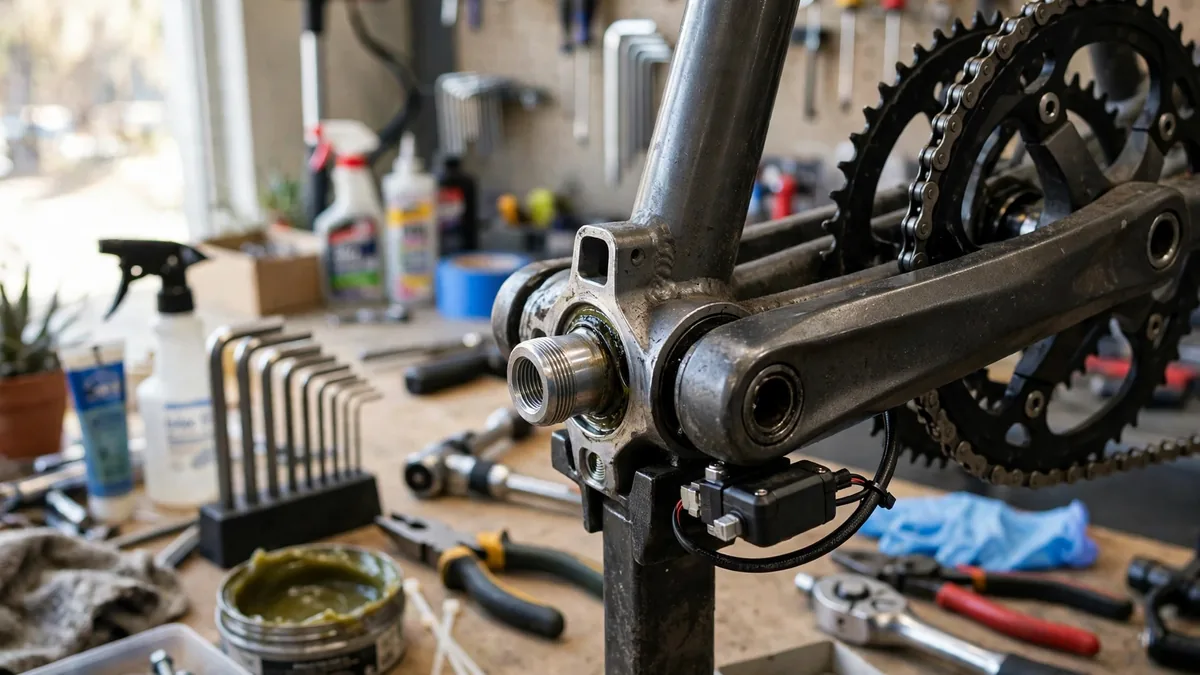
Most modern torque sensors work by measuring strain: when you push on the pedals, the crank spindle twists by a microscopic amount, and the sensor detects that twist. Engineers choose between two main approaches. A strain-gauge sensor bonds tiny electrical resistors to the spindle itself, and their resistance changes as the metal stretches. A magnetic sensor, by contrast, watches a magnetised ring on the spindle and reads how its field shifts as the shaft twists. Strain gauges are precise and well proven; magnetic sensors have no parts touching the shaft and can last longer.
Step 2: Machining the spindle
The sensor is built around the bottom bracket spindle, the steel shaft that the cranks turn on. It is machined from a high-strength steel alloy on a lathe, ground to a smooth finish, and heat-treated so it can survive years of pedalling forces without bending permanently. The section where the sensor sits must be machined to a tolerance of a few microns, because the twist the sensor measures is itself only a few microns deep. A spindle that is even slightly out of round will give false readings, so every spindle is measured with a laser gauge before it moves on. This is the same obsession with tiny tolerances that shapes a phone’s metal shell, as our look at how a smartphone titanium frame is made shows.
Step 3: Bonding the strain gauges
If the sensor uses strain gauges, this is the most delicate step in the whole process. A technician cleans the spindle with solvents, then glues a foil strain gauge — a pattern of fine metal tracks on a thin plastic backing, smaller than a postage stamp — onto the steel with a special adhesive. The gauge must be aligned perfectly with the direction of the twist, because a gauge glued on at an angle measures the wrong force. The adhesive is cured under heat, and the gauge is then wired to a tiny circuit board with hair-fine wires. One speck of dust under the gauge, or one bubble in the glue, and the sensor will drift and lie about how hard the rider is pedalling.
Step 4: Sealing the electronics
The sensor’s electronics live in a hostile place: at the bottom of a bike, where rain, mud, road salt, and vibration all attack them daily. The circuit board is coated in a protective resin, the wires are routed through sealed channels, and the whole assembly is potted in a waterproof compound that keeps moisture out while letting the sensor flex with the spindle. The unit is then tested for water resistance, often to the IP65 standard or better, by being sprayed and submerged. It is the same sealing discipline that protects the motor itself, and it is why the best e-bike motors keep working through winters that kill cheaper ones, as our look at how an e-bike mid-drive motor works explains.

Step 5: Calibrating the sensor
A sensor that is built but not calibrated is useless, because every spindle twists slightly differently. Each unit is mounted on a test rig and loaded with known forces — the equivalent of a light rider spinning gently, then a heavy rider standing on the pedals up a steep hill — while the factory measures what the sensor reports. The results are used to write a calibration table into the sensor’s memory, so that a given twist always means the same torque, whatever the bike. This is a slow, careful step, and it is the reason good torque sensors feel natural: the motor is responding to real forces, not guesses.
Step 6: Fitting and road testing
The calibrated sensor is fitted into the bottom bracket of the bike, wired to the motor controller, and the whole bike is tested on a rolling road. Engineers ride it through simulated hills and starts, checking that the assistance rises and falls smoothly and that the sensor does not lag behind the pedals. A lag of even a tenth of a second feels wrong to a rider, like the bike is pushing you after you have already stopped pushing. The sensor’s readings also feed into the bike’s range calculations, because the motor only uses as much battery as the rider’s effort demands, as our look at e-bike range beyond battery size explains.
Specs
| Specification | Detail |
|---|---|
| Sensor type | Torque sensor (strain-gauge or magnetic, mounted at the bottom bracket) |
| What it measures | Twist (strain) in the crank spindle caused by pedalling force |
| Measurement range | Typically 0 to about 100 Nm of rider torque |
| Response time | Typically under 10 milliseconds from pedal force to motor response |
| Accuracy | Typically within about 2 to 3 percent after calibration |
| Spindle material | High-strength heat-treated steel alloy |
| Water resistance | Typically IP65 or better, sealed and potted electronics |
| Output | Digital signal to the motor controller, updated hundreds of times per second |

Price
A torque sensor is a small part, but it is not a cheap one to make well. The sensor unit itself costs a manufacturer roughly $30 to $80 (estimate), depending on the design and the quality of the calibration, and it is one of the reasons a well-built e-bike with a torque sensor typically retails from around $2,000 (estimate, based on typical pricing of mid-drive e-bikes with torque sensing), while cheaper bikes using a simple cadence sensor can sell for under $1,000.
Rare Fact
The twist a torque sensor measures is so small that if the crank spindle were as long as a football field, the far end would move by less than the width of a pencil line when a rider pushes hard on the pedals. Yet the sensor reads that twist hundreds of times a second, in rain and mud and freezing cold, and turns it into a motor response so smooth that most riders never realise a sensor is involved at all. The best torque sensor is the one you never notice — and that invisibility is the hardest thing in the world to manufacture.