Hold a fast-charging cable in your hand and the first thing you notice is the weight. It is thick as a garden hose and heavy enough that you carry it with two hands, yet the electricity running through it could power a small street. In a few minutes at a charging station, this cable delivers more energy than a house uses in a day, and it does so while staying cool enough to touch, flexible enough to coil, and safe enough for a stranger to handle in the rain. The cable looks simple. It is one of the most engineered objects on the car.
An EV fast charging cable is not a wire with a plug on the end. Inside the black outer sheath there are copper conductors as thick as a finger, liquid cooling channels, temperature sensors, communication wires and layers of insulation, all packed into a tube that must bend thousands of times without breaking. The factory that builds it is part copper mill, part plastics plant and part electronics lab, and every metre it produces is tested as if a life depended on it — because, at 350 kilowatts, one does.

How an EV Fast Charging Cable Is Made
Step 1: Drawing the copper conductors
It starts with copper rod, eight millimetres thick, pulled through a series of ever-smaller dies until it becomes fine wire, then stranded together into flexible bundles. A single fast-charging conductor can contain hundreds of fine copper strands, because stranded wire bends without breaking where a solid bar would snap. The strands are twisted in a precise lay pattern that keeps the bundle compact and flexible, then checked for resistance: too much resistance means heat, and heat is the enemy of everything that follows.
Step 2: Insulating each core
Each copper bundle is coated in insulation, usually cross-linked polyethylene or a silicone rubber compound chosen to survive heat, cold, oil and ozone. The insulation is extruded over the moving conductor in a continuous line, like toothpaste squeezed around a thread, and its thickness is measured constantly with lasers. A pinhole in this layer would be a disaster at 1,000 volts, so the line runs a spark test: a high voltage is applied along the whole length, and any flaw shows up as a spark and a rejected section. Nothing with a weak spot moves on.
Step 3: Adding cooling and communications
Here the cable becomes something no ordinary wire is. Thin tubes for liquid coolant are laid alongside the power conductors, carrying a water-glycol mix that absorbs heat as current flows. Temperature sensors, small thermistors, are placed at intervals, and thin communication wires run the length of the cable so the car and charger can talk to each other while charging. The whole bundle is assembled on a stranding machine that twists the cores, coolant tubes and signal wires together into a round, balanced shape. The cooling discipline is the same one that protects EV battery packs, where heat must be carried away before it can build up.

Step 4: Extruding the outer sheath
The assembled core passes through a second extruder that coats it in a tough outer sheath of thermoplastic polyurethane, the rubbery black skin you actually touch. This layer must survive being dragged across concrete, run over by a wheel, left in desert sun and frozen in winter, and still flex easily in a driver’s hands. The sheath is marked along its length with the cable’s ratings, then cooled in a water trough and wound onto a drum. A cable that kinks or flattens on the drum is scrapped; the round profile matters, because a crushed coolant channel would starve the cable of cooling.
Step 5: Fitting the connector
At the end of the cable, the connector is the part everyone knows: the heavy plug with thick pins and a latch. The copper conductors are crimped or welded to silver-plated pins, the coolant tubes are connected to fittings, and the sensor wires are soldered to tiny contacts. The whole joint is then overmoulded — encased in moulded plastic that seals it against water and locks everything in place. Overmoulding is permanent: once it is done, the connector can never be opened for repair, which is why the crimps are X-rayed and pull-tested before the mould closes. The connector shares its precision DNA with EV inverters, where every joint must carry huge currents without heating.
Step 6: Bending, flexing and pressure tests
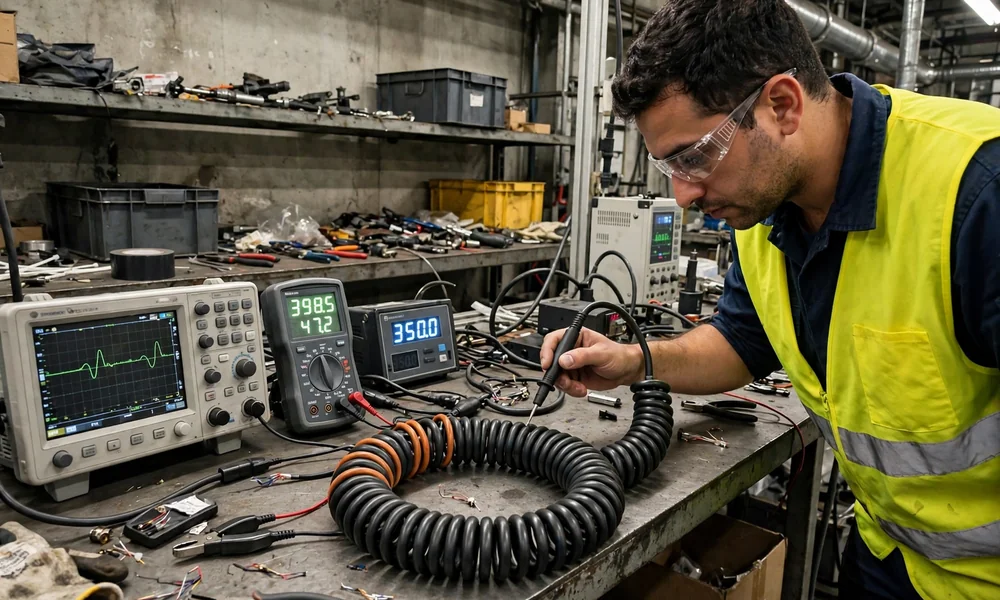
Before a cable ships, it is punished. It is bent back and forth thousands of times on a flex rig, twisted, dragged and dropped, then pressure-tested: the cooling loop is filled and checked for leaks at pressures far above normal use. An electrical test follows — insulation resistance, continuity on every wire, and a high-voltage withstand test that proves the insulation can hold far more than the charger will ever deliver. The temperature sensors are checked too, because they are the cable’s early warning system: if one reports heat, the charger slows down before anything gets hot.
Step 7: Final assembly and traceability
Finished cables are cut to length, fitted with the vehicle-side or charger-side connector, coiled and packed with their test certificate. Each cable carries a serial number and a production record: the copper batch, the insulation run, the operator who crimped the connector, and the results of every test. If a cable ever fails in the field, the factory can trace it back to the exact shift and the exact reel of copper. The same traceability runs through EV charging port production, where every part must be accountable for its own history.
EV Fast Charging Cable at a Glance
| Specification | Typical Value |
|---|---|
| Peak power | Up to 350 kW, some designs 400 kW |
| Peak current | Up to about 500 A, liquid-cooled |
| Voltage rating | Up to 1,000 V DC |
| Conductor | Fine-stranded copper, hundreds of strands |
| Cooling | Water-glycol loop inside the cable |
| Outer sheath | Thermoplastic polyurethane, abrasion resistant |
| Key advantage | High power, cool to the touch, bendable for years |
What Does It Cost?
A liquid-cooled fast charging cable is far more expensive than it looks. A complete cable assembly — cable, connector, coolant fittings and sensors — typically costs a charging operator $800–$2,500 (estimates), and a replacement on a public fast charger can run $1,500–$4,000 installed (estimates). The cost is driven by the copper, which is sold by weight and is not cheap, the silver-plated connector pins, the cooling system and the testing. It is one of the most expensive wearing parts on a charging station, which is why operators protect them from being driven over whenever they can.
A Rare Fact
Without liquid cooling, a cable carrying 500 amps would need copper conductors so thick that a driver could barely lift the plug — engineers estimate an uncooled 350-kilowatt cable would weigh roughly twice as much and be as stiff as a fire hose. The coolant loop, carrying away heat as fast as the current makes it, is what lets a cable you can coil with one hand deliver the power of a small neighbourhood. The water inside the cable is doing as much work as the copper.