There is a screen in your bag that has not been charged in weeks, and it is still showing the last page of your book. It does not glow, it does not flicker, and in bright sunlight it only gets easier to read. It looks like paper, feels like paper to the eye, and yet it can change its words in a blink. That is an E-Ink display, and it works nothing like the screen on your phone.
Instead of light, it uses tiny capsules filled with black and white particles, and instead of power, it uses a brief electric pulse to move them. Once the particles are in place, they stay there with no energy at all, which is why the page survives for weeks. Making such a display means building capsules smaller than a grain of sand, laying down transistor circuits on flexible plastic, and sealing the whole thing against moisture. Here is how an E-Ink display is made, step by step.

How an E-Ink Display Is Made
Step 1: Making the microcapsules
Everything begins with the ink itself, which is not ink at all. In a chemical plant, tiny capsules are made by mixing black and white pigment particles into a clear fluid, then wrapping droplets of that fluid in a thin polymer shell. Each capsule is about the width of a human hair, and each one holds hundreds of charged particles, white ones carrying one charge and black ones the other. The capsules are made in huge batches, then mixed into a liquid that can be coated onto a sheet like paint. The exact recipe is a closely guarded secret.
Step 2: Coating the capsules onto a film
The capsule mixture is coated onto a clear plastic film in a continuous roll-to-roll process, much like printing a newspaper. The film runs through a coating machine that spreads the ink to an even thickness, then dries it gently so the capsules are not damaged. A second layer, the front electrode, is added on top, a transparent conductive film that will carry the electric field across the whole display. The coated film is inspected under light for gaps, bubbles, or clumps of capsules, and any section that fails is cut out and discarded. What survives is a long roll of electronic paper, grey and matte, waiting to be cut into screens.
Step 3: Building the transistor backplane
Underneath the ink film sits the backplane, a sheet of transistors that controls each tiny part of the display. Unlike a phone screen, which uses silicon chips, an E-Ink backplane is usually made with thin-film transistors printed onto glass or flexible plastic. Layers of metal, insulator, and semiconductor are deposited and patterned, one after another, until millions of tiny switches cover the sheet. Each switch controls one pixel, turning its electric field on or off to pull the black or white particles to the surface. The precision electronics here share a family with the chips in a phone, as described in how a 5G modem chip is made, though the E-Ink circuits are far simpler and spread over a much bigger area.
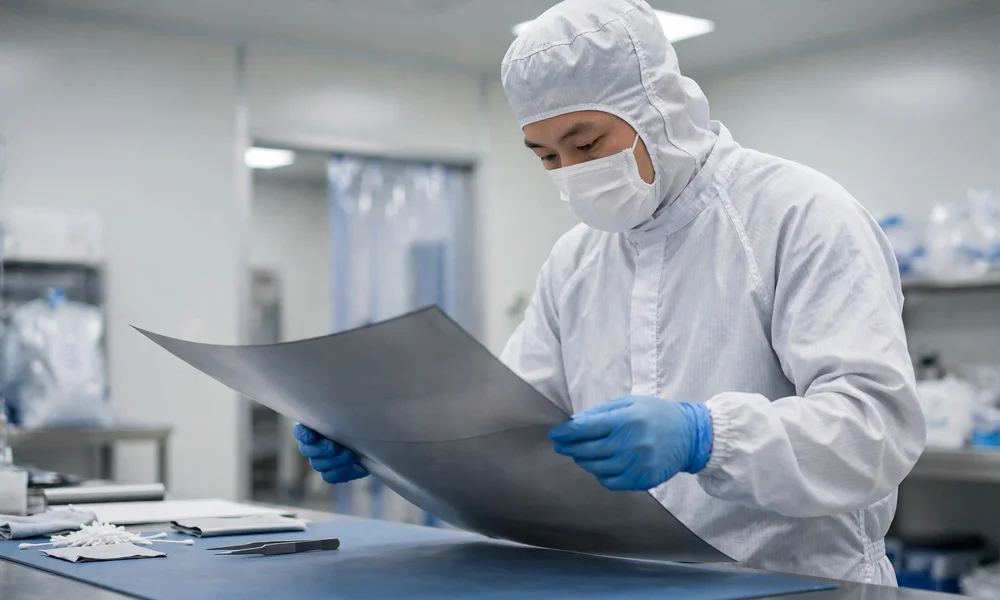
Step 4: Laminating the ink film to the backplane
The ink film and the backplane are brought together in a lamination machine. The film is cut to size, aligned over the backplane with great care, and pressed down so the two stick together without a single air bubble. Alignment matters because every pixel on the backplane must sit under the ink it controls, and a shift of a fraction of a millimetre would blur the text. The laminated sheet is then sealed around its edges to keep moisture out, since water is the great enemy of E-Ink, turning the capsules cloudy and killing the contrast. The sealed panel is tested with a simple pattern, and any panel with dead pixels or a cloudy patch is rejected.
Step 5: Adding the driver electronics and the light
A display panel cannot work alone. A small driver board is attached to its edge, carrying the chips that translate the words of a book into voltages for millions of pixels. The board is bonded to the panel with a flexible connector, then folded behind it so the finished screen stays thin. Most modern e-readers also add a front light, a thin layer of tiny LEDs along the edge that shines light across the page, not into the reader’s eyes. The light guide is a clear plastic sheet with microscopic patterns that spread the light evenly, and it is laminated on top of the display. The driver chips and their precise assembly echo the miniature motor work in how a camera autofocus motor is made, where tiny parts must also be placed with almost no error.
Step 6: Testing the display and fitting it into a device
The finished panel is tested by flashing it through pages of text and images, checking that every pixel changes cleanly and that no ghost of the old page remains. Engineers measure the contrast, the whiteness, and the speed of the refresh, and they bend flexible panels to make sure the ink survives. The panel is then fitted into an e-reader, a price tag, or a notebook, with its battery and processor, and the whole device is tested again. The glowing screens it sits beside in shops are a different technology entirely, covered in the OLED display panel specs explained, which trades battery life for colour and speed.

E-Ink Display Specs
| Specification | Typical figure |
|---|---|
| Capsule size | Around 50 microns across |
| Resolution | Up to around 300 pixels per inch |
| Refresh time | Roughly 0.5 to 1 second per page |
| Power when static | None, the image stays on its own |
| Backplane | Thin-film transistors on glass or plastic |
| Front light | Edge LEDs with a light guide layer |
What an E-Ink Display Costs
A typical E-Ink display panel for an e-reader is estimated to cost the device maker roughly 20 to 60 dollars, though the exact figure is an estimate and varies with the screen size, the resolution, and the order size. That is one of the most expensive parts of an e-reader, which is why the devices cost more than their simple looks suggest. Larger panels for signs and notebooks cost far more.
A Rare Fact About the E-Ink Display
Here is a detail most readers never hear: an E-Ink display can hold its image with no power for years. The black and white particles stay exactly where the last electric pulse put them, held in place by nothing more than their own charge and the thickness of the fluid around them. If you took the battery out of an e-reader today, the page would still be there next year. That is why E-Ink is used for price tags in shops and signs in stations, places where changing a battery every few weeks would be absurd, and why a forgotten e-reader in a drawer still greets you with the page you left.


