An electric car can pour out hundreds of kilowatts in a few seconds, and every one of those kilowatts makes heat. Left alone, that heat would cook the battery cells, shorten their life, and in the worst case start a fire. Yet EVs charge in minutes and climb hills at motorway speed without breaking a sweat. The reason is a cooling system woven through the battery pack itself, a network of plates, pipes, and pumps that carries heat away as fast as the cells make it.
The system looks simple from the outside, a few hoses and a small radiator, but inside the pack it is a maze. Thin metal plates sit between the cells, coolant flows through channels thinner than a pencil, and sensors watch the temperature of every module. Building it means sealing hundreds of joints against leaks, bending pipes that never kink, and testing the pack until it can be fast-charged on the hottest day of the year. Here is how EV battery cooling is made, step by step.
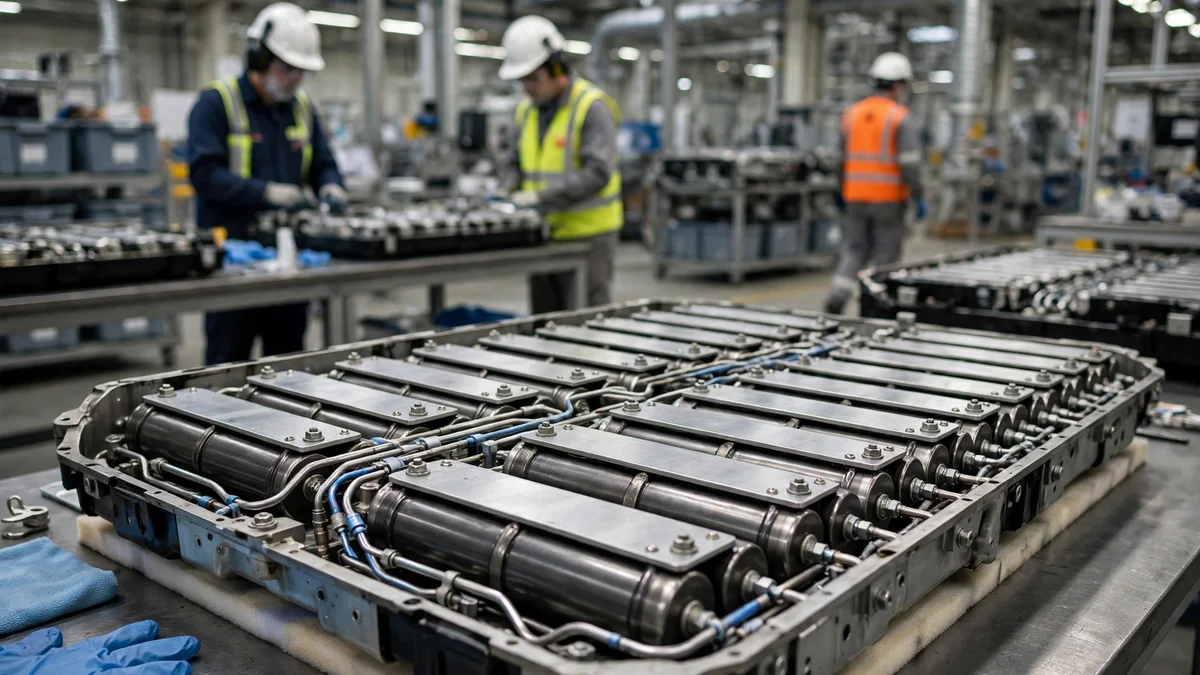
How EV Battery Cooling Is Made
Step 1: Designing the cooling layout for the pack
Cooling design starts with the pack itself. Engineers map where the heat is made, which is mostly in the cells during fast charging and hard driving, and decide how the coolant should flow to reach it. Most packs use cold plates, flat metal sheets with channels inside, placed under or between the cell modules. The team models the flow in software, checking that every module gets its fair share of coolant and that no corner of the pack runs hotter than the rest. The pack this system protects is its own engineering story, as explained in how an EV battery pack is made, where the cells and structure come together first.
Step 2: Making the cold plates
A cold plate starts as two sheets of aluminium. One sheet is stamped or machined with a winding channel, like a maze, and the other is laid flat on top. The two are joined by brazing, a process that heats them in a furnace until a filler metal melts and bonds them into a single sealed plate. The channel inside must be smooth and free of blockages, because a single trapped speck can starve a whole section of the pack of coolant. Each plate is pressure-tested with air or water before it is allowed near a battery, and any plate that loses pressure is scrapped. The plates are also coated or treated so the coolant never corrodes them from the inside over years of use.
Step 3: Bending and fitting the coolant pipes
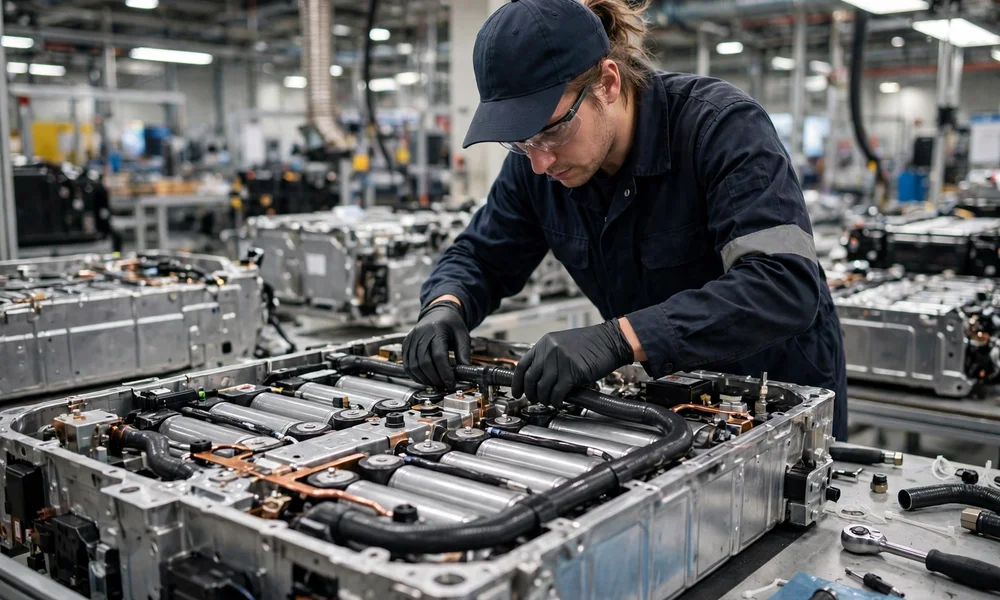
Coolant travels between the plates and the rest of the car through pipes and hoses. The metal pipes are bent on computer-controlled machines that shape them to the exact curve of the pack, with no kinks that would slow the flow. Rubber hoses join the rigid sections where the pack needs to flex, and each joint is sealed with a clamp or a quick connector that can be opened for servicing and closed again without leaking. Every connection is marked and checked, because a slow leak inside a sealed battery pack is one of the hardest faults to find later.

Step 4: Fitting the pump, chiller, and valves
The coolant does not move by itself. An electric pump, usually a small sealed unit with no shaft seal to leak, pushes it around the loop. In most EVs the loop also passes through a chiller, a small heat exchanger that hands the heat to the car’s air conditioning system, and a radiator at the front for mild days. Valves decide where the coolant goes, sending it to the battery when the cells are hot, and to the cabin or the motor when they need the heat instead. The pump, chiller, and valves are mounted on brackets, wired to the car’s computers, and connected to the pipes. Each part is tested on its own bench first, and the whole loop is flushed clean before it is filled with coolant.
Step 5: Adding the temperature sensors
A cooling system that cannot feel the heat is useless. Temperature sensors are placed throughout the pack, on the cells, on the cold plates, and in the coolant itself, sometimes dozens of them in one car. Each sensor is a small chip or thermistor, wired back to the battery management system, the computer that watches the pack. The management system is calibrated so it knows the temperature at every point in the pack, and it decides when to run the pump faster, open a valve, or ask the charger to slow down. This thermal watching is part of a wider system, covered in how EV thermal management is made, which keeps the battery, motor, and cabin all at their best temperatures.
Step 6: Filling, sealing, and testing the pack
With everything fitted, the loop is filled with coolant, a water and glycol mix, and bled of air. The pack is sealed with its lid and gasket, then put through a battery of tests. It is pressure-tested for leaks, run on a bench while heaters simulate fast charging, and checked to make sure no module runs hotter than the rest. The finished pack is also tested in a real car, fast-charged on a hot day and driven hard, while engineers watch the temperatures. A pack that holds its temperatures steady is approved, and one that does not is opened up and fixed. Smaller batteries face the same thermal challenge, as seen in how an e-bike battery is made, where the same heat has far less room to escape.
EV Battery Cooling Specs
| Specification | Typical figure |
|---|---|
| Coolant type | Water and glycol mix |
| Cooling method | Liquid cold plates and chiller |
| Target cell temperature | Around 20 to 35 degrees Celsius |
| Temperature sensors | Dozens per pack |
| Plate material | Brazed aluminium |
| Pump type | Sealed electric coolant pump |
What EV Battery Cooling Costs
The cooling hardware in an EV battery pack is estimated to cost the maker roughly 500 to 1,500 dollars per car, though the exact figure is an estimate and varies with the pack size, the chiller type, and the production volume. That is a small share of the battery’s total cost, yet it protects the most expensive part of the car. A pack that overheats ages years faster, so makers treat the cooling system as cheap insurance. The cost also covers the sensors and the software that runs them, which are tuned for each model and updated over the life of the car.
A Rare Fact About EV Battery Cooling
Here is a detail most drivers never hear: an EV battery cooling system can also warm the battery up. On a freezing morning the cells are too cold to accept a fast charge, so the system runs in reverse, using heat from the motor or a small heater to bring the pack up to temperature before charging begins. The same pipes and plates that save the battery from heat in summer save it from the cold in winter, and the car quietly manages both without the driver ever noticing.